
AI-led outperformance amid USD and energy headwinds
Please download PDF using the link above for the full report
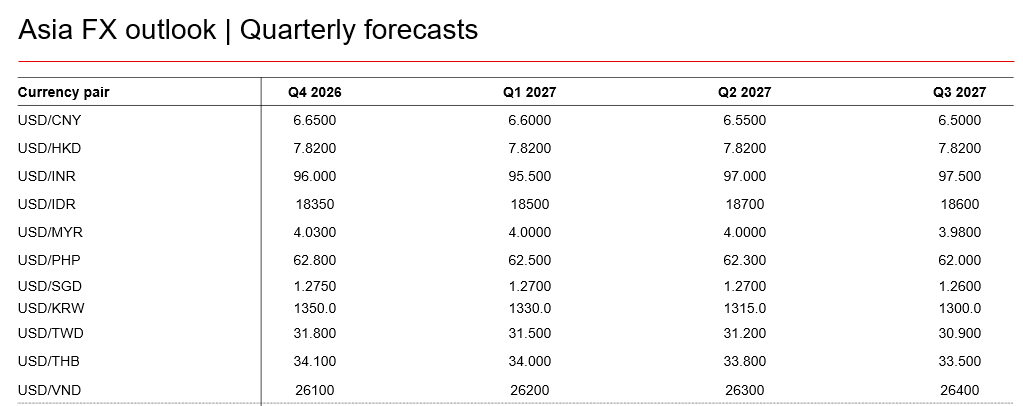
We expect Asia FX to post a modest aggregate appreciation in Q4 2026, but performance across Asia FX pairs will remain highly differentiated. Near-term USD resilience and elevated US yields remain headwinds, while the AI-led export cycle, external balances, energy exposure and domestic policies will drive relative performance.
The AI and semiconductor cycle remains the key source of regional FX differentiation. Taiwan and South Korea are the clearest beneficiaries, with strong technology exports, capital expenditure and benign terms of trade supporting TWD and KRW. Korea’s semiconductor upturn has been predominantly more price-driven, while Taiwan’s has been more volume-led, suggesting different transmission channels but similarly constructive currency implications. Malaysia also benefits from technology exports and relatively strong external buffers. SGD should remain resilient, supported by electronics exports, refined-fuel trade and a firm S$NEER policy.
China’s outlook remains two-speed. Advanced manufacturing, high-technology exports and digital services continue to outperform, while property activity, household confidence and traditional credit demand remain subdued. Strong exports, a large trade surplus, additional fiscal implementation and reduced tariff risks following the Xi-Trump meeting, like continue to support CNY. Meanwhile, recent stronger-than-expected PBoC fixings suggest the authorities remain reluctant to tolerate meaningful RMB depreciation. We forecast USD/CNY declining to 6.65 by end-2026 and 6.50 by Q3 2027. However, persistent softness in property sector and overall domestic demand is likely to limit the extent of RMB gains, suggesting a measured pace of appreciation rather than a one-way move lower in USD/CNY.
External vulnerabilities remain more evident. Indonesia faces pressure from elevated oil prices, high US yields and volatile foreign portfolio flows despite Bank Indonesia’s tightening. Thailand’s weak growth, deteriorating terms of trade, seasonal softness in tourism and limited policy space should leave THB vulnerable. India’s FX measures have rebuilt RBI intervention capacity and reduced the risk of disorderly depreciation, but FDI repatriation, domestic issuance and persistent structural dollar demand should keep INR on a gradual weakening path. PHP also faces elevated food and energy inflation, although additional BSP tightening and an eventual improvement in external conditions should support stabilization.
Inflation and monetary-policy paths will consequently diverge. Energy price pass-through differs across Asia due to varying fuel subsidies, price controls and market-pricing regimes. A potentially strong El Niño, alongside elevated fertilizer and energy costs, adds further food-inflation risk. China and Thailand remain focused on supporting growth, while India, Indonesia, Philippines and South Korea retain tightening biases. Singapore’s firm FX policy should continue cushioning imported inflation, whereas Taiwan and Malaysia have less urgency to adjust policy.
Overall, In Q4, we expect MYR, CNY and KRW to outperform, appreciating by 1.3%, 0.9% and 0.7%, respectively, expect TWD and SGD to deliver smaller gains, while INR remains broadly unchanged. IDR and THB are expected to underperform, depreciating by 2.0% and 1.5%, respectively, followed by VND and PHP. Key downside risks include renewed energy disruption, further increases in US yields, weaker global risk sentiment and a sharper slowdown in AI investment.
AGMR