

Dollar strength tests Asia FX
Ahead Today
G3: US Initial Jobless Claims, Home Sales
Asia: India CPI
Market Highlights
A firmer dollar is reasserting itself as the key headwind for Asia FX. DXY has pushed towards 102.80 following firmer US inflation, with markets continuing to price a December Fed hike. Higher US yields, renewed dollar strength and high oil prices leave the near-term backdrop challenging for the region, with most Asia currencies weakening yesterday, led by JPY and THB.
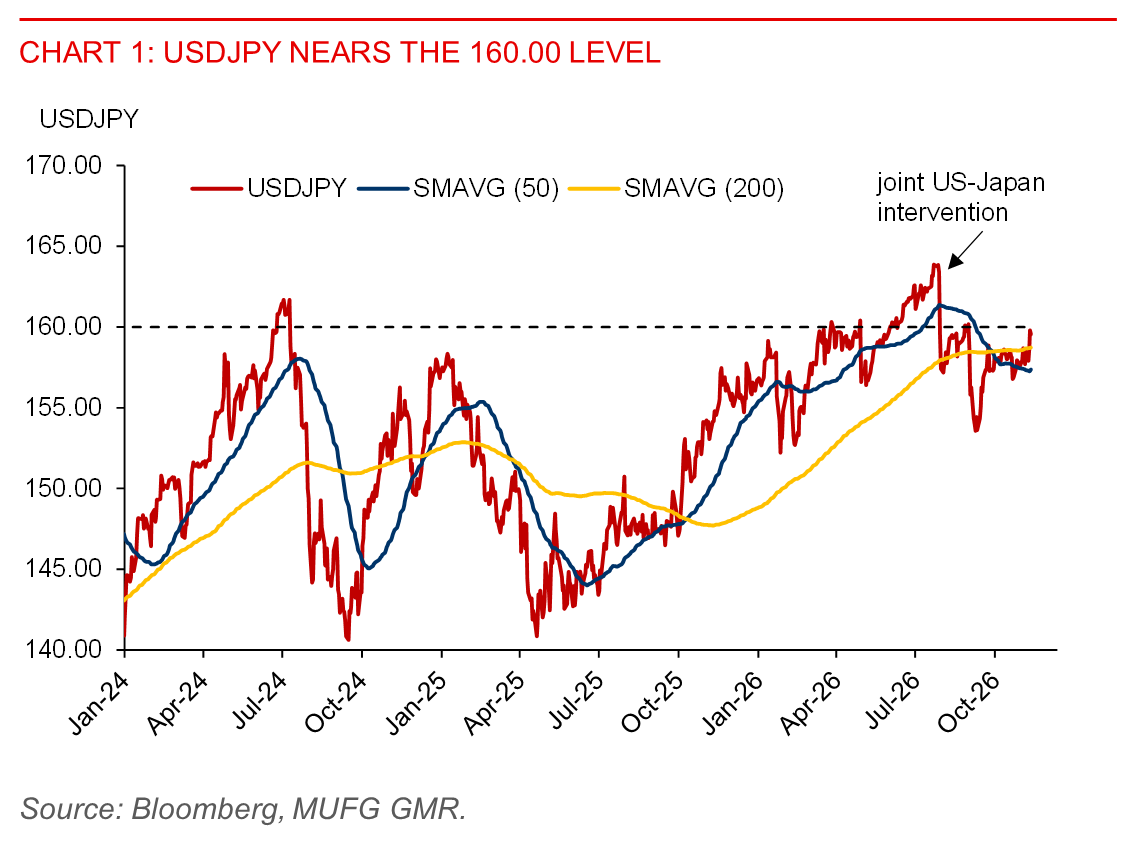
JPY is once again approaching the intervention zone. The yen weakened 0.7% yesterday, taking USD/JPY towards 159.70 and within sight of the historically sensitive 160–163 range. Hawkish Fed repricing has widened the US rate advantage, for now outweighing support from expectations of further BoJ normalisation. As USD/JPY approaches 160, however, the risk-reward from chasing the pair higher becomes less attractive.
IDR remains another key vulnerability amid a deteriorating external-domestic mix. USD/IDR rose to 18,145 yesterday, approaching its recent high around 18,190. Dollar strength has been compounded by domestic political uncertainty following Vice-President Gibran's resignation, against a backdrop of persistent net foreign equity outflows. Prolonged political uncertainty risks raising Indonesia's risk premium further , leaving IDR particularly exposed while Fed expectations remain hawkish.
KRW continues to outperform, although the pace of appreciation is moderating. South Korea's unemployment rate fell to 2.5% in October, partly reflecting lower labour-force participation that masked some softness in hiring, but still pointing to a relatively resilient labour market. KRW gained 0.5% despite broader dollar strength. The relative macro backdrop remains supportive, although further KRW gains will remain sensitive to global tech sentiment and broader risk appetite.
INR's resilience is perhaps the more interesting development. USD/INR extended its decline towards 93.70 despite the dollar's post-CPI rebound, highlighting continued relative outperformance. Attention now turns to India's October CPI, with market consensus expecting inflation to rise to 6.0%yoy from 5.54%. The composition will matter as much as the headline: evidence that food-price pressures are spilling into underlying inflation would reinforce expectations for further RBI tightening and might provide additional near-term support for INR.