

Hotter US CPI lifts yields and USD
Ahead Today
G3: US PPI, Retail Sales and Initial Jobless Claims, Japan Industrial Production
Asia: India Trade Data
Market Highlights
US inflation accelerated more than expected in September. Headline CPI rose to 3.7%yoy from 3.4%yoy in August, above the 3.6%yoy market consensus, while core inflation increased to 2.6%yoy from 2.4%yoy. This rise partly reflects a renewed rise in fuel prices, keeping rate-hike expectations intact. That said, the 2-year US Treasury yield initially rose sharply towards 4.95% before retreating to 4.80%, while the DXY index eased to 102.50 level after initially strengthening to 102.95 level. Nonetheless, US yields are still at an elevated level, while the dollar continues to hold relatively firm in the near term.
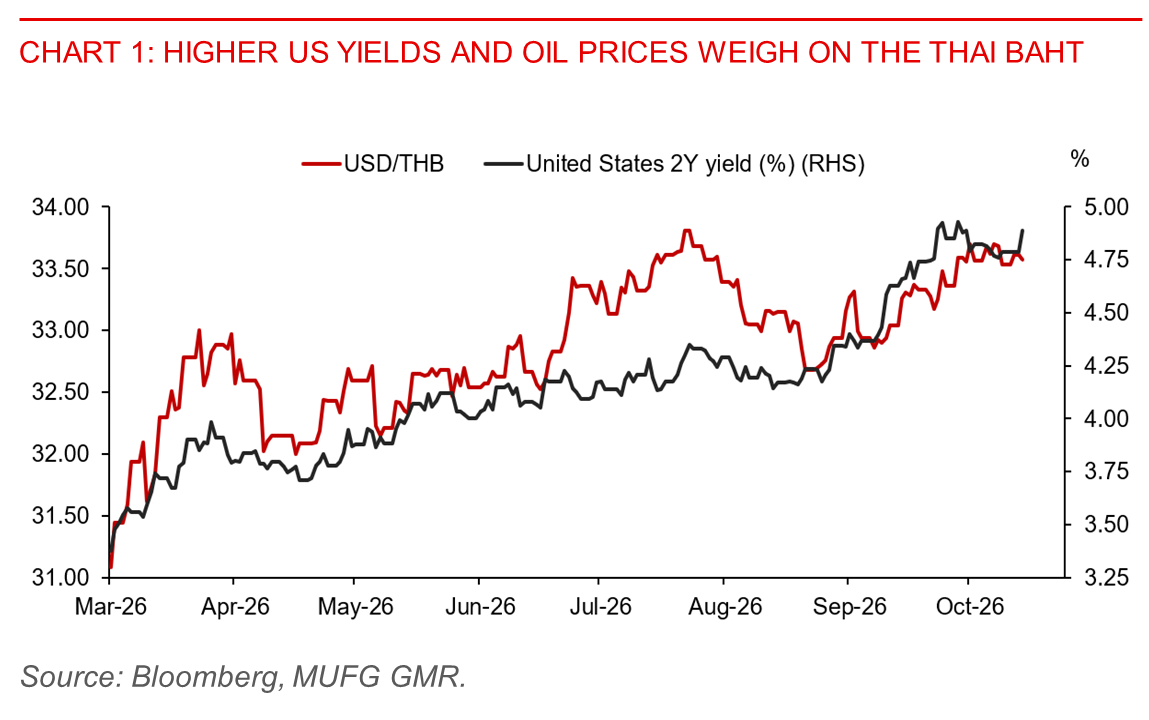
For Asian FX, the firm US dollar, along with still elevated US Treasury yields and oil prices, added to depreciation pressure across several regional FX, with the INR, IDR and THB possibly much more vulnerable.
That said, RBI’s recent FX measures to curb speculations on the rupee may help temper downside pressure on INR, although higher crude prices remain a headwind.
In Indonesia, elevated US yields weaken the relative appeal of Indonesian assets and leave the rupiah sensitive to foreign portfolio outflows; we reiterate our end-2026 USD/IDR forecast of 18,350. THB also remains sensitive to the stronger US dollar and higher oil prices, which together raise the cost of Thailand’s energy imports and weaken the terms of trade. We maintain our end-2026 USD/THB forecast at 34.10.
Meanwhile, Singapore’s economy expanded 5.4%yoy in Q3, moderating from an upwardly revised 6.2%yoy in 2Q but still exceeding the 5.1%yoy market consensus. As highlighted yesterday, MAS maintained the slope, centre and width of the S$NEER policy band, contrary to market expectations for a slight tightening. MAS expects AI-related orders and capacity expansion to support near-term growth, although the positive output gap should narrow through 2027. Core inflation is projected to remain slightly above 2% through 1H 2027 before easing thereafter. Nonetheless, given an appreciating S$NEER slope, SGD will likely stay relatively resilient.