

BI holds rates despite rupiah pressures
Ahead Today
G3: US Initial Jobless Claims, Eurozone Consumer Confidence
Asia: BSP and BOK policy rate decisions, Malaysia and Thailand reserves
Market Highlights
External conditions remain challenging for several Asian currencies, although policymakers across the region are increasingly deploying FX measures to slow the pace of depreciation. The US 10-year Treasury yield remains around 5.1%, while Brent crude continues to trade above USD100/bbl. In Japan, September exports rose 16.7%yoy, below the 21.3% market consensus, while the trade balance remained in a USD3.4bn deficit, partly reflecting the elevated oil import bill. The data provided little support for JPY, with elevated US yields continuing to dominate the near-term backdrop. USD/JPY has remained range-bound between 157.50 and 158.60 in recent days.
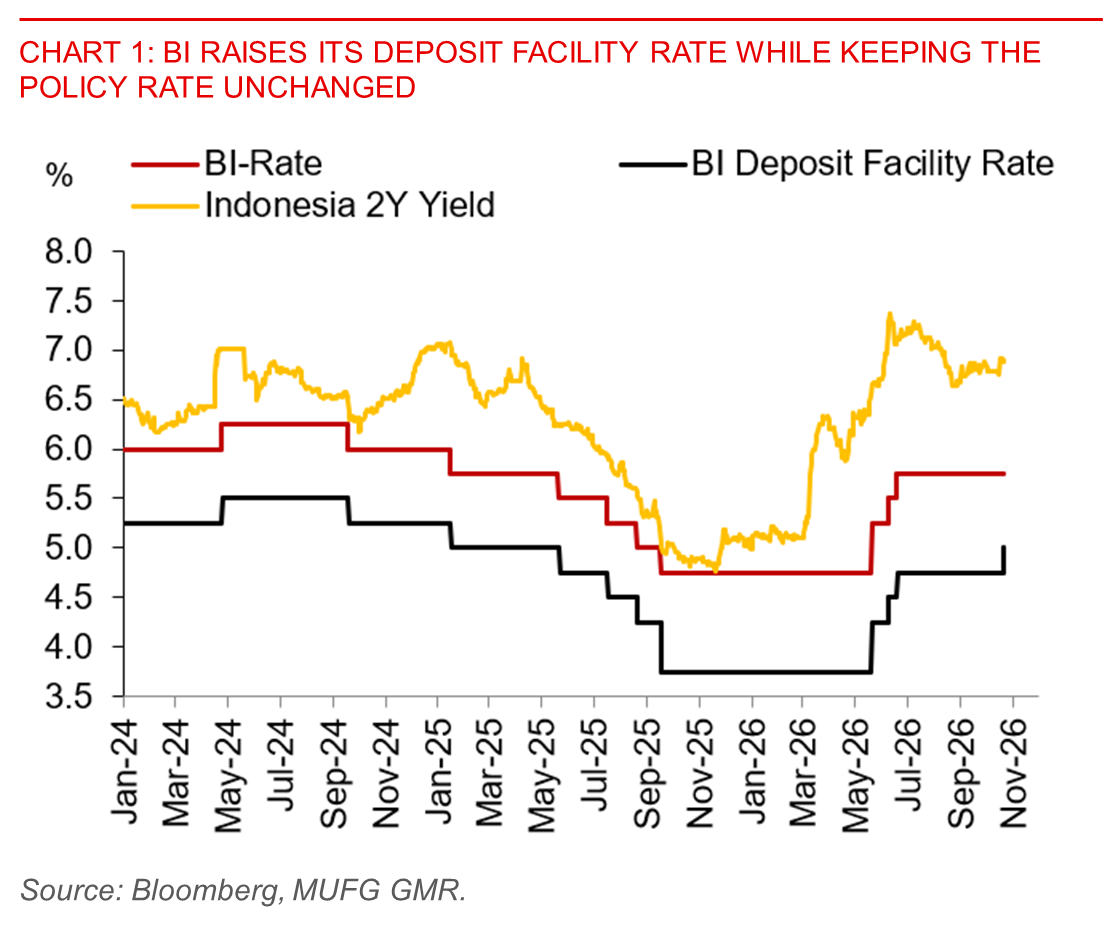
Bank Indonesia was the main focus yesterday, keeping the BI rate unchanged at 5.75% while adjusting other parts of its policy toolkit to balance rupiah stability against domestic growth. BI kept the Lending Facility rate at 6.50% but raised the Deposit Facility rate by 25bps to 5.00%. We think the asymmetric move is important. Rather than raising the headline policy rate and tightening financial conditions more broadly, BI is seeking to support the rupiah at the margin while containing the impact on borrowing costs and growth.
At the same time, BI announced a phased reduction in banks’ reserve requirement ratio, providing additional domestic liquidity. For conventional banks, the reserve requirement ratio will fall from 9% to 8% on 1 November and further to 7% on 1 December. For sharia banks, the reserve requirement ratio will decline from 7.5% to 6.5% and subsequently to 5.5%. BI also strengthened incentives for DNDF hedging. Hedging cost discount for 6-month tenor was raised to 40% (25% previously) and 12-month tenor to 45% (from 30% previously).
Taken together, the measures highlight BI’s policy balancing act: supporting the rupiah through targeted measures, while simultaneously maintaining sufficient liquidity to support the domestic economy.
Nonetheless, we remain cautious on IDR as the external and portfolio-flow headwinds persist. Elevated US yields and energy prices remain unfavourable for the rupiah, while MSCI has launched a consultation to potentially reclassify Indonesia directly from Emerging Market to Standalone Market status.
In our view, BI’s latest measures could help slow the pace of rupiah depreciation, but they are unlikely to reverse the trend, especially amidst external pressures and persistent equity-related outflows. We maintain our USD/IDR forecasts at 18,350 by end-2026 and 18,500 in 1Q2027.
Elsewhere in Asia, attention turns to monetary policy decisions in Korea and the Philippines. We expect BOK to keep the policy rate unchanged at 3.00% after back-to-back hikes. In the Philippines, September inflation accelerated to 7.2%yoy while USD/PHP has traded above 63.00, strengthening the case for further tightening. We expect the BSP to raise its policy rate by 25bps to 5.25% today