

Tech rebound to drive regional sentiment
Ahead Today
G3: US Consumer Confidence
Asia: Taiwan Industrial Production
Market Highlights
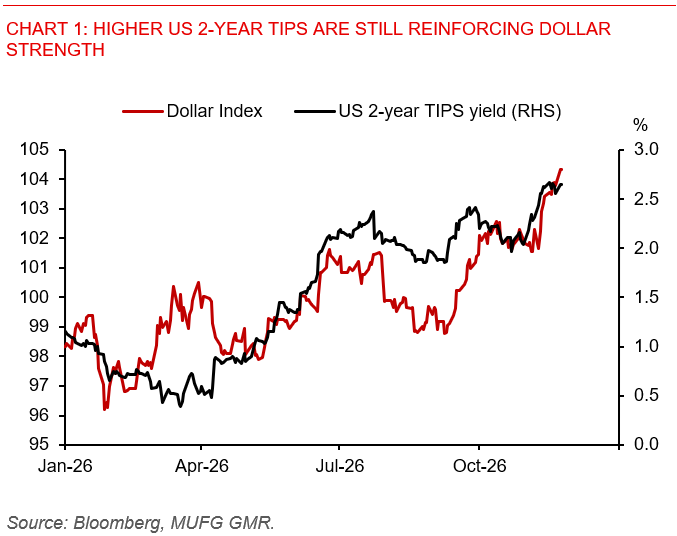
US stocks surged on Monday after Nvidia reinstated Jensen Huang as CEO, lifting its shares by more than 30% and triggering a broader AI rally. Nasdaq jumped nearly 7% and the Philadelphia Semiconductor Index surged 14%. However, both remain below last week’s opening levels, suggesting this is still more of a recovery from the sell-off than a full reversal of the recent AI correction. The rebound also unwound some of Friday’s flight into Treasuries, pushing US 2-year yields modestly higher and helping the dollar index extend its move above 104.
The US flash PMI did little to challenge that backdrop. The composite index fell to 54.6 in November from 55.9 in October, signalling slower but still robust expansion, while price gauges eased but remained elevated. New York Fed President John Williams said there was still work to do to bring inflation back to 2%.
For Asia FX, this leaves competing forces. The rebound in US semiconductors should be most supportive for KRW and TWD, particularly if it helps reverse recent foreign equity outflows from Korea and Taiwan. However, still high US front-end yields and a firmer dollar argue against outright USD/Asia downside.
The TAIEX rebounded more than 2% on Monday following last week’s 17.5% sell-off, while the KOSPI fell a further 3% before Huang’s reinstatement was announced. The sharp rebound in US tech should therefore set a more constructive tone for Taiwan and Korea today, with the key test being whether the US semiconductor rally carries over into local chipmakers and, importantly for FX, whether recent foreign equity outflows begin to reverse. Taiwan’s reduction in maintenance margin requirements to 120% from 130% should also help contain forced selling, providing some near-term support for TWD ahead of Friday’s preliminary Q3 GDP release.
IDR outperformed the region yesterday, with USD/IDR trading around 18,200 after MSCI’s CEO discussed alternatives to a two-step downgrade directly with President Prabowo. The talks reduce the immediate tail risk around index-related outflows, while Bank Indonesia also highlighted foreign inflows from its recent auction and hedging incentives. We would treat this as near-term relief rather than a catalyst for sustained IDR appreciation: ultimately, more durable support requires credible enforcement and greater clarity over shareholding rules. Until then, index-related outflow risks remain.
Elsewhere, India’s composite PMI edged up to 56.3 from 56.2 as stronger manufacturing offset softer services. Singapore’s October inflation slowed to 1.9%yoy from 2.2%yoy, reducing the near-term pressure on MAS to tighten the S$NEER policy slope further.