

Treasury selloff deepens
Ahead Today
G3: US initial jobless claims, new home sales; Germany IFO survey
Asia: Hong Kong trade
Market Highlights
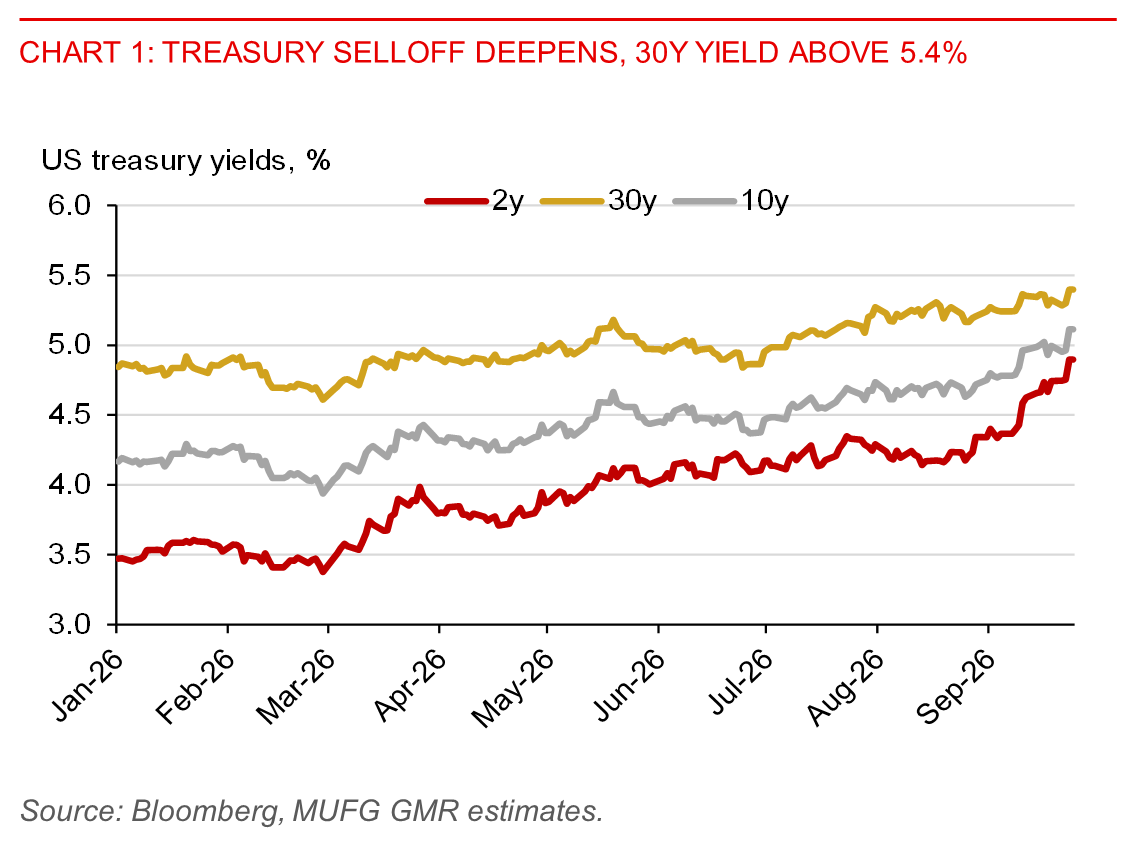
The dominant market theme remains the relentless rise in US yields and the renewed repricing of Fed expectations. Treasury yields moved sharply higher as strong US activity data and rising energy prices reinforced concerns that inflation could prove more persistent. The US 2-year Treasury yield jumped 14bp to around 4.9%, while the 10-year yield rose above 5.0% and the 30-year yield climbed beyond 5.4%. Markets now price around 37bp of additional Fed tightening by December 2026, equivalent to roughly 1.5 rate hikes by year-end.
The catalyst was a set of surprisingly strong US economic data. Manufacturing PMI rose to 57.0 in September from 53.9 previously, comfortably beating consensus expectations, while services PMI climbed to 58.7 and composite PMI reached 58.4. This economic resilience raises the risk that policymakers may need to do more to prevent inflation pressures from becoming entrenched. Adding to these concerns, the oil market has been an important inflation risk. Brent crude surged a further 4.3% yesterday, while US gasoline prices have also moved higher. Geopolitical tensions remain elevated after Iran reiterated its stance on nuclear activities and warned that the Strait of Hormuz would remain vulnerable while sanctions remain in place. The combination of stronger US growth, rising inflation risks and higher oil prices have created a toxic combination for bonds, driving yields sharply higher across the curve.
The US dollar extended its advance, with the DXY rising a further 0.5% and bringing cumulative gains since Jackson Hole to around 2.0%. Rising US yields and Fed tightening expectations have supported the US dollar, reinforcing a challenging external backdrop for Asia FX. Most Asian currencies weakened against the dollar yesterday, led by KRW (-0.8%) and JPY (-0.6%), with some of the recent gains in these currencies now being partly unwound.
The broader backdrop for Asia FX remains challenging, though the ongoing tech upcycle will provide an important cushion for selected economies such as Korea, Taiwan, Singapore, and Malaysia. By contrast, currencies with limited exposure to the technology cycle and greater vulnerability to higher energy prices could come under renewed pressure. As such, we expect Asia FX performance to become increasingly differentiated.
Meanwhile, the rupiah gained 0.4% against the dollar yesterday, despite the stronger DXY backdrop. Bank Indonesia left rates unchanged at 5.75% but announced a reduction in hedging swap costs of up to 25% for portfolio investment hedges, signalling a preference to support the currency through market-based measures rather than a rate hike. With US yields continuing to climb and oil prices pushing higher, the hurdle for maintaining an unchanged policy stance may eventually increase.