

US overcapacity tariffs raise tail risks
Ahead Today
G3: Japan leading index
Asia: BOK policy meeting, Singapore industrial production
Market Highlights
The USTR has concluded its Section 301 investigations into “structural excess capacity” across 14 economies, including China, Japan, Korea, Taiwan, and several ASEAN economies. The proposed overcapacity tariff ceiling ranges from 20% to 40%. Importantly, however, several of these economies already have prior negotiated tariff rates with the US, which would effectively cap the appliable rate. In addition, USTR has indicated that the new overcapacity duties will not stack on top of the existing 10%-12.5% forced-labour Section 301 tariffs. In all, that should help contain the incremental tariff shock, assuming prior negotiated commitment remains in place. The overcapacity tariffs will not take effect immediately. Implementation would follow a consultation process, including a public hearing in January.
The latest tariff move is therefore better viewed as a reconstruction and legal hardening of the Trump tariff regime than a fresh “Liberation Day” shock. The more important development is that USTR has now established higher tariff ceilings that can be activated should trade negotiations or existing commitments break down. This raises the tail risks.
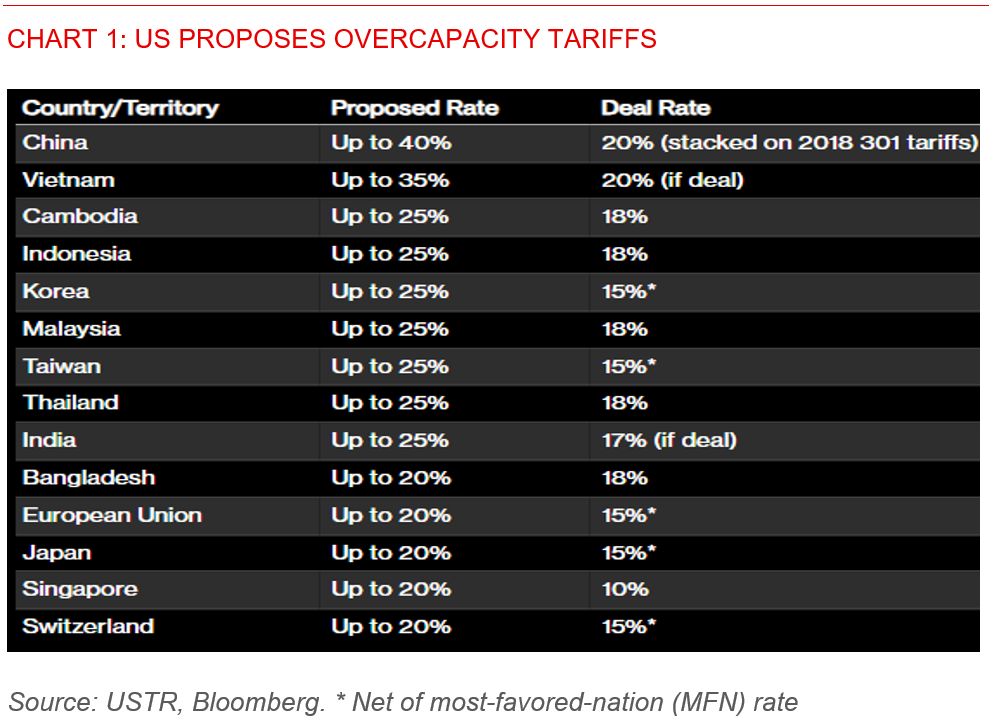
China remains the clearest tariff target and the main source of regional spillover risk. The new 20% overcapacity tariff on China would stack on top of the existing Section 301 duties imposed on China back in 2018. The overcapacity duties could rise to as high as 40% if the US-China trade truce breaks down.
For KRW, TWD, and SGD, we would avoid treating the announcement as a new bearish catalyst. Korea and Taiwan can retain tariffs around the negotiated 15% if existing commitments are respected, while Singapore has a path towards a 10% rate if it reaches a trade agreement with Washington.
Within ASEAN, Vietnam stands out as having the largest tariff tail risk. Vietnam could face 20% overcapacity tariffs if ongoing trade agreement is reached with the US, or as much as 35% if negotiations fail.
Malaysia, Thailand, and Indonesia face potential 25% ceilings, while prior negotiated tariff rate is 18%. That said, the macro consequences could differ amongst them. Malaysia and Thailand are relatively more exposed through manufacturing and the global trade cycle, whereas Indonesia’s more domestic-oriented economy limits the direct growth impact.
The broader Asia FX sentiment is likely mildly negative but differentiated rather than uniformly bearish.
Key event to watch ahead is the BOK policy meeting. The BoK is expected to hike 25bp to 3.25%, with inflation still above the 2% target and October retail sales strengthening to 5.7%yoy from 4.5% in September. A hike would provide some domestic support for KRW.
In Singapore, industrial production data, particularly electronics output, will provide an important read on the electronics cycle. Resilient electronics production would help distinguish an equity/valuation correction from a broader deterioration in the regional tech cycle.