

Don’t chase the dollar broadly, trade the regional divergence
Ahead Today
G3: Dallas Fed manufacturing activity, Japan leading index
Asia: Thailand trade, Singapore industrial production
Market Highlights
Markets enter a pivotal week with the 27–28 October FOMC meeting taking centre stage. With markets broadly expecting the Fed to keep the policy rate unchanged, the bigger catalyst should be its guidance around the policy decision. More importantly, positioning increasingly matters as much as policy. Long-USD positions have built alongside dollar strength, suggesting that part of the higher-US-rates, stronger-USD narrative is already priced. The setup is asymmetric: a hawkish tone from the Fed could extend USD strength, but absent a meaningful hawkish surprise, crowded positioning leaves scope for a tactical dollar pullback or consolidation.
Meanwhile, the US macro backdrop remains supportive. October manufacturing PMI edged higher to 56.0 from 55.9, while services PMI eased to 57.9 from 58.8 but remained consistent with robust expansion. Treasury yields have also rebounded modestly relative to their recent decline, with yields rising across the curve last Friday.
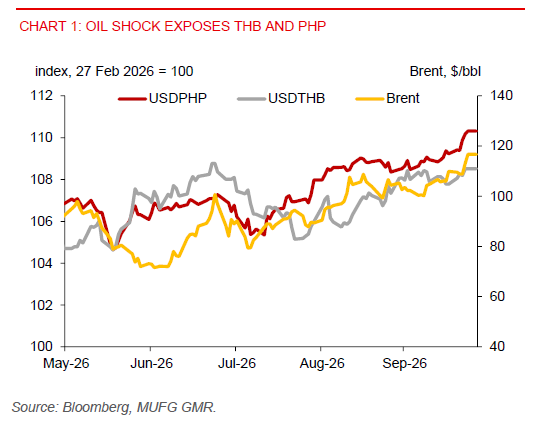
For Asia FX, we would avoid chasing USD strength broadly ahead of FOMC. The more compelling story is increasing regional FX differentiation, particularly as the oil shock intensifies. We continue to see risks of a larger oil shock. The transmission through trade balances, inflation and monetary-policy constraints should increasingly differentiate regional currencies.
THB remains one of our preferred expressions of the oil shock. Higher energy import costs weaken Thailand's external backdrop, while the BoT is likely to keep its policy rate at 1%. There is therefore little rate support to cushion THB from a sustained oil shock. PHP faces a similar oil headwind but with a different policy response. Inflation pressures and peso weakness have forced the BSP to raise rates by 50bp to 5.5%. Higher rates could help slow the pace of peso depreciation, though acting a drag on growth. We also remain negative on IDR, where oil, portfolio-flow risks and domestic policy constraints are increasingly reinforcing each other.
Elsewhere, the divergence in KRW and TWD remains striking despite both economies benefiting from strong tech exports. This highlights the growing importance of central-bank policy divergence. SGD should remain relatively defensive, supported by tight MAS policy stance, but further appreciation room looks limited. Headline and core inflation have eased, MAS remained on hold in October, and rate support remains limited. Meanwhile, Indonesia's decision to reduce pipeline gas exports to Singapore adds another energy-related development, although we see limited near-term macro or SGD implications. Singapore's Energy Market Authority (EMA) says the reduction amounts to less than 2% of Singapore's daily gas demand.