

Oil shock reinforces regional divergence
Ahead Today
G3: US Durable Goods Orders, New Home Sales, Conference Board Consumer Confidence
Asia: China Industrial Profits
Market Highlights
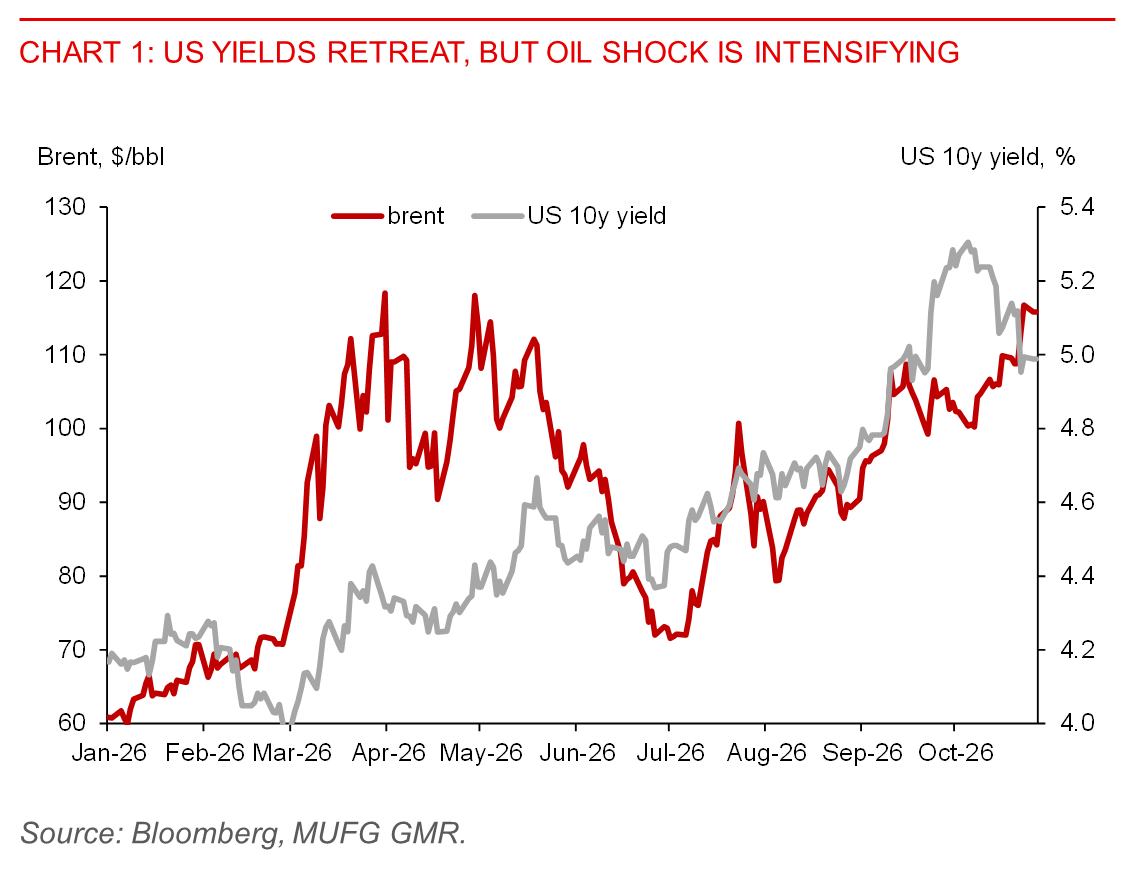
Oil and US rates remain the two dominant global forces for Asia FX. Brent is holding around USD116/bbl, with the Middle East geopolitical premium remaining elevated. Markets will be monitoring Israel's election, where Israel Prime Minister Netanyahu has continued to advocate a more aggressive stance towards Iran, while his challenger Gadi Eisenkot has argued for narrower goals such as curbing Iran's nuclear programme. With US President Trump hinting at renewed military action against Iran after the US midterm elections, a renewed escalation that pushes crude materially higher would amplify the adverse terms-of-trade and inflation shock for the region’s net energy importers and those with current account deficits.
Markets expect no change to policy rate in the FOMC meeting this week, while still retaining their expectations of one US rate hike in December, leaving the dollar supported by relatively restrictive US rates.
Within Asia FX, THB remains one of our preferred expressions of the oil shock. Thailand’s September trade numbers reinforce this view. The trade deficit widened sharply to USD5.86bn from USD2.48bn in August. Imports surged 50.4%yoy, considerably faster than the still-strong 24.0% expansion in exports. Electronics and AI-related global demand remain important supports for shipments, but higher energy costs and strong demand for imported electronic components have simultaneously pushed up the import bill. We remain cautious on THB and expect the Bank of Thailand to keep its policy rate at 1.00% on 28 October to support growth. In our view, this leaves USD/THB biased higher while the oil shock persists
USD/IDR rose to 18,124 yesterday, approaching its June record high around 18,190, as investors continue to digest uncertainty surrounding MSCI’s review of Indonesian equities alongside broader pressure from foreign portfolio outflows and high oil prices. Indonesian government bonds are also under pressure, with the 10-year yield rising to the 7.48% level. The combination of elevated crude prices, portfolio-flow pressure and MSCI-related uncertainty leaves IDR vulnerable. Investor demand for protection against further rupiah weakness also suggests that the market remains sensitive to tail risks.