

US yields stay high despite soft payrolls
Ahead Today
G3: US ISM Services, Eurozone PPI
Asia: Singapore Retail Sales
Market Highlights
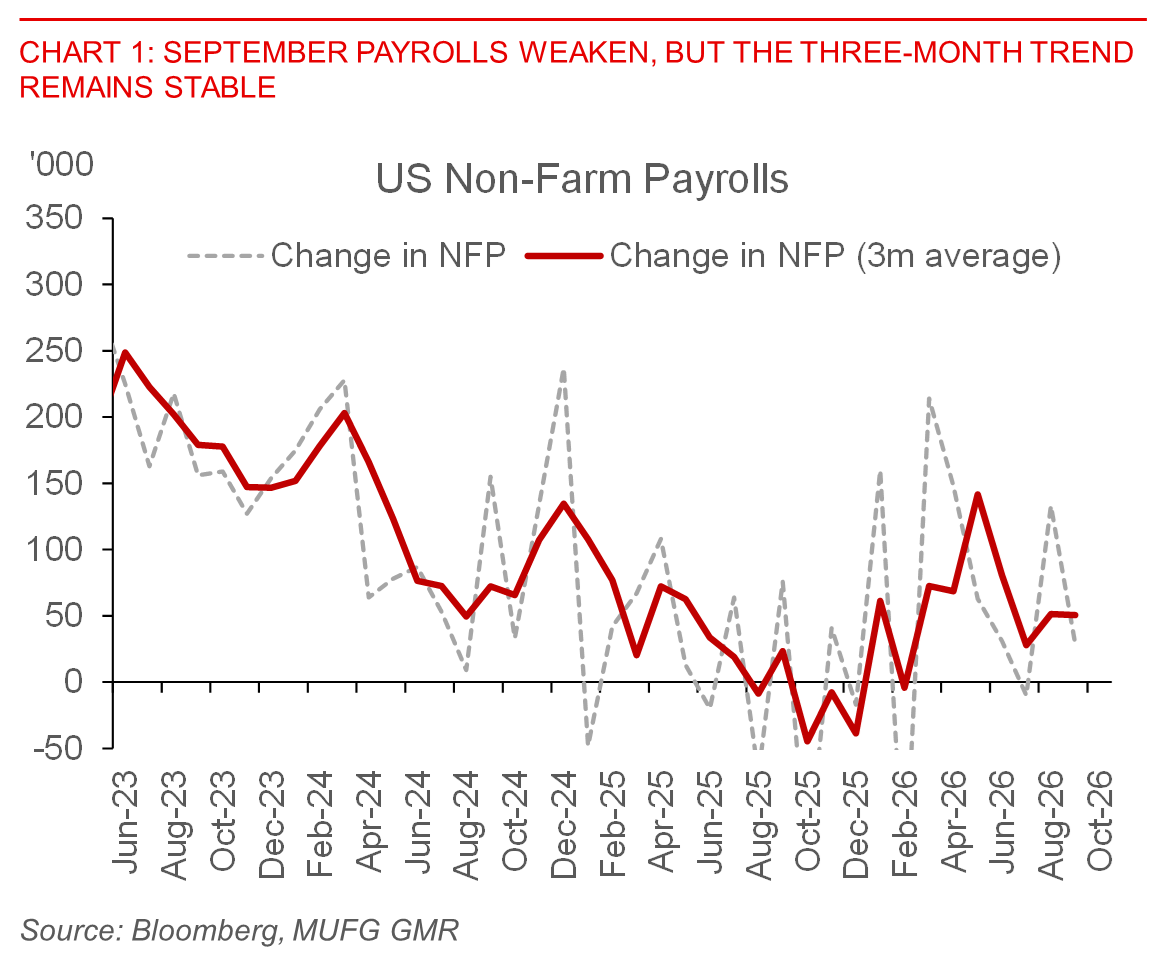
The September US nonfarm payrolls report weakened the case for an October Fed hike, although the details remained consistent with a low-hire, low-fire labour market rather than a sharp downturn. Nonfarm payrolls increased by 29k, below the 90k consensus and down from a downwardly revised 133k in August. The unemployment rate edged up to 4.2% from 4.1% as labour-force growth outpaced employment gains. Wage growth moderated to 0.1%mom, below the 0.3% consensus and previous reading, while on a year-on-year basis, wage growth slowed to 3.0% from 3.1%. Job gains were also concentrated in fewer industries, while previously reported payroll growth for July and August was revised down by a combined 60k. The soft jobs report could allow the Fed to take a pause in October.
Nonetheless, the intra-day rebound in Treasury yields suggests that the softer employment data may not be able to provide sustained relief for the US Treasury market. The US 10-year yield initially fell to 5.15% before rising to around 5.29%, while the two-year yield recovered from 4.71% to 4.83%. Oil-supply uncertainty, persistent price pressures and term premia appear to partly continue supporting longer-dated yields.
In Korea and Japan, the latest inflation data kept market attention on underlying price pressures despite differing headline CPI moves. Korea’s CPI inflation eased to 2.9%yoy in September, matching consensus and down from 3.1%yoy. In Japan, headline Tokyo CPI, which serves as a leading proxy for nationwide inflation, accelerated to 2.7%yoy in September, above the 2.5% consensus and 1.9% in August. Core Tokyo CPI excluding fresh food and energy rose markedly to 3.0%yoy, above the 2.5% consensus and 2.0%yoy in August, marking its highest reading under the Takaichi administration. The readings should keep both the BOK and BOJ attentive to inflation and the need for policy tightening.
Meanwhile, Vietnam’s data showed strong growth alongside continued inflation risks. GDP expanded 9.95%yoy in Q3, above the 8.65% consensus and an upwardly revised 8.81% in Q2, while industrial production accelerated to 16.7%yoy from a revised 13.5%yoy. The trade balance was in a $1.27bn surplus, against expectations for a $1.5bn deficit. However, headline CPI rose further to 5.1%yoy from 4.9%yoy, broadly matching market consensus.