

Ahead Today
G3: Jackson Hole Kevin Warsh speech
Asia: Philippines Trade Deficit, India industrial production
Market Highlights
We had policy decisions and/or communication from 3 key Asian central banks yesterday (27 Aug), and one common thread was the idea of the central bank as a risk manager working under imperfect information and uncertainty over how long it takes for their tools to take effect, especially during times of structural changes and shocks. For instance, Bank of Korea’s Governor Shin Hyun Song repeatedly invoked a local proverb warning against delaying action to raise rates, saying that a problem that can initially be contained with a “homi” – a small traditional Korean agricultural tool – may eventually require a “garae”, a much larger spade requiring multiple people to operate, if left unaddressed for too long. Similarly, Bank of Japan Deputy Governor Himino gave the analogy of a large bus with an accelerator and a brake that can only affect the bus gradually and over time, with the efficacy affected by the existing speed of the bus and also the road conditions. Meanwhile, BSP Governor Remolona highlighted the meaningful risks of a severe El Nino and minimum wage hikes to inflation, and with that the BSP will tighten as much as they need to.
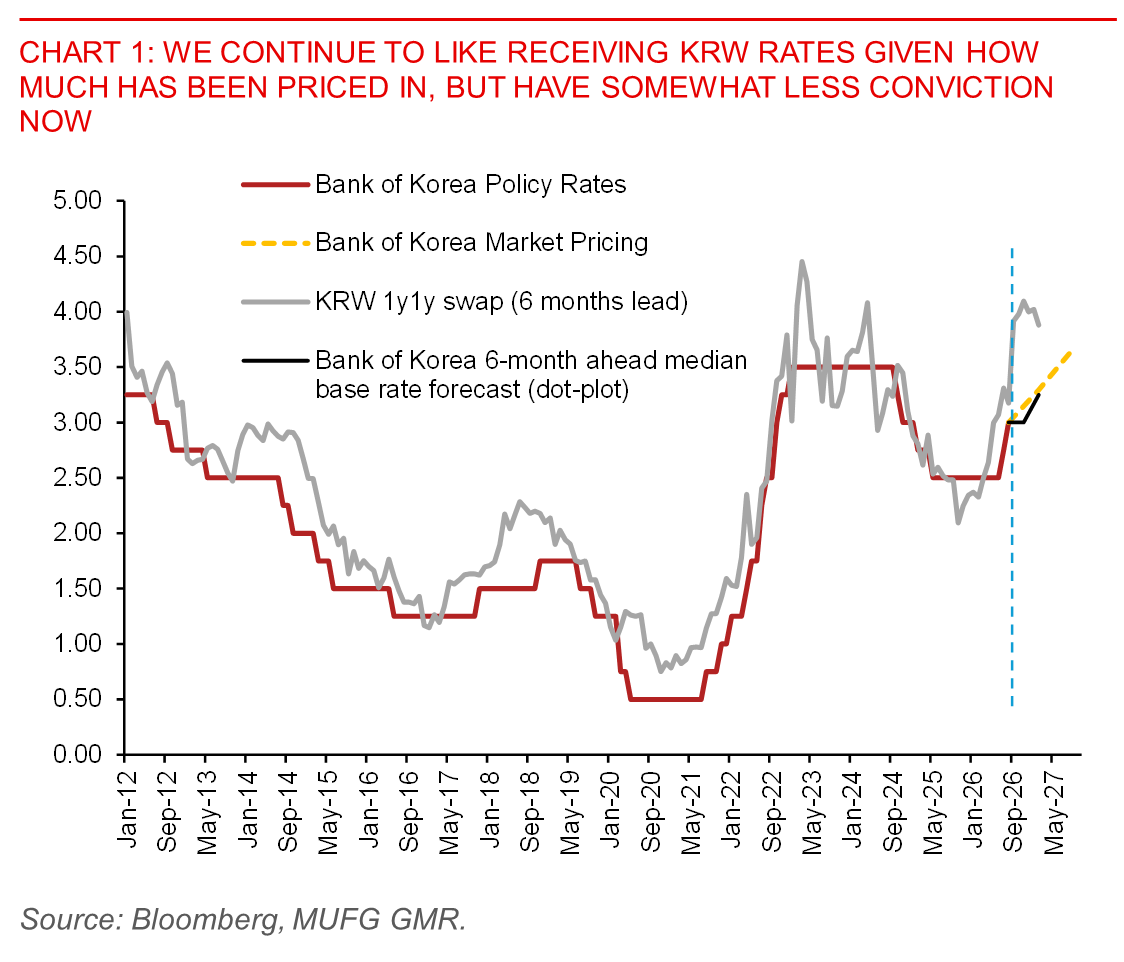
On that note from a policy decision perspective, we had both the BOK and BSP raising their key policy rates by 25bps yesterday to 3.00% and 5.00% respectively (from 2.75% and 4.75%).
More importantly for markets, the communication and tone for both generally pointed to a slower pace of rate hikes moving forward, even as both the BOK and BSP kept the option to do more to tighten monetary policy to address inflation risks moving forward.
For the Bank of Korea, the dot plot pointed to a median forecast by the BOK Board Members of a 3.25% rate (and as such one more 25bps rate hike), while BOK Governor Shin also emphasised that a back-to-back rate hike which the BOK just delivered in its August meeting departs from the central bank’s usual practice. BOK’s decision was also not unanimous, with one member (Hwang Kunil) voting to keep rates unchanged. BOK also raised its 2026 and 2027 GDP growth forecasts to 3.3% and 2.9% (from 2.6% and 2.1%), while keeping its inflation forecasts unchanged.
Meanwhile, the BSP lowered its 2026 CPI forecasts to 6.1% (from 6.4%), but importantly raised its 2027 inflation forecasts substantially to 5.4% from 4.5% previously, coupled with a 2028 inflation forecast of 3.3% (from 3.1%). The key driver of the forecast change was an expectation of a severe El Nino event coupled with the lagged impact of minimum wage hikes feed through to inflation over time, even as oil prices have come down from the previous peak seen earlier this year. Overall, while we still have one more rate hike by the BSP in our profile, we are now somewhat less confident that BSP will deliver that given the risks that are already factored into the central bank’s inflation forecasts.
From a strategy perspective in Asia FX and rates, we continue to like and hold onto a short USD/KRW position, but as highlighted previously we would risk manage it by lowering our stop loss/take profit to the 1400 level (see Asia – BOK kicks off its rate hike cycle and Asia – BOT on hold for some time). This in part reflects a communication by the BOK for a slower pace of rate hikes, but also reflects some weekend risk moving forward into Kevin Warsh’s Jackson hole speech. We continue to be biased to receive KRW rates given the amount of rate hikes already in the KRW curve (see Asia – BOK kicks off its rate hike cycle). Nonetheless, with pricing having moved down with the KRW 1y1y rate at 3.89% from around 4.2% previously, we have slightly less conviction on that call at these levels.
For USD/PHP our bias is to see the pair moving lower in part reflecting our expectation for oil prices to move lower, the BSP to hike once more and remain somewhat hawkish, and for perhaps the worst of El Nino effects to not materialize in domestic rice prices as our base case. Nonetheless, the downside risks on global commodity prices are quite substantial and we don’t quite want to take a call on that. At current USD/PHP levels closer to 61.80 we could however see BSP coming in more to intervene in the markets, and so in the very near-term we think potential for USD/PHP to move higher from here is not that great.