

Ahead Today
G3: US initial jobless claims, BOJ Deputy Governor Himino speech
Asia: Bank of Korea, BSP policy decisions
Market Highlights
US yields rose with a flatter curve, the Dollar strengthened slightly, and equity futures rose, as US inflation data came in line with expectations while Nvidia earnings beat consensus expectations. In particular, headline PCE inflation rose by 0.2%mom, higher than expectations for a 0.1%mom rise, while core PCE was in line with expectations at 0.2%. This combined with stronger than expected personal income and spending data was enough to give some lift to the Dollar coupled with US yields and more so in the front-end.
Meanwhile, Nvidia gave a bullish sales outlook, with the CFO saying that the company expects revenue to grow approximately 70% in fiscal 2028, relative to analyst projection of 45% for that year. Nonetheless, Nvidia said that even as demand is accelerating the key constraint is on supply and that would have some impact on margins moving forward albeit manageable.
As we have highlighted several times previously, the best leading indicators of industrial activity we like to track in Asia remain positive and tells us a story of still robust demand, even if growth is likely to moderate modestly into 2027. These indicators include copper prices, Bank of Korea’s tech sentiment indicators, semiconductor stock prices, coupled with growth minus inflation economic surprise indicators (Asia – why US yields rise matter for Asia).
As such, we continue to think that the tech-linked currencies can outperform moving forward.
We have a short USD/KRW idea that has worked very well so far, but admittedly partly for wrong reasons (see Asia FX Talk – Bank of Korea kicks off rate hike cycle). Given how much USD/KRW has already moved lower we think it makes sense to risk manage slightly by moving stop loss/take profit down to the 1400 levels. Our strongest call right now is short USD/TWD, and this reflects TWD as a catch-up play to the strength seen in KRW, the fading of peak dividend outflows season in August, our expectation that the AI story still remains very much present and positive, coupled with the fading of Dollar buying needs by lifers given that hedge ratios in Taiwan’s lifers have already stabilized at around the 40-50% levels.
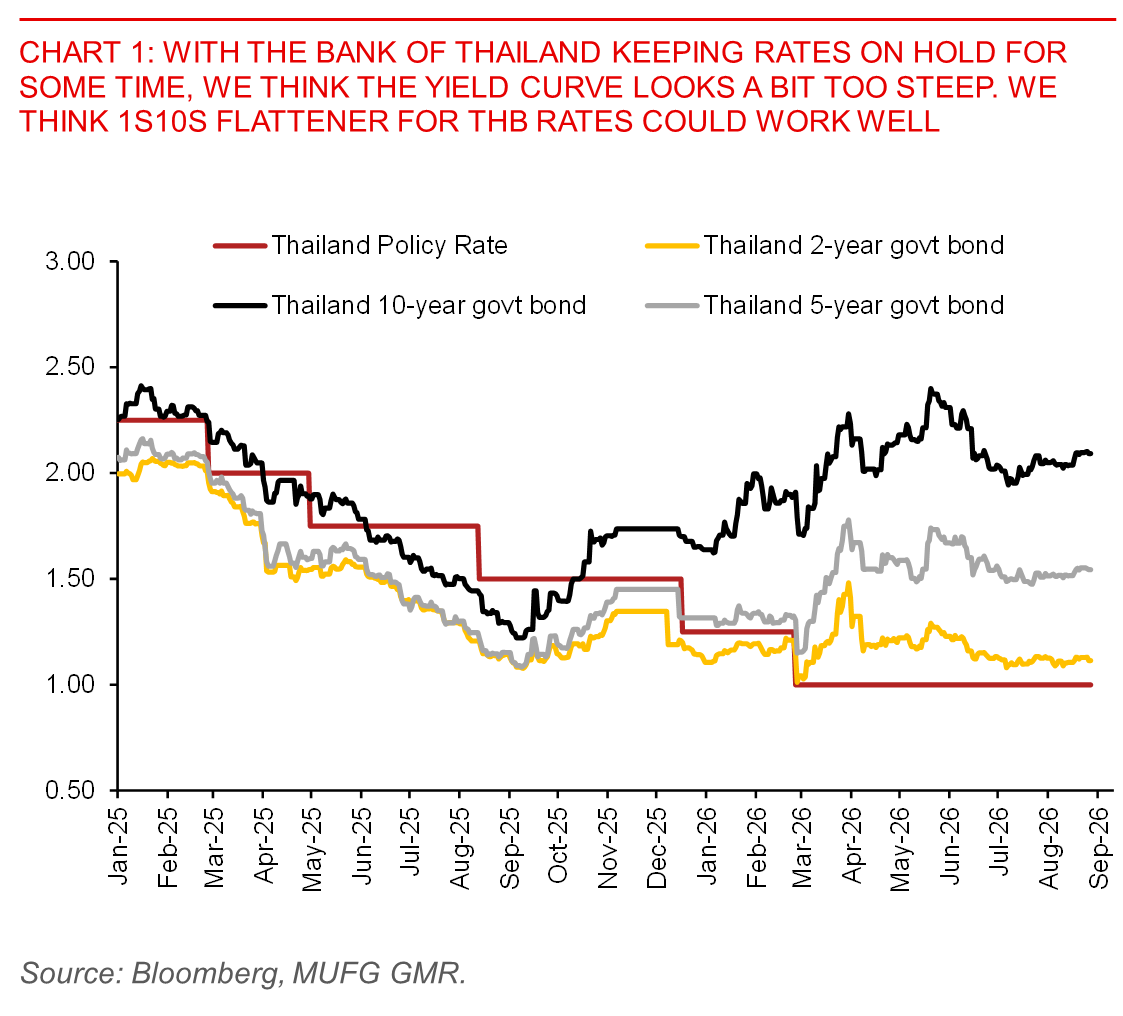
Meanwhile, the Bank of Thailand unanimously voted for its policy rate to be kept at 1.00%, in line with expectations. While exports and investments continue to benefit from the technology and AI cycle, the recent statement highlighted limited domestic spillovers and weaker private consumption amid rising living costs. Headline inflation for 2026 and 2027 was revised lower due to softer energy prices and limited cost pass-through; with recent data showing July's print to be 1.95%yoy, well below the consensus of 2.40%yoy. Despite this, the BoT acknowledged that El Niño and its pass-through effects may still lift inflation through 1Q 2027. Overall credit growth has improved since June, but SME loans continue to contract.
With BOT likely to remain on hold and accommodative for some time, we continue to think the THB yield curve looks a bit too steep (Asia – oil prices fell further supporting lower yields). We like flattener trades in THB rates and we think THB offshore OIS 1s10s flattener (current: 103bps) could work well moving forward.