

Ahead Today
G3: US Conference Board Consumer Confidence, US New Home Sales, RBA Minutes
Asia: Taiwan Industrial Production
Market Highlights
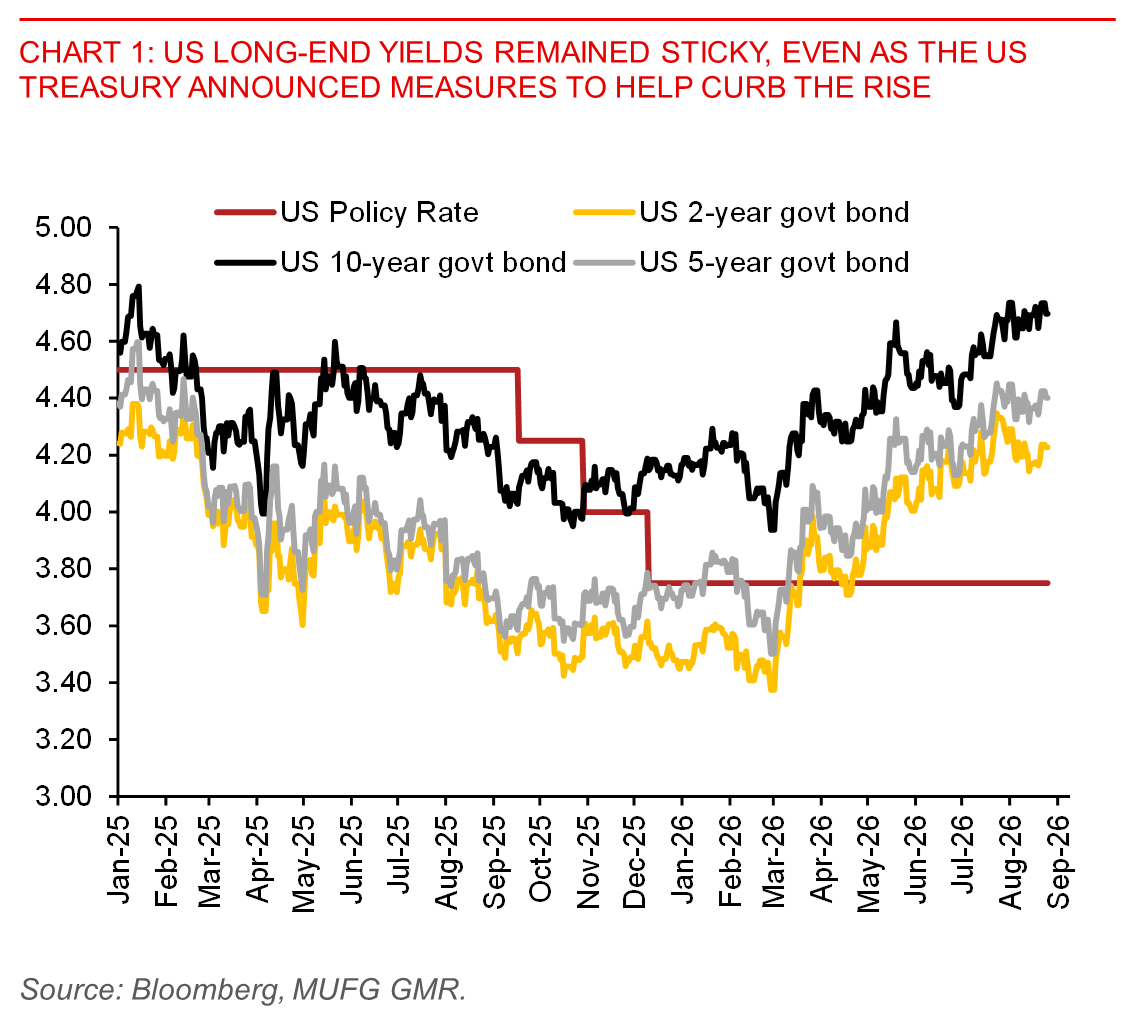
US 10-year yields fell a touch to 4.69% as news reports emerged that the US Treasury could use the Treasury General Account – essentially the US Treasury’s “savings account” at the Fed – for buyback auctions. This is even as Treasury Secretary Scott Bessent refrained from providing any further signals on revamping US debt management, and that the US Treasury will continue with regular program of debt auctions as announced in the last quarterly refunding.
In theory, this means that the US Treasury could potentially net inject liquidity into the banking system rather than fund buybacks through maturity transformation by greater issuance of bills, at least in the very near-term. The extent to which the Treasury could do so is however unclear given liquidity needs for tariff refunds and in emergencies, but with the TGA balance at US$935bn there may be some scope to do so. Moving forward, the US Treasury may also cut issuance at the longer-end amidst greater competition from bond issuance by AI companies and hyperscalers.
All this comes as the US threatened economic punishment against any country doing business with Iran as part of an “economic D-Day” campaign to isolate the country, with Scott Bessent saying that countries will face a specific timeline to shutdown links with Iran or face unilateral US punishment. The US also unveiled sanctions against more than 60 entities, focusing on five of Iran’s “most vital lifelines”, including digital assets, technology, gold, aviation and shipping.
Beyond whether these measures will be effective in achieving the US’ aims and objectives, the broader macro picture is that with greater geoeconomic fragmentation, it seems rational for countries around the world to diversify their reserves, trade and financial linkages further to prevent themselves from being too reliant on any one system, including our current Dollar-based one. This also perhaps includes ongoing trade tensions that we see playing out right now between the US and Canada, and certainly in Asia there is also a quiet and unspoken sense that trade deals and agreements with the US are written more on pencil rather than with a pen, as Canada Prime Minister Mark Carney said.
In Singapore, CPI inflation came in lower than expected, with headline at 2.2%yoy from 1.9%yoy previously, and MAS core inflation rose 2%yoy from 1.6%yoy. Some of this was well-telegraphed with a rise in electricity prices pushing up inflation, but overall these numbers give us some confidence for now that the MAS is likely to remain on hold, after announcing a small tightening move back in July.