

Ahead Today
G3: US NFIB Small Business Index
Asia: Taiwan CPI, China Exports and Trade Balance
Market Highlights
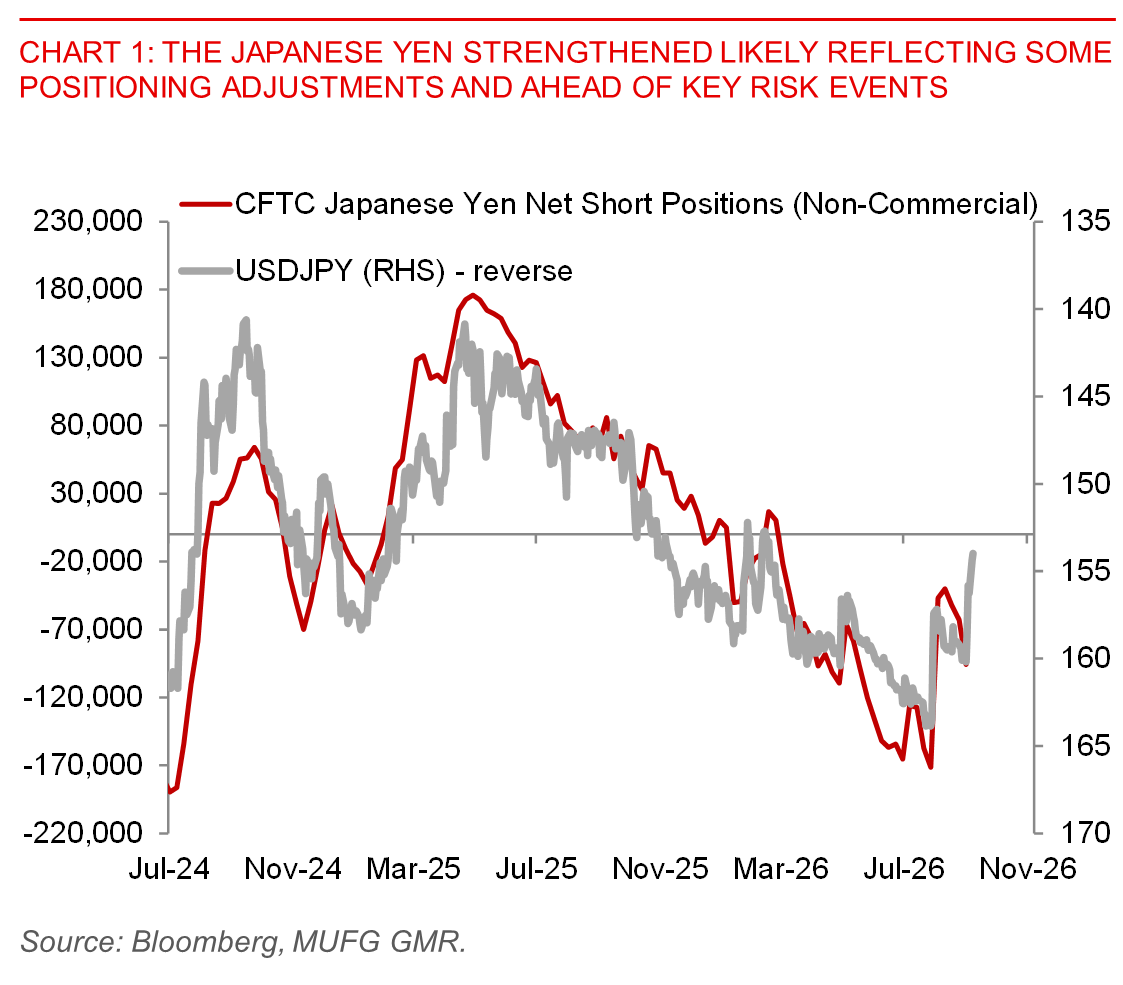
The Japanese Yen strengthened to below the 154 level against the Dollar, its strongest since 23 February, amidst holiday-thinned US trading, likely positioning adjustments ahead of upcoming risk events, coupled with ongoing market pricing on a faster pace of monetary policy tightening by the Bank of Japan. A 25bps hike at the BOJ’s 18 September meeting has already been largely priced in, while attention is shifting towards the BOJ’s communication about the broader path of rate hikes at subsequent meetings. Latest data from the CFTC as of 1 Sep suggests that Yen shorts started to rebuild post the joint US-Japan intervention at the end of July, and the recent moves in USD/JPY corroborate with some potential reduction in Yen shorts given the scale of the existing positioning coupled with being consistent with historical patterns. Meanwhile, Japan's Foreign Reserves data for August also highlighted the potential magnitude of intervention. Japan’s foreign reserves fell by 6.2% to USD$1,208bn, with securities holdings in particular declining by USD$87.8bn to USD$839.6bn. Overall, our Japan and global teams are forecasting USD/JPY to move towards the low 150s level over time, with the BOJ hiking in the September and January policy meetings.
We continued to see divergence in performance across Asian FX and rates markets ahead of the key US August CPI this Friday (11 Sep), the strengthening of the Yen, coupled with a continued rise in Brent oil prices towards the US$100/bbl mark amidst tensions between US and Iran.
On one hand, the South Korean won, Taiwan Dollar and to a smaller extent Thai baht outperformed, with USD/KRW in particular trading around the 1340 levels. We have been positive on KRW for some time, and have an existing trade idea to short USD/KRW which has worked very well, albeit partly for the wrong reasons (see here and here). The release today of the second revision of the 2Q GDP numbers in South Korea reinforces that, with real GDP rising 3.7%yoy but more importantly real Gross Domestic Income surging 15.7%yoy and nominal GDP up by 17%yoy. To further risk manage we recommend shifting the stop loss/take profit levels on short USD/KRW further to the 1370 levels from 1400 previously. Meanwhile, we continue to like TWD and have an existing recommendation to short USD/TWD, helped by the fading of dividend outflows after the peak season in August, strong AI activity, foreign inflows and over time exporter conversion especially if CBC turns more hawkish moving forward (see here).
On the flipside, PHP was weaker with USD/PHP rising up towards the 62.70 levels. From a strategy perspective, we think the risk-reward to go long USD/PHP is not good. Among other things, given how sensitive PHP is to changes in global oil prices, any possible resolution in the US-Iran conflict could result in some positioning adjustments and PHP strength given oil prices are already trading close to the US$100/bbl mark. In addition from a fundamental perspective, we are forecasting the Philippines’ trade deficit to narrow, headline GDP growth to improve as the worst of the fiscal contraction fades, some better balance in supply and demand in the domestic rice market, a hawkish BSP and wider interest rate differentials against the US, coupled with some estimated undervaluation in PHP right now. If anything, we think the risk reward tilts towards going short USD/PHP at these levels, although we stress our conviction levels are not very strong at this point given multiple cross currents. We continue to forecast USD/PHP moving lower towards 62.20 in 3Q2026, 62.00 in 4Q2026, 61.50 in 1Q2027 and 61.00 in 2Q2027 (see Philippines: Keeping an eye on inflation).