
Week Ahead FX outlook:
Key FX views:
Asian markets face a week dominated by monetary-policy decisions and inflation releases. The Bank of Korea is expected to deliver a consecutive 25bp hike to 3.00%, as rising core inflation, surging semiconductor exports and memory prices, coupled with a buoyant housing market keep BOK on a tightening bias. Meanwhile, we think the BSP will hike by 25bp to 5.00%, but the key for FX markets could also be the tone and whether the central bank signals a more dovish stance with recent softer than expected GDP. By contrast, the Bank of Thailand is expected to hold at 1.00% amid contained inflation and demand. Hawkish policy guidance will support KRW and PHP, while we think THB could be a preferred funding currency in the region given a still dovish central bank.
Across Asia, data will test how the energy shock and weaker global demand are feeding into prices and activity. Singapore CPI is forecast to accelerate to 2.7%yoy, while Australian inflation is expected to ease to 3.6%yoy, remaining above the RBA’s target range. India’s industrial-production growth should remain resilient at around 6%yoy.
In China, industrial-profit growth is projected to moderate to 18.1%yoy YTD, with resilient technology earnings offsetting softer production and weakness outside high-tech sectors.
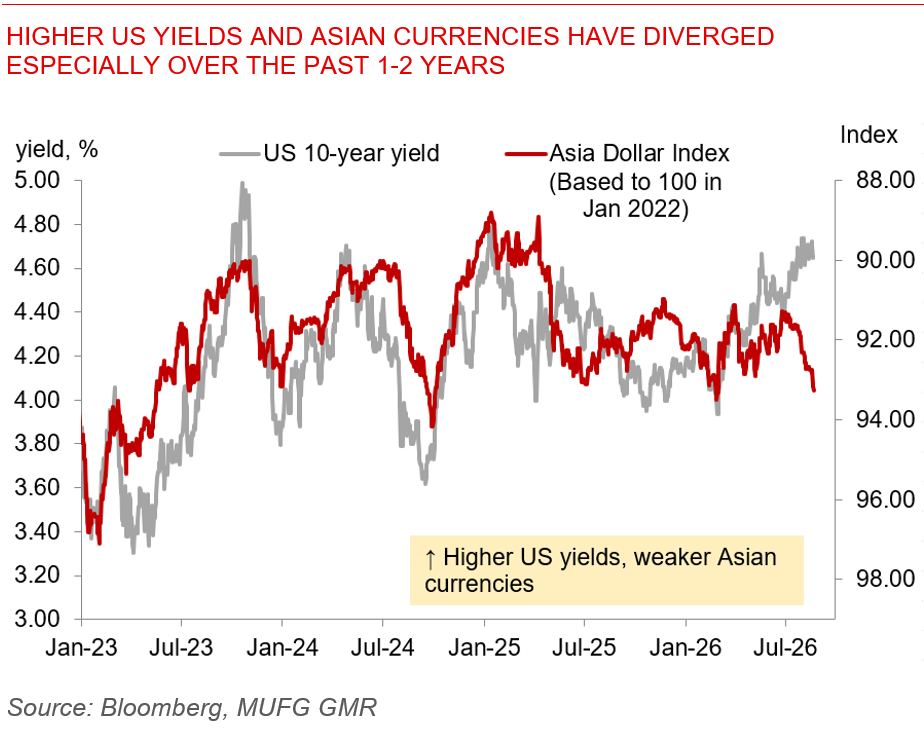
Outside Asia, the main event will be Fed Chair Kevin Warsh’s inaugural speech at Jackson Hole, which takes even more significance amidst the sell-off in US Treasuries. On the data front, the release of the second estimate of US Q2 GDP alongside July personal income, spending and PCE inflation will also be key. The report could shape expectations for Fed policy with implications for Treasury yields, the dollar and Asian currencies. Europe’s lighter calendar shifts attention to German activity indicators. Overall, markets will remain sensitive to whether oil-driven price pressures are becoming embedded in underlying inflation as Asian central banks balance currency stability against uneven growth.
Higher US Yields and Asian currencies have diverged, especially over the past 1-2 years.