
US CPI & yields and China data to drive regional FX markets
Week Ahead FX outlook:
Asia FX is likely to trade with a cautious tone in the week ahead, with currency performance driven primarily by US inflation data, movements in US Treasury yields and developments in China’s growth outlook. A softer-than-expected US CPI print could reinforce expectations for further Fed easing and provide support for higher-yielding Asian currencies, while any upside inflation surprise would likely boost the USD and weigh on regional FX. At the same time, investors will monitor incoming Chinese activity and credit data for evidence that recent policy support is gaining traction, as a firmer China growth outlook would benefit pro-cyclical currencies such as KRW, MYR and THB. Meanwhile, Asia FX remains sensitive to the interaction between domestic policy expectations and US yields, while oil price movements and broader geopolitical developments will continue to influence external balances and risk sentiment across the region. Overall, we expect Asia FX to remain range-bound, with domestic fundamentals taking a back seat to global macro drivers and China-related developments.
This week, foreign investors remained net sellers of Asian equities, with total outflows moderating to USD7.6bn after an intense net sale of USD11.5bn previously. Selling was concentrated in Korea (USD4.9bn), India (USD1.3bn) and Taiwan (USD0.8bn), while ASEAN markets continued to register modest outflows. Looking ahead, a softer US inflation print and lower yields could help stabilize sentiment and attract renewed inflows into Asian equities or reduced outflows, particularly in technology-heavy markets such as Korea and Taiwan. Conversely, another bout of USD strength and rising US yields would likely extend foreign outflows and keep investor positioning defensive across the region.
Next week, India's September CPI and trade data will be closely watched following the RBI's recent 25bp rate hike. Consensus expects inflation to accelerate, driven by higher food and energy prices, while a wider trade deficit could reflect the impact of rising oil imports and festive-season gold demand. Singapore takes centre stage with the MAS policy decision and advance 3Q GDP estimate, where a modest tightening of the S$NEER policy band remains a possibility amid firmer inflation trends. South Korea's labour market data is expected to confirm continued employment resilience, although the release is unlikely to alter expectations for further policy tightening.
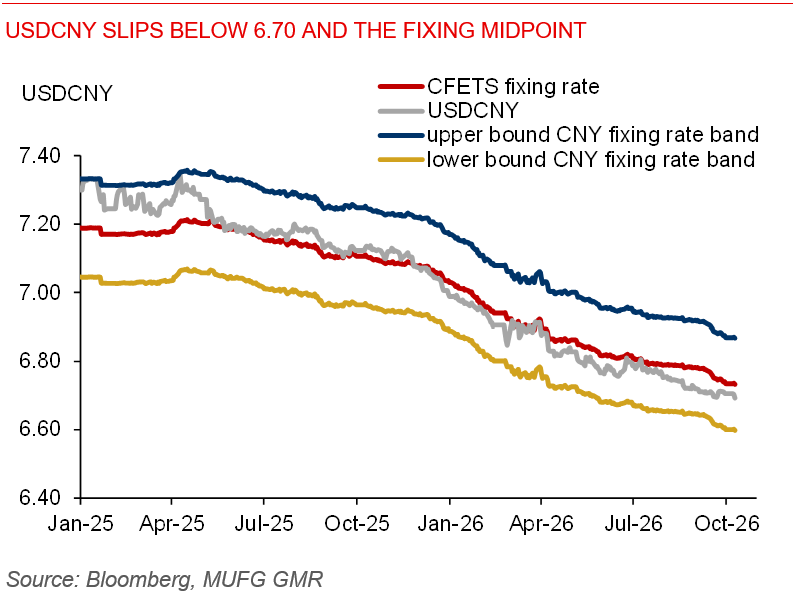
USDCNY slips below 6.70 and the fixing midpoint