

Signs of renewed JPY underperformance
JPY: Downside risks versus US dollar
The USD/JPY high today of 158.51 is just at the 200-day moving average level and if breached would certainly signal scope for further gains over the short-term. Some of the upward momentum for the US dollar has eased following the US employment report last week but the data has not had a notable impact on market expectations for the Fed with three further 25bp hikes priced through to mid-2027. An October hike now looks unlikely and the 5-6bps of pricing reflects uncertainty around the CPI data released next Wednesday. A failure of the Fed to hike this month is unlikely to do much damage to US dollar sentiment. The FOMC minutes from the September meeting will be released this evening and market participants will be looking for indication of how much further the fed funds rate could go. Fed Chair Warsh at that meeting stated that the Fed was removing “a dose” of monetary accommodation and stated that he was “hard-pressed” to describe conditions as restrictive. So are those views widespread across the FOMC and how do FOMC members measure financial conditions?
Given the dots profile, we will likely see minutes that likely broadly endorse current market pricing for rate hikes ahead and that should mean the support for the US dollar is maintained for now. We do still believe the Fed will not deliver what is currently priced but we need to see evidence of measures of inflation slowing and it’s too soon for that. Kansas City Fed President Schmid spoke yesterday and was clear that the Fed “had some work to do” in part because he viewed AI as “one of the largest” drivers of inflation in the US. That driver remains very resilient. The Nasdaq Composite and the S&P 500 both hit new record closing highs yesterday with optimism still very high. Factset is reporting an Q3 earnings growth estimate of 29.5%, which if realised would be the third consecutive quarter of YoY earnings growth over 25%.
Until recently, the yen was pretty much matching the performance of the US dollar against other G10 currencies, but the yen is now starting to underperform. So far in October, the yen is the second worst performing G10 currency with only the euro behind. The Japanese authorities have worked hard to reduce perceptions of the Takaichi administration being reflationist and have argued more strongly in favour of a stronger yen. However, Yomiuri is today reporting that the government is considering another supplementary budget to be compiled by November and passed through parliament by year-end. With the BoJ already priced for three hikes by July next year, front-end rates are unlikely to move higher on this speculation.
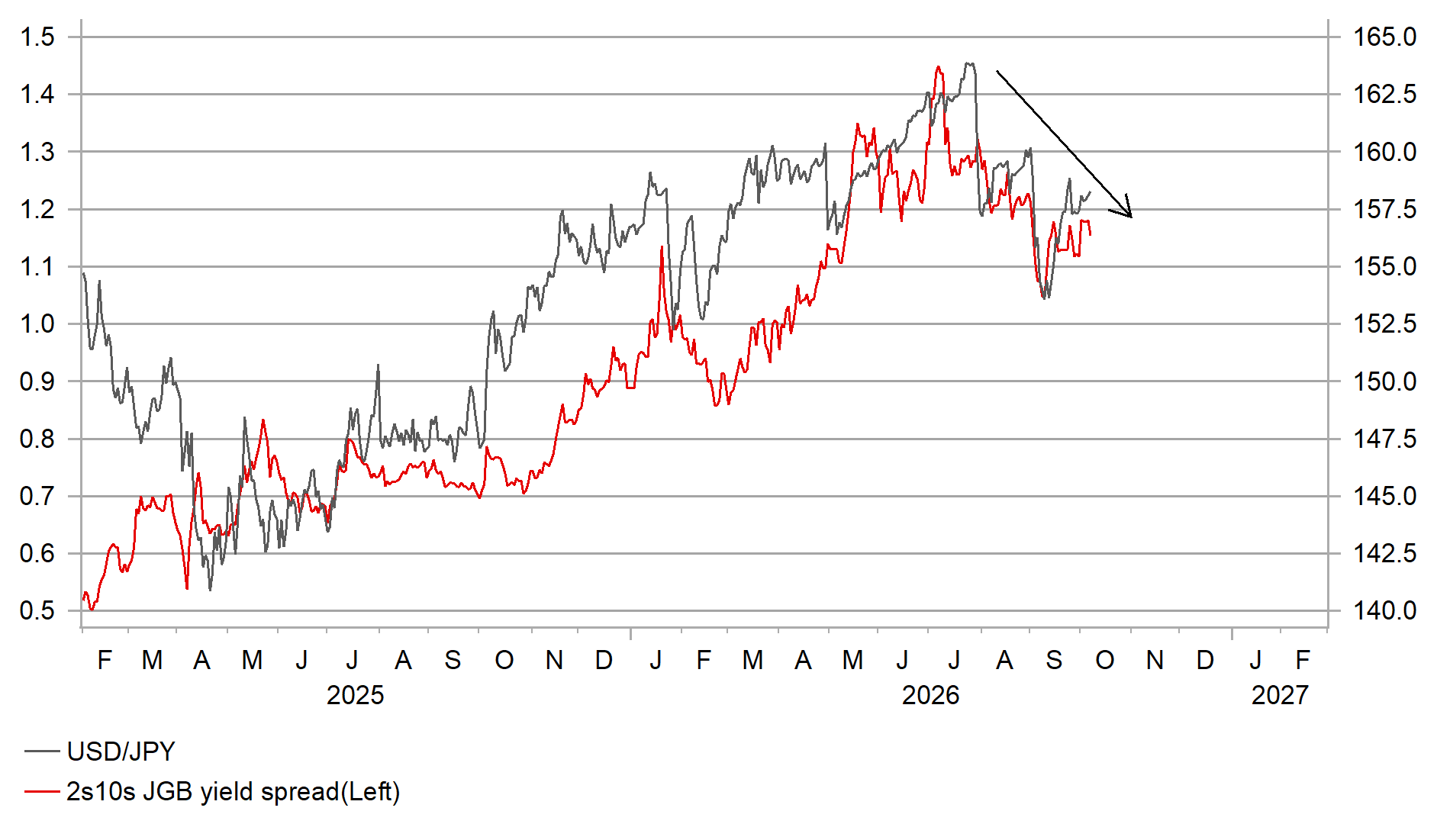
It could however rekindle doubts over the government’s inflation fighting credentials and its push toward fiscal consolidation. The size of any supplementary budget will be important of course and it may well turn out to be small but there is a risk it could feed into some renewed steepening of the JGB curve that tends to coincide with yen underperformance. Even if small in size it could still blur the lines on the government and the BoJ being in unison in fighting inflation risks. A break of the 200-day moving average will open up the potential for renewed momentum in USD/JPY with the potential for a full retracement back to the 160-level from early in September and to levels where intervention speculation would likely resume.
RECENT 2S10S FLATTENING HAS COINCIDED WITH JPY RECOVERY
Source: MUFG Research, Macrobond, Bloomberg
EUR: OAT selling eases as Le Pen presents alternative budget
The selling of OATs last week and the OAT/Bund spread widening out to 150bps certainly looked like a move that was overdone and with the broader global fixed income sell-off easing, there has been some scope for the OAT market to stabilise as well and that has now turned into a retracement from oversold levels. There had never been any specific catalyst in France for the intensified selling and France merely being a weak link during a period of heavy fixed income selling had resulted in OATs suffering more than other markets. There was a budget presented that lacked credibility, which didn’t help but that’s not exactly a new development for France.
It’s tempting to point to the budget proposals announced by Marine Le Pen yesterday as the factor behind the sharp narrowing of the OAT/Bund spread. In all likelihood this was more the result of global fixed income markets and the oversold levels that OATs had reached. The Le Pen proposals look unrealistically aggressive and will likely be questioned by investors who will doubt the capacity for such a sharp fiscal consolidation over such a short period. The proposed budget would see the deficit shrink to 3.7% next year and to 3.0% by 2030 and 2.2% by 2032. In order to achieve this even with increased spending in areas like pensions, the RN proposes EUR 140bn worth of spending cuts. A big component of that would be reducing the French contribution to the EU budget of between EUR 11-20bn per year. She proposed a ‘Golden Rule’ to cap national debt at 60% of GDP and to reduce the deficit each year by 0.5ppt of GDP until close to a balanced budget. It would be put for a vote in a referendum. Whether it would pass is debatable.
Still, offering such a proposal does help give RN a degree of credibility and while the numbers will be questioned the prospect of a more meaningful action after years of political gridlock may be seen by investors as at least offering a path to change and an attempt to address years of fiscal slippage.
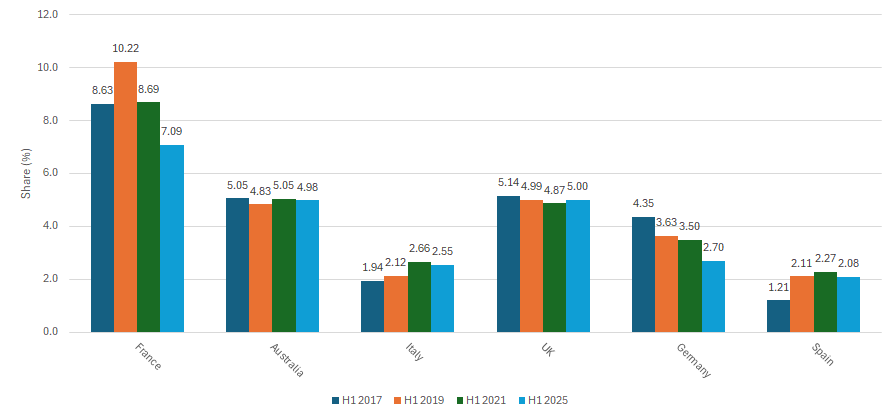
But with 56% of French sovereign bonds held by foreign investors, global fixed income sentiment will remain a key driver of the OAT/Bund spread over the period ahead. This alternative budget is unlikely to make much difference to the risks associated with OATs ahead of the election next year – especially given a plausible scenario of a presidential election run-off in the second round between Le Pen and the hard-left candidate Jean-Luc Melechon, who is now usually polling second on around 20% versus Le Pen on around 30%. Japan has been steadily cutting back on OAT holdings as we have highlighted before and other countries could well be doing the same keeping OAT risks elevated. EUR/USD downside risks are set to prevail.
JAPAN HOLDINGS OF FOREIGN BONDS % OF TOTAL FOREIGN BOND HOLDINGS – FRANCE % IS HIGH BUT COMING DOWN (US 50%)
Source: Bloomberg, Macrobond, MUFG Research
KEY RELEASES AND EVENTS
Country | BST | Indicator/Event | Period | Consensus | Previous | Mkt Moving |
EZ | 08:20 | ECB's Vujcic speaks | !! | |||
US | 12:00 | MBA Mortgage Applications (WoW) | - | - | -6.0% | ! |
US | 16:00 | NY Fed 1yr Inflation Expectations | (Sep) | 3.60% | 3.6% | ! |
US | 18:00 | 10-Year Note Auction | - | - | 4.834% | !! |
EZ | 18:30 | ECB's Vujcic speaks | ! | |||
US | 19:00 | FOMC Meeting Minutes | - | - | - | !!! |
US | 20:00 | Consumer Credit | (Aug) | 14.40B | 18.06B | ! |
Source: Bloomberg & Investing.com