

USD advance after NFP report curtailed ahead of US CPI report
USD: Will US CPI report prove pivotal for Fed policy action this month?
The US dollar has continued to trade at stronger levels at the start of this week following the release of the stronger than expected nonfarm payrolls report on Friday. It has helped to lift the dollar index back up to support from the 200-day moving average at around 99.150. The stronger US dollar has been encouraged by the pick-up in US yields reflecting market participants moving to price back in more Fed rate hikes. The 2-year US Treasury yield has increased by around 3-4bps since the nonfarm payrolls report was released, and there are currently around 15bps of hikes priced in for this month’s FOMC meeting. It represents only a modest increase from prior to the release off the nonfarm payrolls report on Thursday when there were around 13bps of hikes priced in. While the nonfarm payrolls report for August was not a game changer for the outlook for Fed policy, it does provide further reassurance that labour demand has gradually strengthened this year. Private employment has increased on average by 84k/month in the first eight months of this year compared to only 25k/month in 2025.
It helps to explain why the Fed has become less concerned over the health of the US labour market, and has switched its policy focus to upside risks to the inflation outlook. As a result, the release at the end of this week of the latest US CPI report for August is likely to prove more important in determining whether the Fed will hike rates this month although when setting policy a central bank should never place too much emphasis on just one report. Fed Governor Waller did explicitly state last week thought that “if this [disinflation] continues in the data due over the next two weeks, I would be inclined to support holding the target for the federal funds rate at its current setting”. One reassuring aspect of the nonfarm payrolls report is that continues to indicate that the risk of second round inflation effects from higher energy prices in the labour market appear to be contained. The nonfarm payrolls report provided further evidence that wage growth has continued to slow this year. Average hourly earnings growth slowed to an annual rate of 3.1% in August which was the lowest rate since 2021.
Overall, the last week’s latest developments including the nonfarm payrolls report for August and dovish comments from Fed Vice Chair Williams and Fed Governor Waller leave the prospect of a Fed hike this month finely balanced encouraging expectations that Friday’s CPI could tip the balance. Core inflation has undershot expectations in two out of the last three months, and another soft report may be required to prevent a hike this month with the price of oil trading back closer to USD100/barrel.
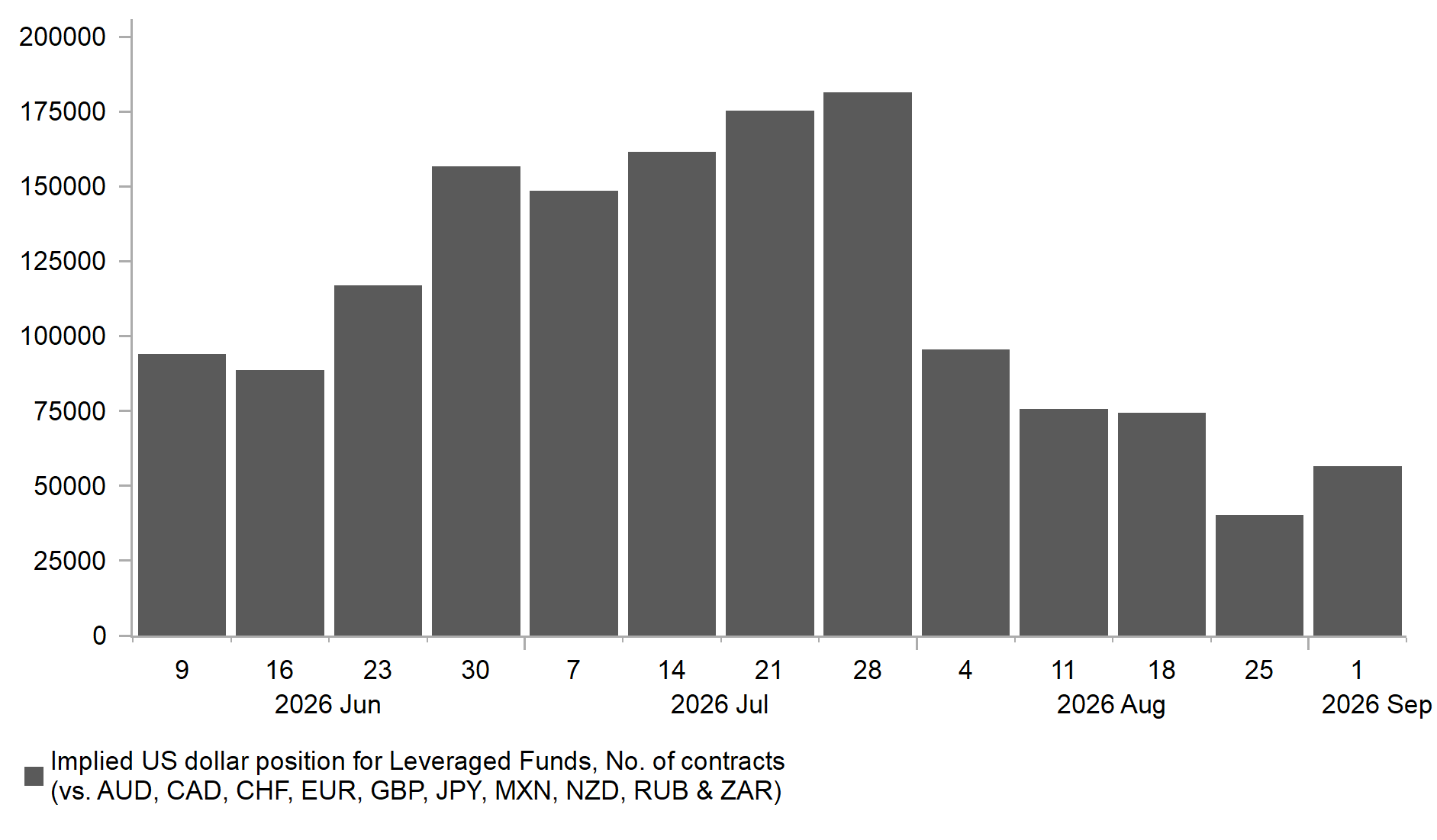
SPECULATIVE LONG USD POSITIONS SCALED BACK OVER THE SUMMER
Source: MUFG Research, Macrobond, Bloomberg
EUR: ECB policy update & German political risks in focus
The ECB’s updated outlook for monetary policy will also attract market attention in the week ahead. The euro-zone rate market has moved over the summer to price in a more hawkish outlook for ECB policy ahead of this week’s policy meeting. There are currently around 75bps of hikes price din by the middle of next year including a 25bps for this week and almost 50bps of hikes by year end. The recent repricing provides a higher hurdle for the ECB to deliver a hawkish surprise in the week ahead. We expect the ECB to deliver a second 25bps hike this week, and leave the door open to further rate hikes if required. However, the ECB could disappoint some expectations if they do not signal strongly that another hike will be delivered before the end of this year posing some modest downside risk for the euro. Please see our latest FX Weekly report (click here) for more details.
At the same time, political developments in Europe have also attracted attention at the start of this week although the initial market impact has been limited. It has been reported that the far-right Alternative for Germany (AfD) party performed strongly in the Saxony-Anhalt state election over the weekend but just fell short of a parliamentary majority. The AfD won almost 44% of the vote amid record turnout up from a vote share of 20.8% in the 2021 regional elections. In contrast, Chancellor Merz’s Christian Democratic Union (CDU) party suffered a heavy defeat securing just 17.2% of the vote down from 37.1% in 2021.
The AfD’s ability to win a majority was scuppered by the leftwing Bundnis Sahra Wagenknecht (BSW) party reaching the 5% threshold required enter parliament. Difficult talks over forming a coalition government are now expected. The AfD has rejected the offer of working with the BSW, while also ruling out coalitions with any other parties. Similarly, the CDU has ruled out coalitions with the AfD and the Left, but may have to rely on support from the Left in state parliament if it wants to retain power. Two more state elections will take place in Berlin and Mecklenburg-Vorpommern on 20th September. Market participants will be watching closely to see if the ruling parties continue to perform poorly which could undermine political stability although we do not expect any significant policy changes with fiscal policy set to remain supportive for growth in Germany
KEY RELEASES AND EVENTS
Country | BST | Indicator/Event | Period | Consensus | Previous | Mkt Moving |
SW | 07:00 | CPI YoY | Aug P | 0.5% | 0.2% | !! |
GE | 07:00 | Industrial Production SA MoM | Jul | 0.2% | 0.2% | !! |
SZ | 08:00 | Unemployment Rate | Aug | 3.0% | 3.0% | !! |
EC | 09:30 | Sentix Investor Confidence | Sep | 170.0% | 90.0% | !! |
EC | 10:00 | GDP SA QoQ | 2Q T | 0.4% | 0.4% | !!! |
EC | 10:00 | Employment QoQ | 2Q F | -- | 0.1% | !! |
Source: Bloomberg & Investing.com