

Growth resilience in Europe as trade tensions with China mount
EUR: China pushes back against CNY criticism
The euro looks to be stabilising after falling sharply from 1.1600 to 1.1200 on the back of rising global yields and the increased concerns over the fiscal position in France ahead of the French presidential elections in April/May next year. Increased concerns over a terms of trade hit from rising refined energy prices has also played a role and any further notable jumps in natural gas and diesel prices would likely hurt the economies in Europe. Still, we continue to see evidence of economic resilience in Europe that could help stabilise the euro at these lower levels. The Economy Ministry in Germany yesterday revised up its GDP growth projection from 0.5% and 0.9% for this year and next to 1.3% and 1.1% respectively. Growth had been downgraded in response to the war but the new estimate for this year is above the 1.0% estimate at the start of the year underlining the level of resilience. Germany’s industrial production advanced by 2.0% in August and orders for defense and tech-related goods have helped. The resilience will help maintain current pricing for ECB hikes.
The focus now is on trade with a European delegation meeting in China to discuss trade relations. Trade Commissioner Maros Sefcovic is in talks with Chinese Commerce Minister Wang Wentao and coinciding with these talks is the release yesterday of a PBOC document defending the FX policy of China and arguing against the level of CNY as being the cause of China’s large trade surplus. Competitive gains within China’s manufacturing sector is the main driver of increase exports from China. There has been speculation that Europe is soon to respond with agreeing to a more flexible trade policy mechanism that would allow for easier implementation to counter against huge imports to Europe from China. An import cap could be agreed as well as additional tariffs that could see trade tensions rise and prompt retaliation from China. These talks could be the final opportunity to avoid increased tensions. An escalation into grater trade conflict could be another EUR negative factor.
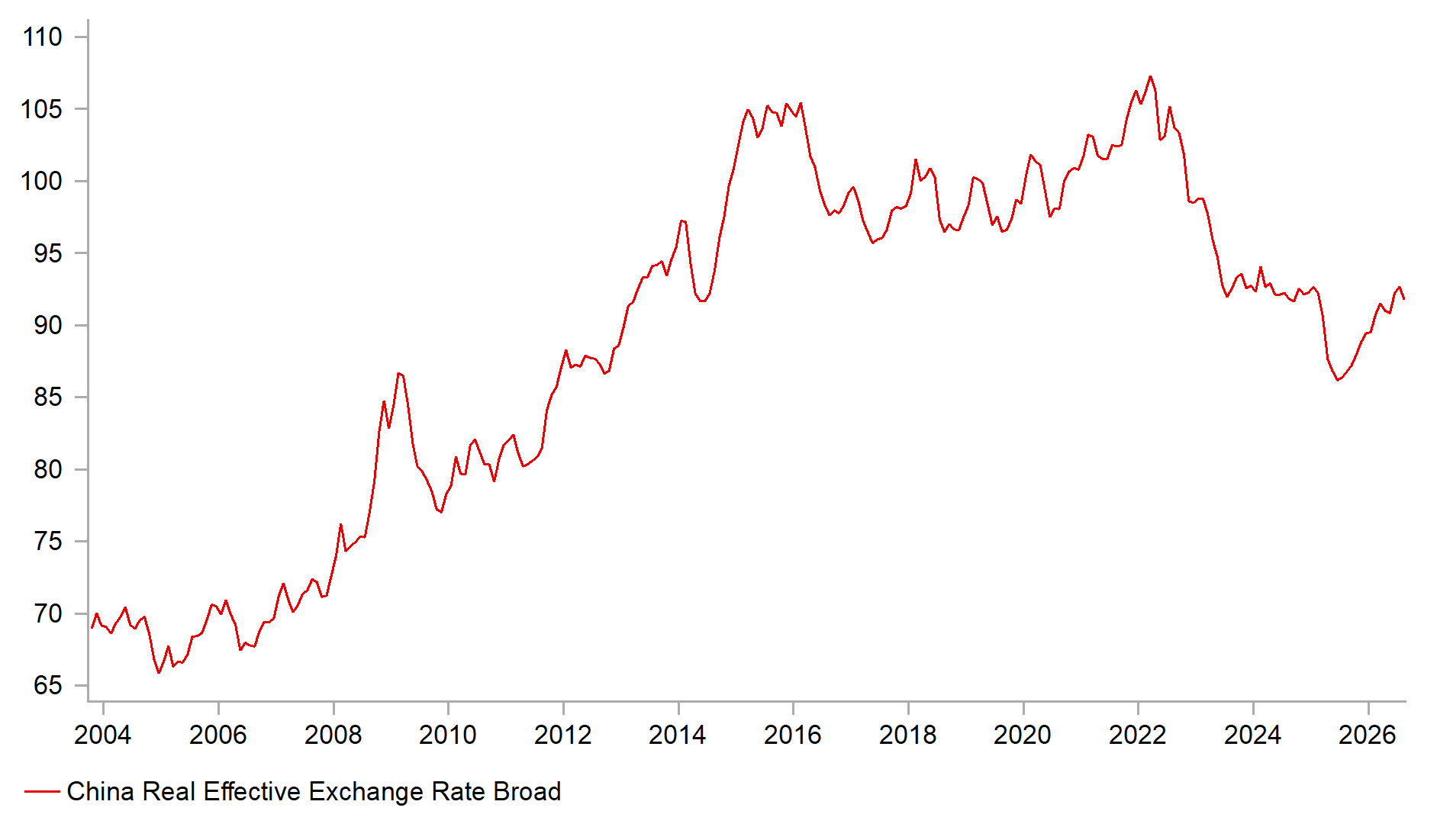
The release of this document by the PBoC suggests China isn’t budging. Is the CNY undervalued? The answer seems certainly yes although the scale of undervaluation is debated and while this undervaluation helps boost exports the FX factor is only a partial explanation. The BIS REER level of RMB advanced notable from 2005 – by nearly 60% through to end-2015. However, from the 2022 high the index fell 20% to last year’s low before 6.5% to today’s level. The IMF estimates an undervaluation of between 12% to 20% which is around the consensus range.
This mounting pressure looks to be encouraging China too allow renewed gains. Recent PBoC fixing in USD/CNY indicate a desire to keep CNY on a strengthening path despite the broader gains for the dollar. EUR/CNY is 10% lower from the January high and we see near-term scope for further declines. The continued CNY strength is helping isolate Asian currencies from the broader dollar gain. While the DXY has advanced 3.3% from the September low, the dollar against a basket of Asia FX is just 0.7% higher.
CNY REER REMAINS 14.5% BELOW THE PEAK LEVEL IN 2022
Source: MUFG Research, Macrobond, Bloomberg
JPY: NISA-related outflows picking up further
Yesterday, the MoF released the International Transactions in Securities data for September that reveals the Japanese investor-type and foreign investor cross-border flows and two stand-out observations are worth noting.
Firstly, September was a month of turmoil in global bond markets and that was evident in the selling of foreign bonds by Japanese investors. However, interestingly foreign investors did not show the same aversion to fixed income and there was a notable JPY 3,091bn worth of purchases of Japanese bonds. September was also a month in which the BoJ raised rates again and that flow could be indicative of improved confidence in JGBs after three consecutive months of selling through to August. Sales in those three months totalled JPY 4,490bn, the largest since the three months to February 2023. That improvement is coinciding with better sentiment overall as was evident from the better 10yr and 30yr auction results this week.
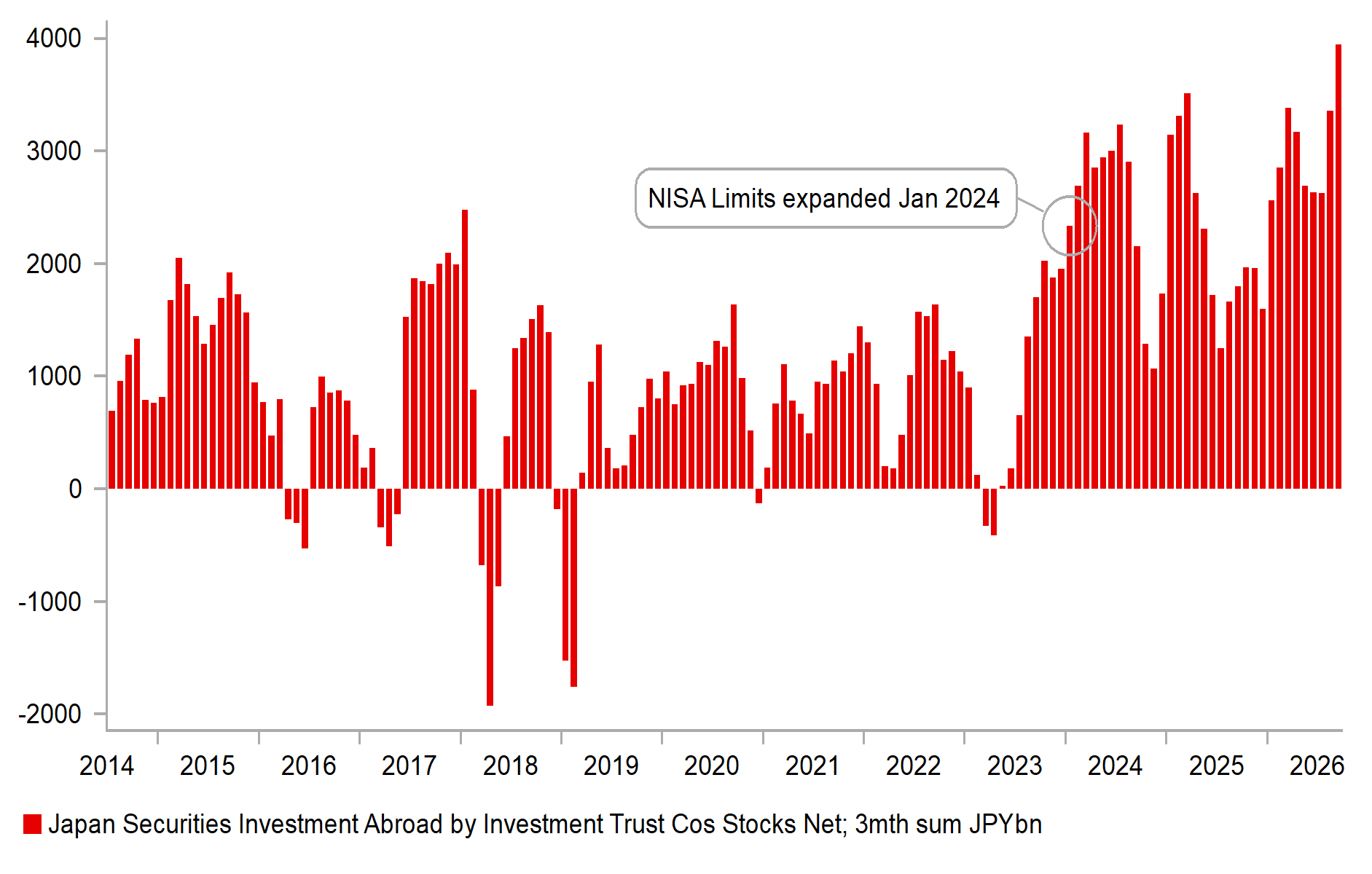
Secondly, the Japan Investment Trust flow was telling with foreign equity purchases totalling JPY 1,360bn in September. The buying has picked up and the 3mth sum of foreign equity purchases totalled JPY 3,949bn, a new record over a 3mth period. This Investment Trust flow captures households buying of foreign securities via NISA accounts and it remains clear that the expanded NISA limits adopted in January 2024 continues to have a notable impact. Annualising this 3mth flow implies an outflow of close to JPY 16trn (USD 100bn) and is an increasing negative yen factor.
When PM Takaichi spoke yesterday, she mentioned her hope “to firm up JGB retail products” to enhance domestic demand for JGBs. Previously, in July, Finance Minister Katayama stated that it was time to consider including JGBs in the array of products available under NISA accounts. Providing tax-free opportunities to hold JGBs could well have an impact on the flows to foreign equity markets that is so evident today and given the scale of foreign equity purchases currently would be viewed as a clear yen positive. It would be one policy initiative that would help the government reach a target of 40% of household financial assets being invested in domestic securities. Currently, nearly half of all household savings are parked in cash deposits and large portions of pensions and investment trusts are invested in foreign securities.
JAPAN INVESTMENT TRUSTS PURCHASES OF FOREIGN EQUITIES REMAIN STRONG – ON A 3MTH BASIS A NEW RECORD WAS RECORDED IN SEPT
Source: Bloomberg, Macrobond, MUFG Research
KEY RELEASES AND EVENTS
Country | BST | Indicator/Event | Period | Consensus | Previous | Mkt Moving |
IT | 09:00 | Industrial Production MoM | Aug | 0.00% | 0.70% | ! |
IT | 09:00 | Industrial Production WDA YoY | Aug | 2.10% | 0.00% | ! |
IT | 09:00 | Industrial Production NSA YoY | Aug | -- | 0.00% | ! |
CA | 13:30 | Net Change in Employment | Sep | 5.0k | -41.7k | !!!! |
CA | 13:30 | Unemployment Rate | Sep | 6.50% | 6.40% | !!!! |
CA | 13:30 | Full Time Employment Change | Sep | -- | -35.9k | !! |
CA | 13:30 | Part Time Employment Change | Sep | -- | -5.8k | !! |
CA | 13:30 | Participation Rate | Sep | 65.00% | 65.00% | !! |
CA | 13:30 | Hourly Wage Rate Permanent Employees YoY | Sep | 2.30% | 2.00% | !!! |
EZ | 14:30 | ECB's Schnabel speaks | !! | |||
US | 15:00 | U. of Mich. Sentiment | Oct P | 47.6 | 48.1 | !! |
US | 15:00 | U. of Mich. Current Conditions | Oct P | 50.3 | 50.9 | !! |
US | 15:00 | U. of Mich. Expectations | Oct P | 45.5 | 46.3 | !! |
US | 15:00 | U. of Mich. 1 Yr Inflation | Oct P | 4.70% | 4.60% | !!! |
US | 15:00 | U. of Mich. 5-10 Yr Inflation | Oct P | 3.50% | 3.40% | !!! |
US | 21:00 | Fed's Collins speaks | !!! |
Source: Bloomberg & Investing.com