

FX spillovers from rising bond yields & energy prices
USD: Rising yields triggering more risk-off trading in FX market
The US dollar has continued to trade at modestly stronger levels overnight ahead of tomorrow’s FOMC meeting. After hitting a low of 98.599 on 9th September, the dollar index has risen for four consecutive trading days and currently stands around 1.0% higher. It has returned to levels where it was trading prior to the US Treasury’s announcement that it planned to increase the size of long-term debt buybacks on 19th August. The stronger US dollar has been encouraged by the hawkish repricing of Fed rate hike expectations. The 2-year US Treasury yield has increased by almost 30bps since 8th September as market participants have moved to price in a more extended Fed tightening cycle. The US rate market now expects the Fed to deliver almost 100bps of hikes in the year ahead fully reversing last year’s rate cuts that totalled 75bps. The hawkish repricing of yields at the short-end of the curve has also helped to lift yields at the long-end of the curve with the 10-year US Treasury yield rising above 5.0% yesterday and hitting the highest level since the middle of 2007 in the run up to the Global Financial Crisis.
The ongoing move higher in bond yields is encouraging building investor concerns that it could trigger a deeper correction lower for risk assets. So far global equity markets have held relatively well with rising yields not yet triggering a significant pick-up in financial market volatility. MSCI’s global equity index remains close to recent record highs and has also declined by around 2.5% from the peak back in mid-August. Measures of volatility in both the equity and FX markets have started to pick up but are still at low levels. It highlights that spillovers from rising bond yields into the FX market have been modest so far. Looking at how currencies have performed since the dollar index bottomed on 9th September, one can see that the high beta commodity currencies of the New Zealand and Australian dollars have underperformed alongside the Swedish krona. The price action is more consistent with risk-off trading. Similar price action has also been evident amongst emerging market currencies where heat commodity and high-yielding currencies have underperformed such as the Chilean peso, South African rand, Hungarian forint and Mexican peso. Downside risks for those currencies would intensify if rising bond yields and energy prices triggered a deeper correction lower for risk assets heading into year end.
VOLATILITY IS PICKING UP FROM YEAR-TO-DATE LOWS
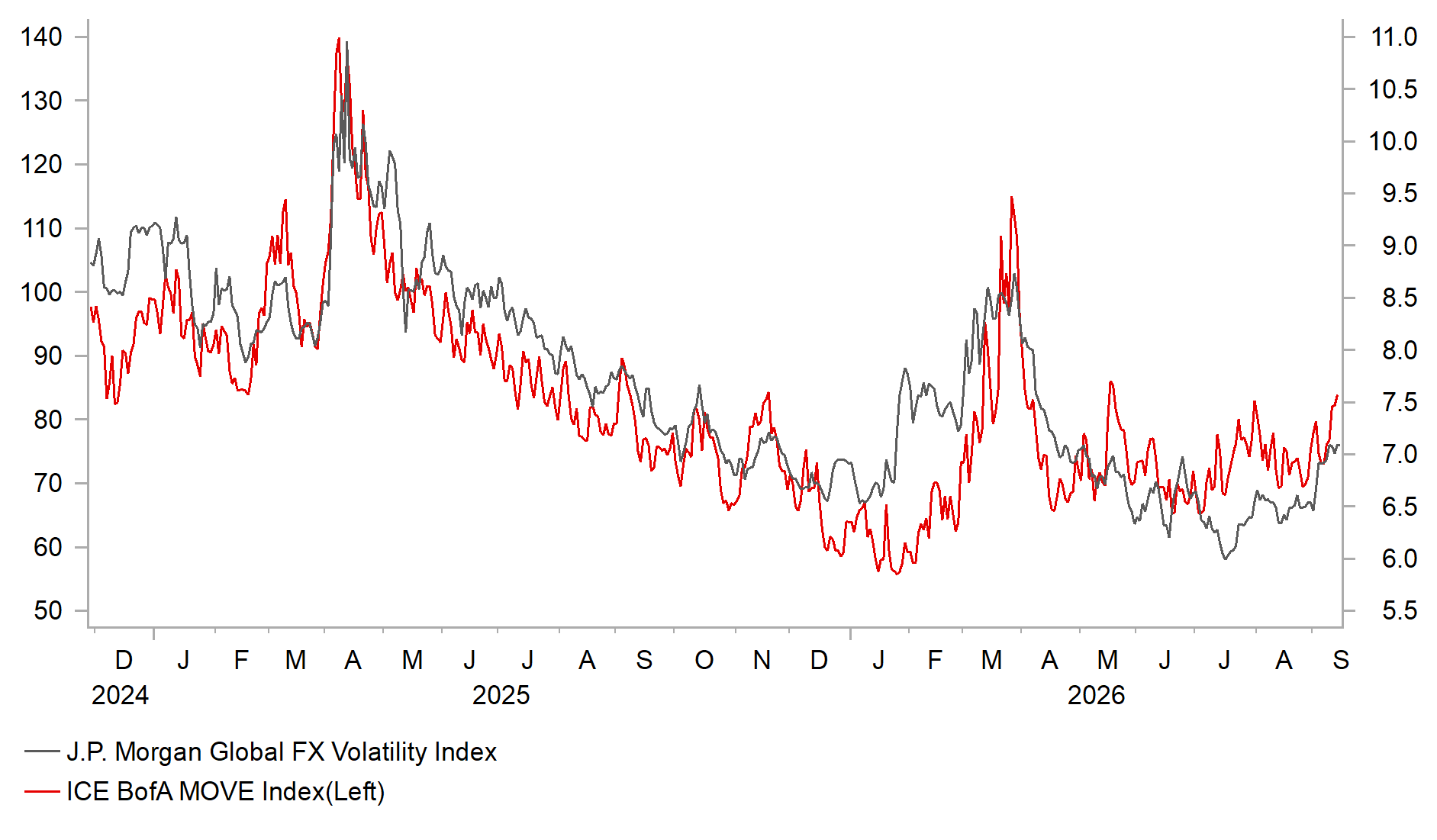
Source: MUFG Research, Macrobond, Bloomberg
GBP: UK labour market remains weak ahead of BoE policy update
The pound is continuing to hold up better than expected to the worsening energy price shock. It has been the second best performing G10 currency since the US dollar bottomed on 9th September. There was further encouraging evidence last week that the UK economy is continuing to grow more strongly than expected this year which has helped to support the pound. Monthly economic growth unexpectedly picked up to 0.4% in July from 0.3% in June highlighting that growth momentum was much stronger than expected (consensus forecast at 0.0%M/M) at the start of Q3. It follows annualized growth of just over 2% in the first half of this year. Growth is expected to slow significantly in the second half of this year similar to the seasonal pattern evident in recent years although July activity suggests it may not slow as much as feared.
The combination of stronger growth, rising energy prices and building expectations for other major central bks to tighten policy have been encouraging expectations that the BoE will soon take action to begin tightening policy as well. The 2-year gilt yield has jumped sharply by almost 40bps from the low earlier this month, and there are now over 100bps of BoE hikes priced into the year ahead. While we expect the Boe to leave rates on hold this week, we expect the updated guidance to indicate that MPC members are moving closer to voting to a hike as soon as the next meeting in November. Rising yields in the UK which are amongst the highest in offer in the G10 are helping to support the pound while growth holds up. However, the UK labour market has remained weak despite stronger growth. The latest labour market report released this morning revealed another month of bigger than expected private sector job losses totalling -26k in August, and private sector pay growth held at target consistent levels at 2.9%. Weakness in the labour market could curtail the scale of tightening the BoE is willing to deliver.
KEY RELEASES AND EVENTS
Country | BST | Indicator/Event | Period | Consensus | Previous | Mkt Moving |
EU | 10:00 | Trade Balance | (Jul) | 3.7B | 8.6B | !! |
EU | 10:00 | ZEW Economic Sentiment | (Sep) | 39.9 | 31.4 | !! |
US | 13:30 | NY Empire State Manufacturing Index | (Sep) | 14.10 | 20.60 | !! |
US | 13:55 | Redbook (YoY) | - | - | 8.3% | ! |
EU | 18:00 | ECB's Schnabel Speaks | - | - | - | !! |
Source: Bloomberg & Investing.com