

JPY remains weak after BoJ sticks to path for gradual hikes
JPY: Gradual pace of BoJ hikes fails to trigger stronger yen
The yen is largely unchanged after the BoJ’s latest policy meeting with USD/JPY continuing to trade just above the 160.00-level. After initially weakening in response to the US-Iran deal announced over the weekend, there has been a lack of follow through for US dollar selling ahead of tomorrow’s important FOMC meeting. The muted yen reaction to the BoJ’s latest policy meeting highlights that the BoJ had already clearly signalled that they planned to hike rates today by 0.25 point to 1.00%. At the same time, the BoJ announced that they plan to pause their QE taper programme from FY2027. Until then the BoJ will continue to slow monthly JGB purchases by around JPY200 billion per quarter. From April 2027, the amount of monthly JGB purchases will remain at about JPY2 trillion. Both the decisions to raise rates and pause the QE taper were backed by a majority of 7-1 with Toichiro Asada the sole dissenter.
The updated statement on monetary policy revealed that the BoJ’s decision to raise rates further today was backed by their assessment that Japan’s economy is developing generally in line with their base line scenario. The BoJ judged that there was a reduced risk of a significant slowdown in the economy given that the government has taken measures to reduce the negative hit from higher energy prices, and progress has been made in securing alternative sources of supply for raw materials that are highly dependent on the Middle East.
At the same time, the BoJ noted concern over the risk of underlying CPI inflation deviating upward to a level above the price stability target of 2.0%. the BoJ highlighted that there has been relatively fast pace of price pass-through in business-to-business transactions from higher oil prices, and that the price pass-through could spread to an increase in consumer prices across a wide range of items. The BoJ also highlighted that medium to long-term inflation expectations had continued to rise posing upside risks their inflation target. In light of these developments, the BoJ judged that another rate hike was appropriate, and continued to signal that they “will continue to raise the policy rate and adjust the degree of monetary accommodation”.
We expect the BoJ to stick to a gradual pace of monetary tightening and deliver another rate hike later this year. The weak yen is one factor which could encourage the BoJ to speed up the pace of rate hikes but there was no strong indication over the timing of the next hike at today’s policy meeting. The yen’s failure to strengthen on the back of today’s BoJ rate hike will keep pressure on Japan to intervene again to provide support. As we highlighted in yesterday’s FX Daily Snapshot, leveraged funds have been ramping up short yen positions over the past month which will add to concerns that speculative selling is driving the weaker yen. The US-Iran deal to reopen the Strait of Hormuz should help to ease fundamental selling pressures for the yen by lowering energy prices and dampening expectations for Fed rate hikes.
BOJ POLICY RATE IS MOVING UP CLOSER TO NEUTRAL ESTIMATES
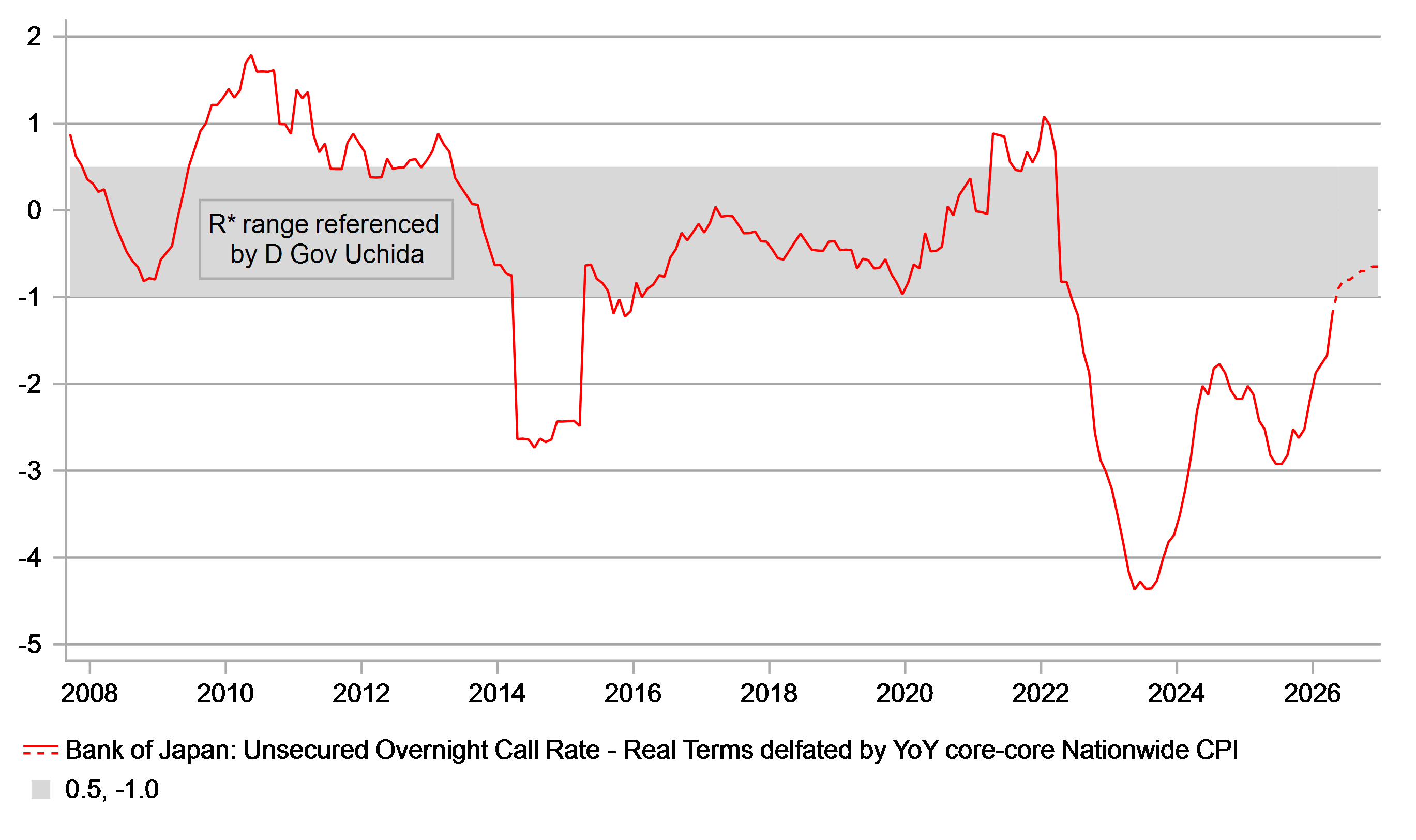
Source: Bloomberg, Macrobond & MUFG Research
AUD: RBA is happy to leave rates on hold to assess impact of prior rate hikes
The Australian dollar has weakened modestly overnight after failing to break back above the 0.7100-level yesterday. The Australin dollar had weakened in the run up to last night’s RBA policy meeting driven in part by paring back of expectations for further RBA rate hikes. After raising rates in February, March and May the RBA unanimously decided to leave rates on hold overnight for the first time this year at 4.35%.
In the updated policy statement, the RBA acknowledged that financial conditions have tightening this year in responses to the three rate hikes which is having a dampening impact on activity. The RBA highlighted that “there are signs that growth in consumer spending is slowing as expected and momentum in the housing market has shifted, with house prices falling in some capital cities”. At the same time, the unemployment rate was higher than expected in April. Evidence of slower growth have been encouraging market participants to scale back expectations for further RBA rate hikes.
However, the RBA did not rule out that further hikes maybe required given that headline and underlying inflation judged to be “still too high”. Inflation pass-through from higher oil prices is adding to the high inflation recorded at the start of the year that was reflected capacity pressures in the economy. The RBA wants demand growth to slow to reduce capacity pressures and remains prepared to tighten further if required.
Overall, today’s policy update indicates that the RBA is currently comfortable to leave rates on hold in the near-erm while it continues to assess the economic impact of the three hikes it delivered so far this year. The US-Iran deal and ongoing decline in energy prices will help to ease pressure on the RBA to hikes rates further this year. The recent paring of RBA rate hike expectations and correction lower for commodity prices are currently contributing to the Australin dollar giving back some of the strong gains recorded earlier this year. The commodity currencies of the Australian dollar and Norwegian krone are still by far the best performing G10 currencies this year.
KEY RELEASES AND EVENTS
Country | BST | Indicator/Event | Period | Consensus | Previous | Mkt Moving |
EU | 10:00 | Wages in euro zone (YoY) | (Q1) | - | 3.00% | !! |
EU | 10:00 | ZEW Economic Sentiment | (Jun) | -7.6 | -9.1 | !! |
EU | 10:00 | Labor Cost Index (YoY) | (Q1) | 3.30% | 3.30% | ! |
US | 13:30 | Import Price Index (MoM) | (May) | 0.9% | 1.9% | !! |
US | 13:30 | Housing Starts | (May) | 1.420M | 1.465M | !! |
EU | 14:10 | ECB's Lane Speaks | - | - | - | !! |
Source: Bloomberg & Investing.com