

USD is correcting lower into US mid-term elections
USD: Trading on a softer footing heading into US mid-term elections
The US dollar has continued to trade at modestly weaker levels overnight after correcting lower at the end of last week. It has resulted in EUR/USD rising back up towards the 1.1200-level. The US dollar has softened overnight alongside the pullback in the price of oil with Brent falling back below USD110/barrel. It was reported over the weekend by Axios that President Trump had a candid phone call with Israeli Prime Minister Tenyahu about the state of US negotiations with Iran and how quicky to return to combat. The sources said that Prime Minister Netanyahu is pressing President Trump to strike Iran immediately after the US mid-term elections taking place tomorrow. But President Trump, for now, wants to let negotiations play out. President Trump also told reporters over the weekend that negotiations with Iran are “going fine” and noted he is no “in much of a hurry”. At the same time, it has been reported that Qatari mediators met with Iranian officials on Sunday for the third consecutive day in an effort to reach a deal to restart direct negotiations between the US and Iran. The building risk of a bigger and more protracted energy price shock has been contributing towards stronger US dollar in recent months.
Market attention will also be focused on the outcome from the Us mid-term elections at the start of this week. The latest odds from Polymarket highlight that there are high expectations that the Republicans will lose control of Congress, and the Democrats could even take both the house and Senate. The probability of the Democrats winning control of the House has continued to increase hitting a fresh high of 95%, while the probability of winning control of the Senate has also risen to a fresh high of 72%. All 435 seats in the House are up for election and only 35 out of 100 seats in the Senate. For control of the House, the latest Cook Political Report shows 183 seats as solid for Democrats and 22 likely/leaning Democrats. In comparison, 161 seats are viewed as solid for Republicans and 27 likely/leaning Republican. There are also 18 seats are rated as toss ups but currently 14 are held by Republicans. In the Senate, it is harder but not impossible for the Democrats to take control, the Republicans currently hold a 53-47 seat advantage and would need to a net gain of 4 seats given Vice President JD Vance’s vote would hold sway in case of a tie (50 seats each). Losing control of the House and Senate would effectively leave President Trump as a lame duck but he could still use executive orders to act in areas including trade, immigration, AI/technology and foreign policy. A damaging defeat for the Republicans could put a dampener on US dollar strength but we don’t expect it to be game changer on its own. It would limit room for further fiscal stimulus and could increase market attention on the potential for less market friendly policies beyond the current Presidency.
The US dollar has lost upward momentum at the end of last week after the Fed’s policy update was less hawkish than expected, and AI-related US equities came under renewed selling pressure. The 2-year US Treasury yield has fallen by almost 40bps from the high at the end of September. At the long-ed of the curve, market participants will be watching closely this week’s Quarterly Refunding Announcement from the US Treasury. There has been some speculation that the US Treasury could reduce the size of longer-date US Treasury auctions to help ease upward pressure on yields in particular for maturities between 20 and 30 years. The Us Treasury has also stated that it will provide further details on the upcoming sizes of US Treasury buybacks. Global bonds including US Treasury derived support at the end of last week from the deepening correction lower for US AI-related equities. The Nasdaq closed down by -2.9% extending the sell-off since the last month’s high to almost 10%. Intel was the big loser on Friday falling by 28.6% following on from heavy losses earlier in the week from Alphabet which lost -11.7% of its value last week. Market participants will be watching closely to see if the US A-related sell-0ff extends further in the week ahead. A deeper correction poses downside risks for the US dollar.
THE REPUBLICANS ARE EXPECTED TO LOSE CONTROL OF CONGRESS
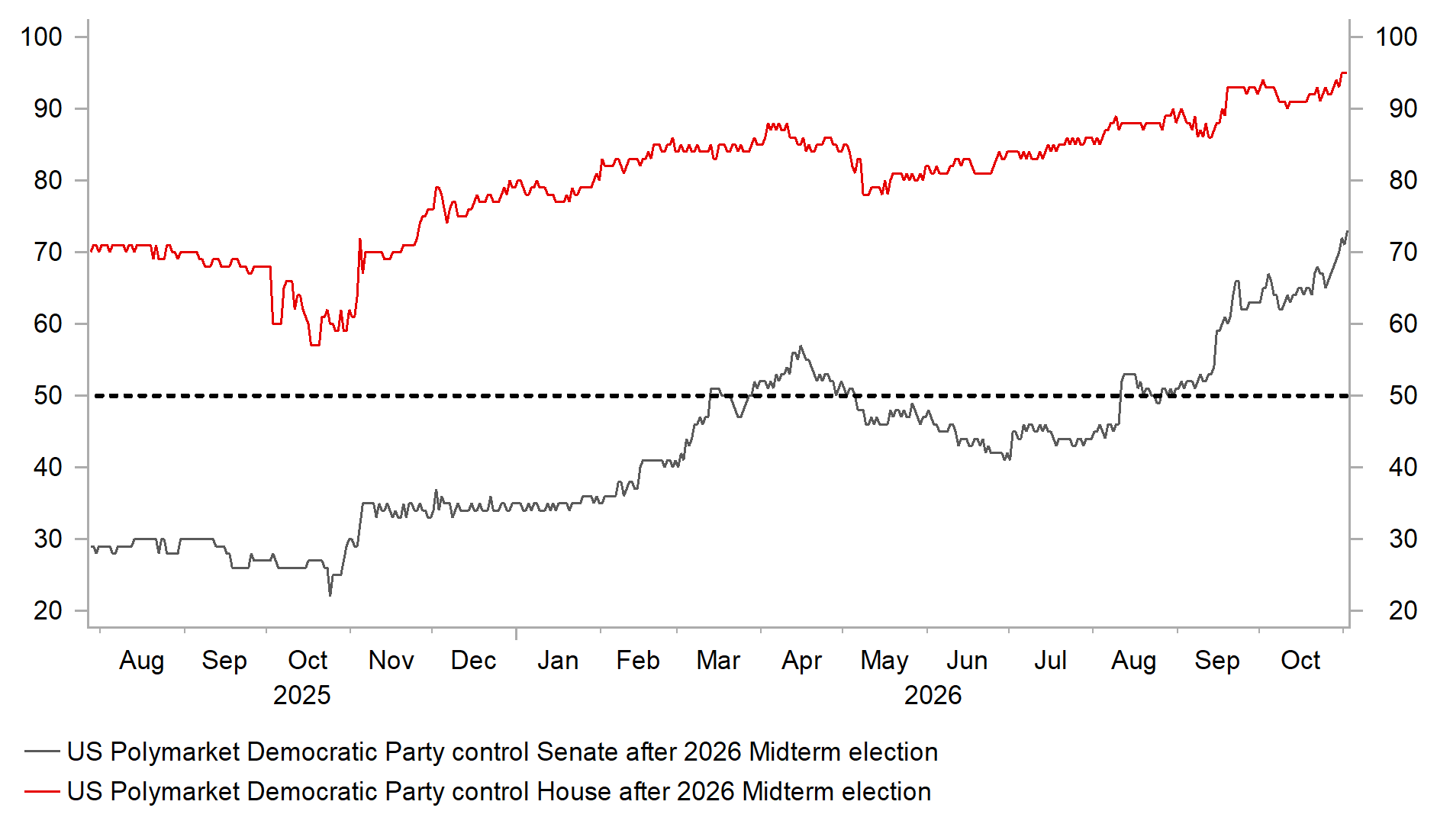
Source: MUFG Research, Macrobond, Bloomberg
EUR: Heightened fiscal risks in France remain a headwind
The euro has been lifted at the start of this week by the pullback in the price of oil which has helped to lift EUR/USD back up towards the 1.1200. Upside potential for the euro continues to be held back by heightened fiscal risks in France. The 10-year yield spread between French and German government bonds remains elevated at around 1.65%. Investor sentiment towards French government bonds will not have been helped by the ratings announcement from Fitch late on Friday. Fitch announced that they have lowered the outlook for France’s credit rating to negative while leaving the credit rating unchanged at A+. S&P currently attached the same credit rating while Moddy’s rates France one-notch higher.
Fitch noted that the negative outlook reflects a deterioration since their last review in August 2026 comprising weaker growth, higher borrowing costs and a wider deficit. Persistent political fragmentation and a challenging social backdrop were also cited as increasing the difficulty of delivering sustained fiscal consolidation. The negative outlook increases the probability of another credit rating downgrade. Fitch expects the next rating review to take place by the end-February 2027. Fitch expects the budget deficit to exceed next year’s target of 5.0% of GDP, and they forecast a wider deficit of 5.5%. It partly reflects a downgrade to their growth forecasts to 0.5% in 2026 and 0.9% in 2027. Earlier on Friday it was announced that France’ economy unexpectedly contracted by -0.1% in Q3. Additionally, higher borrowing costs will make fiscal consolidation more challenging. Fitch expects interest payments to increase to 3.3% of GDP in 2028 up from 2.5% in 2025.
KEY RELEASES AND EVENTS
Country | GMT | Indicator/Event | Period | Consensus | Previous | Mkt Moving |
FR | 08:50 | French Manufacturing PMI | (Oct) | 49.3 | 50.6 | !! |
DE | 08:55 | German Manufacturing PMI | (Oct) | 54.2 | 53.9 | !! |
EU | 09:00 | Manufacturing PMI | (Oct) | 52.4 | 52.9 | !! |
GB | 09:30 | Manufacturing PMI | (Oct) | 52.8 | 51.9 | !!! |
DE | 12:00 | German Buba President Nagel Speaks | - | - | - | !! |
US | 14:45 | Manufacturing PMI | (Oct) | 56.0 | 55.9 | !!! |
US | 15:00 | ISM Manufacturing PMI | (Oct) | 54.5 | 54.5 | !!! |
US | 15:00 | Construction Spending (MoM) | (Sep) | 0.4% | 0.9% | !! |
US | 16:15 | Fed Goolsbee Speaks | - | - | - | ! |
NZ | 21:45 | Building Consents (MoM) | (Sep) | - | 5.6% | ! |
US | 22:30 | Dallas Fed PCE | (Sep) | - | 1.90% | ! |
Source: Bloomberg & Investing.com