

Tech rout intensifies with G10 starting to look familiar
USD: AI angst intensifying risk-off – will the dollar continue to advance?
The US equity markets closed lower yesterday – on the first day of trading for the largest AI-specific IPO that has clearly failed to lift sentiment. Concerns persist over valuation in a world of higher yields and rising regulatory risks following the midterm elections. Equity markets across Asia are lower with Taiwan, Korea and Japan performing worst. The intensified selling has come at a time of a notable upturn in hawkish rhetoric from Fed officials that saw the 2-year yield jump sharply to within 7bps of the high recorded at the end of September. There has been some retracement of this move but it has been modest. Calls for a 50bp rate hike look increasingly unjustified at a time when financial conditions are tightening sharply.
From an FX perspective, the G10 performance table is starting to look very much like what you’d expect in a risk-off period – the yen, euro, and Swiss franc are three of the top performing currencies month-to-date while the Norwegian krone, Australian dollar and Swedish krona are the three worst. The worst performers are not a surprise with the equity rout spreading to the commodities space as well. Iron ore prices have fallen sharply, to levels not seen since July last year while crude oil, gold, silver and copper are all sharply down. The Bloomberg Commodities Index is down nearly 10% in November. AUD is stronger today but the broadening out of selling to the commodity space leaves AUD/USD more vulnerable to a further lurch lower. In a week in which weak employment data was reported, the relative yield driver is also pointing to AUD/USD lower – a drop to around the 0.6500-level is achievable.
But will the US dollar continue to benefit from this risk off? The resilience of the US economy and the support for the economy from AI specifically has been a key factor pushing rates higher and intensifying concerns over inflation. If this rout continues that support will certainly take a hit and with it the outlook for growth. Inflation expectations will fall notably too. There is still close to three Fed rate hikes priced which could quickly look disconnected from what’s happening in the rest of the financial markets.
In a risk-off scenario you would always expect the dollar to benefit versus the higher beta G10 currencies but it would start to suffer versus the core G10 currencies. We see the yen as best positioned and we are not surprised it is the best performing G10 currency after the dollar in November. An AI risk-off in magnitude would be disinflationary and that would help improve the outlook for the yen. If US yields fall, global yields would fall too but Japan now offers a yield it never did before. Most risk-offs since the global inflation shock have been related to inflation and higher yields but this risk-off could turn to a more standard disinflationary/deflationary risk-off that would more beneficial for the yen. We haven’t reached a magnitude yet to strengthen the yen and the market first would have to reappraise the extent of Fed tightening that would prompt a bigger correction lower in global yields.
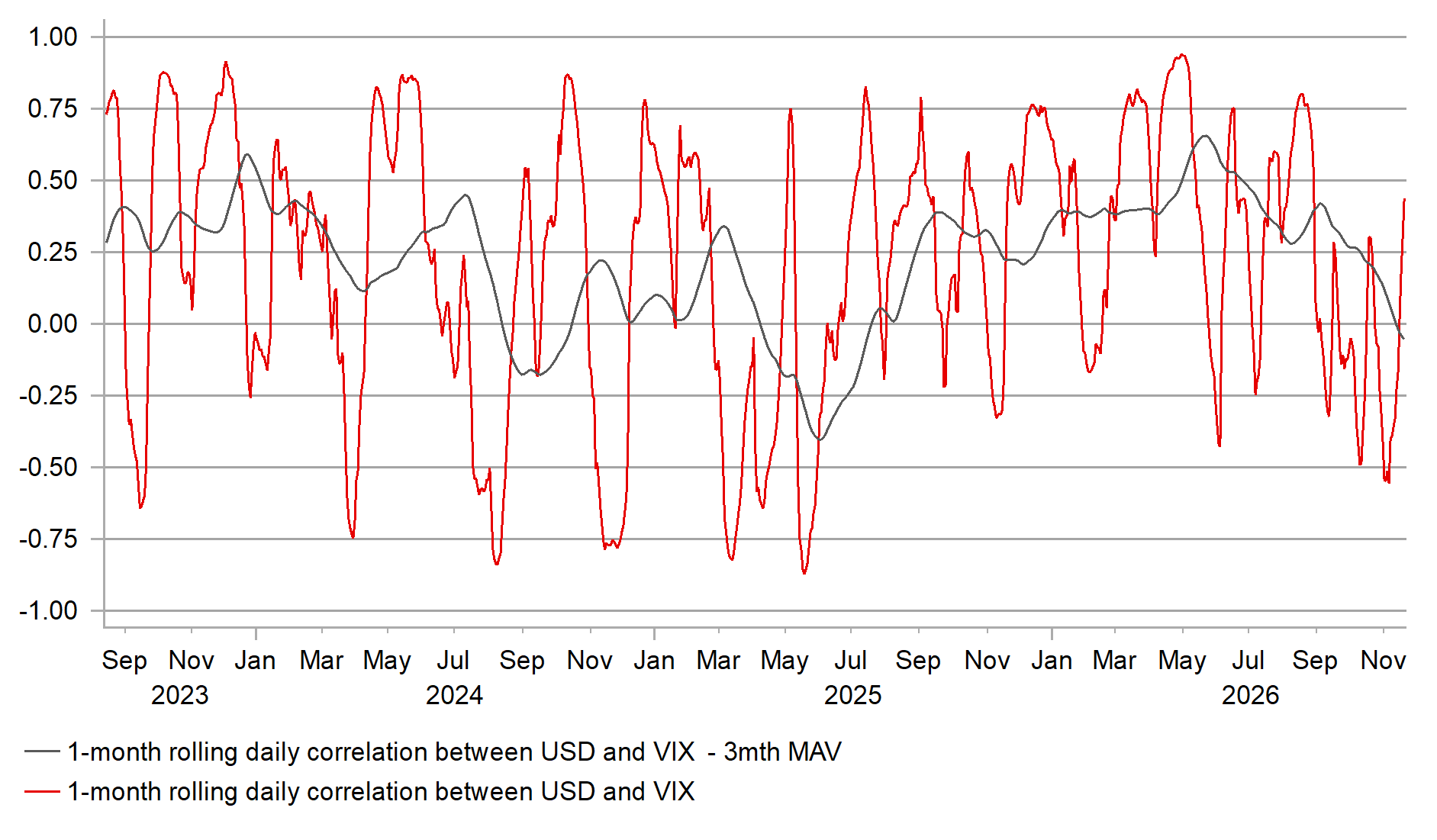
VIX / USD CORRELATION HAS BEEN STRENGTHENING OVER THE LAST MONTH
Source: MUFG Research, Macrobond, Bloomberg
EUR: Cross-border flows supportive for euro
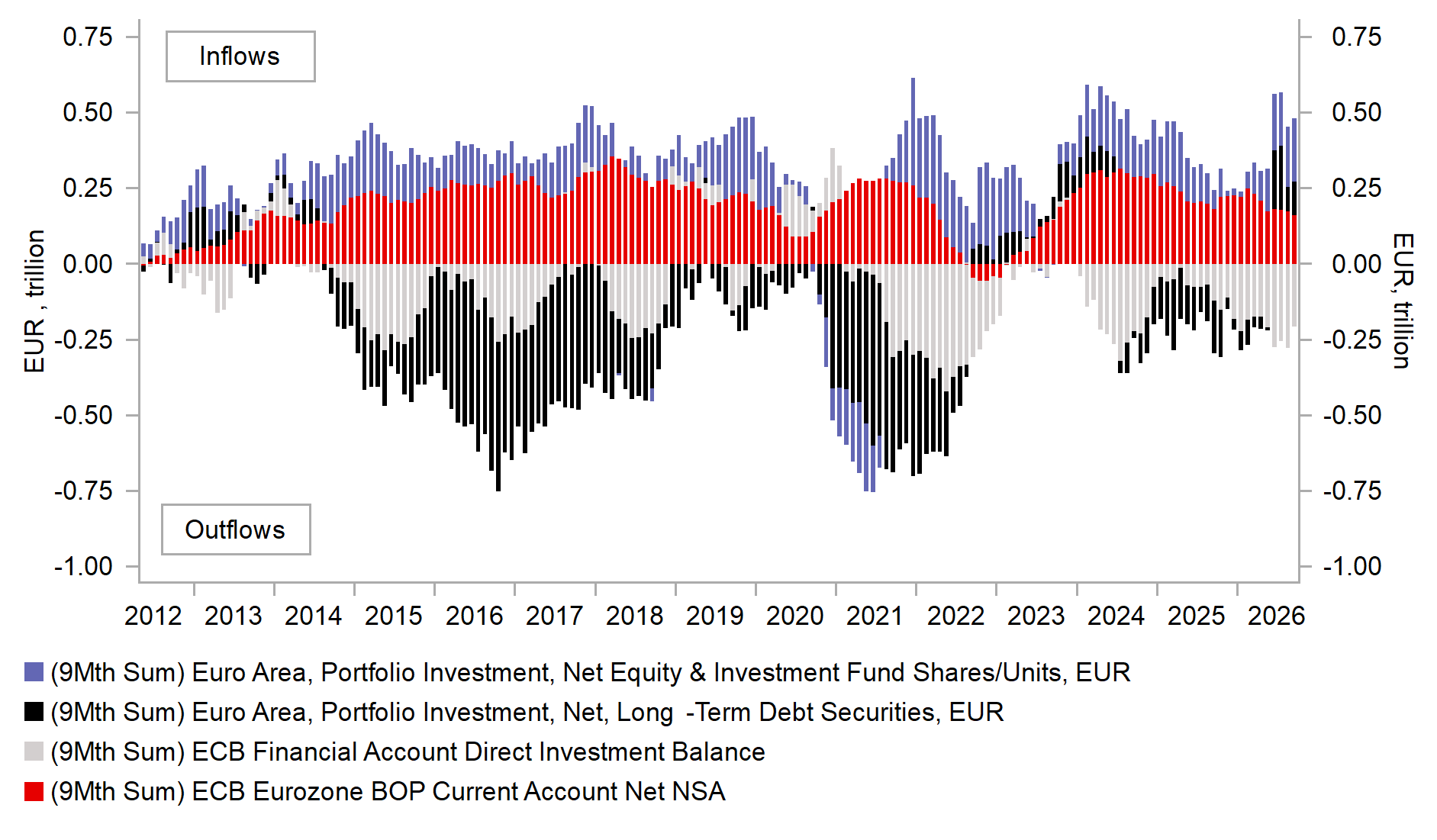
The ECB’s balance of payments data for September were released yesterday and the data indicated supportive EUR flows on a year-to-date basis in the total financial account flows – the current account, FDI account and the portfolio account. The euro-zone has run persistent current account surpluses over the years and that hasn’t changed with the current account surplus at EUR 27.5bn, down from EUR 32.6bn in September 2025. On a year-to-date basis, the euro-zone current account totalled EUR 160bn, down from 180.8bn in the same period last year, reflecting in part the deterioration in the euro-zone energy trade balance due to the jump in energy prices. As consistent as the current account surplus, the euro-zone runs an FDI deficit and the net FDI outflow abroad in September totalled EUR 35.8bn, and on a year-to-date basis net FDI outflows have totalled EUR 206bn, a notable increase in net FDI outflows compared to the EUR 122bn in the same period of 2025. Net equity inflows to the euro-zone have jumped sharply this year from EUR 65bn in 2025 to September to EUR 207bn so far in 2026. While there has been huge equity inflows into the US due to AI, the euro-zone has seen an increase but the net flows are a on a much smaller scale. On the bond side (maturities over 1 year) of the portfolio account, there was a net inflow totalling EUR 113bn to September this year in sharp contrast to a net outflow of EUR 172bn in the same period of 2025.
The net equity inflow stands out at EUR 207bn and is the largest over a 9mth period since March 2025. Net debt flows have turned negative in recent months this is more a reflection of increased buying of foreign bonds by euro-zone investors than selling by foreign investors of euro-zone debt. There are other components to cross-border flows related to hedging and speculative flows captured elsewhere but the message from these components is that foreign investor appetite for euro-zone equities and bonds has been solid on a year-to-date basis.
ON A ROLLING 9MTH WINDOW (TO CAPTURE 2026 YTD) THE EURO-ZONE IS RUNNING SURPLUSES IN C/A; DEBT AND EQUITY FLOWS
Source: Bloomberg, Macrobond, MUFG Research
KEY RELEASES AND EVENTS
Country | GMT | Indicator/Event | Period | Consensus | Previous | Mkt Moving |
EC | 10:00 | Negotiated Wages | Q3 | 2.6% | 2.44% | !! |
US | 13:25 | Fed’s Waller speaks |
|
|
| !!! |
CA | 13:30 | Retail Sales MoM | (Sep) | 0.70% | 1.20% | !! |
CA | 13:30 | Retail Sales Ex Auto MoM | (Q3) | 0.70% | 1.20% | !! |
EU | 15:00 | Consumer Confidence | (Q3) | -18 | -17.9 | !! |
US | 15:00 | U. of Mich. Sentiment | (Q3) | 51.5 | 51 | ! |
US | 15:00 | U. of Mich. Current Conditions | (Q3) | 52 | 51 | ! |
US | 15:00 | U. of Mich. Expectations | (Oct) | 51 | 50.9 | !! |
US | 15:00 | U. of Mich. 1 Yr Inflation | (Oct) | 4.20% | 4.30% | !!! |
US | 15:00 | U. of Mich. 5-10 Yr Inflation | (Oct) | 3.40% | 3.40% | !!!! |
US | 17:15 | Fed’s Cook speaks |
|
|
| !!!! |
Source: Bloomberg & Investing.com