

Yen sell-off post BoJ policy update curtailed by rate check
JPY: BoJ rate check highlights limited tolerance for renewed yen weakness
The FX majors have stabilized overnight after the pick-up in volatility at the end of last week. The yen initially weakened sharply after the BoJ’s latest policy update on Friday resulting in USD/JPY hitting a high of 158.05 but has since dropped back towards the 157.00. The trigger for the yen rebound late on Friday were reports that the BoJ had conducted a rate check during the New York trading session sending a clear signal that they are prepared to intervene again if the yen continues to weaken. The rate check should help to dampen market expectations for how much the yen will be allowed to weaken in the near-term as USD/JPY moves closer to the 160.00-level.
Speculators were encouraged to rebuild short yen positions after the BoJ’s latest policy update failed to aggressive market expectations for future rate hikes. The Japanese rate market is already pricing in 2-3 more hikes by the middle of next year, with the next hike almost fully priced in by December. It was always highly unlikely that the BoJ would indicate that they were considering back-to-back hikes as soon as next month after speeding the pace of hikes to every three months at last week’s meeting. The updated guidance from Governor Ueda on Friday left the door open for another hike before year end although it was not a strong commitment. He characterised monetary policy as entering a “new phase” focused on ensuring that inflation stabilizes at 2% rather than moving above target. Financial conditions were described as still “accommodative” while indicating that the BoJ would continue to adjust policy pre-emptively to ensure that they do not fall behind the curve. We believe that the “new phase” for monetary policy is consistent with a rate hike every three months.
Renewed yen selling after the BoJ meeting also reflected the more challenging external backdrop for the yen over the past week after the Fed finally began their own rate hike cycle and signalled at least one more hike ahead. Yields have risen more outside of Japan recently contributing to widening yield spreads against the yen even as the BoJ speeds up the pace of hikes. The combination of higher energy prices and widening yield spreads is making it more difficult for Japanese policymakers to prevent a weaker yen, and increasing pressure to intervene again to buy more time. The weak yen and higher energy prices will also keep pressure on the BoJ to deliver another hike by the end of this year. The BoJ has a window to tighten policy further until the middle of year after which two more BoJ board members will have been replaced by Prime Minister Takaichi in July 2027. The two dissents on Friday from board members Toichiro Asada and Ayano Sato who favoured leaving rates on hold were both appointed by Prime Minister Takaichi highlighting potential downside risks for the yen later in 2027.
EUR/USD IS MOVING TOWARDS BOTTOM OF TRADING RANGE
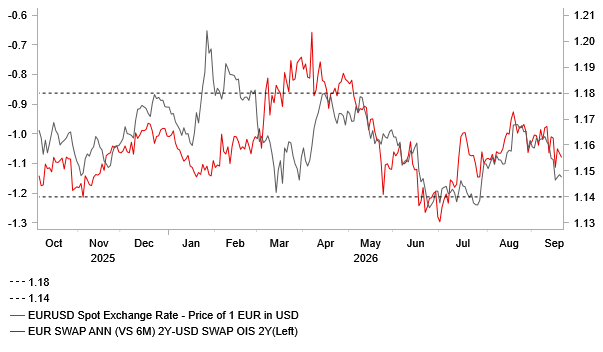
Source: MUFG Research, Macrobond, Bloomberg
EUR: German election results add to political instability risks
The euro is trading just above recent lows against the US dollar after hitting a low of 1.1455 on Friday. The pair has moved down towards the bottom of the 1.1400 to 1.1800 trading range that has been in place for the past year since the Fed began their hiking cycle last week. The uplift in US yields is helping to drag EUR/USD lower. The US 2-year yield jumped higher by around 14bps over the past week compared to an increase of around 5bps for the German 2-year yield. At the same time, the latest political and fiscal developments in European could contribute to undermining confidence in the euro in the near-term.
There is a higher risk of political instability in Germany after two more disappointing state election results for the ruling parties over the weekend. Chancellor Merz’s CDU party won just 4.9% of the vote in the north-eastern state of Mecklenburg-Vorpommern, the party’s worst result in any state election in Germany’s postwar history. It means that the CDU will fail to gain any seats in the regional parliament. Chancellor Merz described the results as a “disaster” but reiterated that “the reforms must come” while vowing to stay in office. The latest results will embolden CDU critics who blame Chancellor Merz’s low personal ratings to seek a change at the top of the party. Merz reportedly convened a meeting with party heavyweights on Sunday evening to consider lessons from the elections and to try to cement their loyalty according to the FT. The main beneficiaries were the far-right AfD party who won 38.2% of the votes in Mecklenburg-Vorpommern who became the biggest party exceeding the governing Social Democrats who dropped to 39.6%.
KEY RELEASES AND EVENTS
Country | BST | Indicator/Event | Period | Consensus | Previous | Mkt Moving |
SZ | 09:00 | Total Sight Deposits CHF | Sep-26 | -- | 451.6b | ! |
EC | 10:20 | ECB's Panetta Speaks | !! | |||
US | 11:30 | Fed's Goolsbee Speaks About Monetary Policy | !! | |||
CA | 16:20 | Bank of Canada Governor Tiff Macklem Speaks | !!! |
Source: Bloomberg & Investing.com