

USD to remain stronger for longer backed by higher US rates?
USD: Rising Fed hike expectations helping to encourage stronger US dollar
It has been a quiet start to the week in the FX market with the US dollar continuing to trade on a stronger footing after the Fed’s decision last week to begin tightening monetary policy. It has helped to lift the dollar index back above the 100.00-level for the first time since the start of August. The next important resistance level is provided by the year-date-high from 24th June at 101.80. The US dollar is deriving support from the sharp ongoing adjustment higher in US yields. The 2-year US Treasury bond yield has already increased by around 55bps since late last month as market participants have moved to price in a more extended Fed rate hike cycle. The US rate market is expecting the Fed to deliver three more hikes in the year ahead. Those expectations were supported by hawkish comments yesterday from regional Fed presidents although neither are voting members this year.
Chicago Fed President Goolsbee, who will become a voting member again from next year, warned that “supply shocks have come more frequently, hit harder and lasted longer…and once supply shocks to inflation become persistent, some of the logic behind ‘looking through’ no longer holds”. He told reporters that if price pressures are also coming from overheating demand, the Fed’s median projection for one additional rate increase may not be enough to restore price stability. He highlighted that recent inflation data, coupled with what he’s learning from businesses in his district, have increased his concern that demand in certain sectors is pushing up inflation, along with the supply-side forces. In particular he “had thought mostly the AI data centre part was staying in its lane” until recently but is now more concerned that it sounds like traditional demand overheating.
At the same time, St Louis Fed President Musalem told Reuters that “both persistent and recurring supply forces are continuing to contribute to keeping inflation risks elevated, and I judge that without further policy restraint on inflation it is more likely to be substantially above our 2% target in 18 months than at target”. He believes that “it’s crucial that policy puts a meaningful restraint on inflation”, and that “earlier and incremental policy firming is better and less disruptive than later and larger and potentially more abrupt policy action”. He judges that the current policy rate is still on the “accommodative side”.
While rising US rates are encouraging a stronger US dollar, the positive impact is being offset by expectations for further policy tightening outside of the US as well. The bigger mover overnight in the FX market has been the New Zealand dollar. The kiwi has been boosted by hawkish comments from RBNZ Governor Bremen who indicated that “if higher oil prices persist, they are expected to result in somewhat higher near-term inflation than we assumed” in September monetary policy statement”. The comments have reinforced markets expectations for the RBNZ to deliver a third consecutive 25bps rate hike at next month’s policy meeting. It follows stronger than expected growth of 0.2% in Q2 as well. The New Zealand rate market is now pricing in around 18bps of hikes for next month and just over 100bps of hikes by next summer.
HIGHER FISCAL & POLITICAL RISKS PRICED INTO FRENCH BONDS
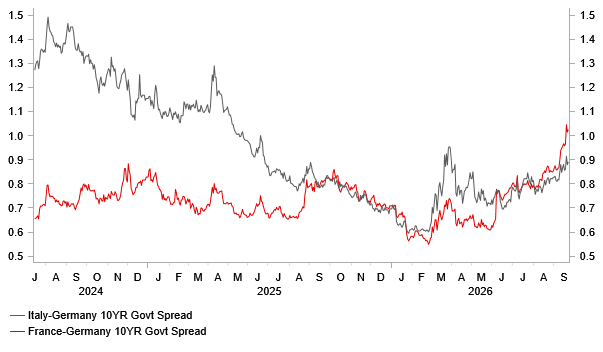
Source: MUFG Research, Macrobond, Bloomberg
EUR: ECB policy tightening & French fiscal risks
The euro is continuing to trade on a softer footing against the US dollar in the near-term hitting a low overnight at 1.1459. The pair is moving back towards the bottom of the 1.1400 to 1.1800 trading range that has been in place over the past year since last week’s FOMC meeting. Market expectations for an extended ECB tightening cycle are helping to offset the hawkish repricing of Fed rate hike expectations. The euro-zone rate market also expects the ECB to deliver three to four more hikes in the year, with over a 50:50 probability of another back-to-back hike in October priced in. ECB Chief Economist Lane has told Le Temps newspaper that “we are no witnessing a second wave of price rises, not only in oil but also in gas. We believe this second wave of energy price rises should lead to higher and more persistent inflation, before a decline toward our target from mid-2027 onwards”. He believes “the second wave of energy price rises we are witnessing today should exert upward pressure on food prices, on energy in the broader sense including electricity and on goods in general”. But remains optimistic that “pressure eon services, on the other hand, should remain contained”. He expects the euro-zone economy to continue to grow at a steady but moderate pace, provided the energy price shock does not intensify”. The resilience of the euro-zone economy so far this year to the energy price shock, is encouraging the ECB to continue tightening policy alongside upside inflation risks providing more support for the euro.
Building fiscal and political risks in Europe remain in focus but so far there appears to have been limited negative spillover impact on the euro. Bigger moves have happened elsewhere with the yield spread between Franch and German 10-year government bond widening above 100bps this month. France was downgraded by one of the minor rating agencies, Scope Ratings at the end of last week who cited concern over a “sustained deterioration in the fiscal outlook, characterized by rising general government debt, persistently high fiscal deficits and limited progress on structural reforms”. The major credit rating agencies of Moody’s and S&P are scheduled to hold their next rating reviews soon as well on 23rd October and 27th November respectively. Moody’s currently attaches a negative outlook to the rating outlook indicating a higher risk of another downgrade. Market participants are understandably pessimistic over the prospect of significant fiscal tightening being implemented ahead of and after next year’s Presidential elections. Higher yields are likely to persist adding to headwinds for France’s economy which has expanded relatively weakly this year.
KEY RELEASES AND EVENTS
Country | BST | Indicator/Event | Period | Consensus | Previous | Mkt Moving |
DE | 09:30 | German Buba President Nagel Speaks | - | - | - | !! |
EU | 12:00 | ECB President Lagarde Speaks | - | - | - | !! |
US | 13:55 | Redbook (YoY) | - | - | 8.5% | ! |
US | 15:05 | FOMC Member Williams Speaks | - | - | - | !! |
DE | 15:10 | German Buba Vice President Buch Speaks | - | - | - | !! |
US | 15:20 | Fed Governor Jefferson Speaks | - | - | - | ! |
US | 18:00 | FOMC Member Barkin Speaks | - | - | - | ! |
DE | 20:30 | German Buba President Nagel Speaks | - | - | - | !! |
Source: Bloomberg & Investing.com