

No end in sight as fixed income selling continues
JPY: Katayama reveals Trump’s concerns over yen
We start the final day of the week with some respite for fixed income markets – UST bond yields are down modestly today indicating a potential for at least a pause in the recent strong selling. Yields are currently very tightly correlated with crude oil prices and Brent crude oil is currently over 1% lower today on reports of a possible agreement between the US and Iran on a phased reopening of the Strait of Hormuz. Iranian Foreign Minister Araghchi confirmed that Iran had offered the US a new proposal for a reopening if certain conditions were met. There is natural scepticism on this and hence the drop in crude is modest so far when compared to the 10% increase over the two previous days. If there were credible reports on the US side to emerge on progress on a deal it would likely have a much bigger impact on oil and UST bond yields.
A move like that would certainly have an impact on FX and perhaps most notably in USD/JPY. The yen is already the top performer today on the comments made by Finance Minister Katayama and Growth Strategy Minister Kiuchi in Tokyo today. Katayama’s comment that President Trump expressed concern over yen weakness clearly underlines the ongoing efforts in Tokyo to portray the efforts to stem yen weakness as a continued joint strategy. That certainly reinforces the possibility that additional intervention could again include the US. It’s unusual for the US to act jointly with Japan beyond one occasion so acting jointly again would be a strong message to the markets. That’s certainly possible given the BoJ did hike last week and did indicate there was more to come. The yen weakened in response to the BoJ meeting but that was more a reflection of excessive hawkish pricing rather than Governor Ueda communicating a dovish message. He didn’t do that in our view.
The comments from Growth Strategy Minister Miura were also interesting. He was very explicit in stating that “the era of ‘Abenomics-style’ reflationary policies – which involved aggressively easing monetary policy and taking a flexible approach to fiscal policy – is over”. This could well be the kind of communication the US want to hear from Tokyo. It gains more credibility when the BoJ has hiked and yields in Japan are much more elevated – the 2-year JGB yield is now trading close to 2.00%.
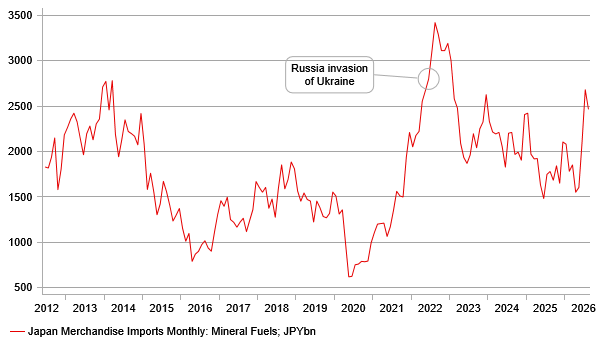
Global Markets Research released a new FX Quant publication (here) yesterday and the focus of this first edition was USD/JPY with the analysis pointing to much better prospects of a more sustained turning point in USD/JPY direction. Some of the more structural metrics have started to turn and that could open up a more sustained trend. While Fed rate hikes do counter that argument (and rising energy prices, which are driving energy imports higher), the stronger efforts by Tokyo to counter yen weakness on show today will act to counter that to some degree. US yields are up sharply this week but the yen is one of the best performing G10 currencies after the US dollar.
JAPAN’S MINERAL FUEL IMPORTS ARE RISING SHARPLY AGAIN
Source: MUFG Research, Macrobond, Bloomberg
CHF: Further encouragement for selling the franc
The Swiss franc was the worst performing G10 currency yesterday and ahead of yesterday’s SNB meeting there had been building expectations that the SNB would convey some concerns over potential inflation risks given the broader international backdrop like rising energy prices and a weaker franc. But those expectations were not met and the SNB failed to push back against a weaker currency and convey any strong message on possible future action to stem inflation risks.
Market pricing did look a little excessive – indeed the OIS market is still priced for more than two hikes by the middle of next year and you certainly did not get a sense from the communication yesterday that hikes are on the radar. The inflation forecast changes throughout most of the forecast period were the least possible – from Q3 next year the CPI YoY rate forecast was nudged 0.1ppt higher, peaking at 0.9% at the end of the forecast horizon in Q2 2029. Before Q3 next year the revisions higher were larger but the message in the forecasts is that the inflation outlook hasn’t changed much – the statement acknowledged this with the view that “Medium-term inflationary pressure have increased only slightly”.
The weakness of the franc was acknowledged with the removal of the “increased willingness” to intervene and replacing this with the “SNB is also willing to be active” in the FX markets “as necessary”.
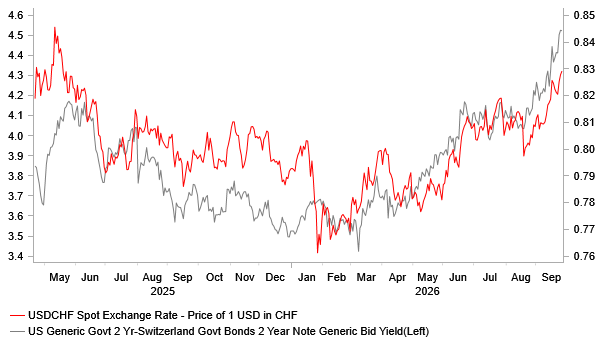
A near-term risk of the SNB being hawkish yesterday has been removed and that understandably has opened up scope for renewed franc selling. The press conference did acknowledge the impact of other central banks hiking on franc performance and there is a scenario in which the SNB does turn more hawkish. Investors now are effectively charged a bigger premium for using the franc as a safe haven and for now investors do not believe that premium is worth paying. Further rises in global yields that pushes the franc even weaker could trigger a change in SNB rhetoric. But certainly, over the short-term if global yields continue to move higher investors will see this as a green light to further franc selling.
WIDENING YIELD SPREADS KEY FOR CHF WEAKNESS THIS YEAR
Source: MUFG Research, Macrobond, Bloomberg
KEY RELEASES AND EVENTS
Country | BST | Indicator/Event | Period | Consensus | Previous | Mkt Moving |
EZ | 09:00 | M3 Money Supply (YoY) | (Aug) | 3.5% | 3.4% | ! |
EZ | 09:00 | Private Sector Loans (YoY) | (Aug) | 3.2% | 3.1% | ! |
UK | 10:15 | BoE Gov Bailey Speaks | - | - | - | !!! |
US | 10:15 | Fed's Williams Speaks | - | - | - | !!! |
US | 13:30 | Durable Goods Orders (MoM) | (Aug) | -0.3% | 1.1% | !! |
US | 13:30 | Core Durable Goods Orders (MoM) | (Aug) | 0.6% | 0.4% | !! |
US | 13:30 | Durables Excluding Defense (MoM) | (Aug) | - | 1.3% | ! |
US | 14:20 | Fed Schmid Speaks | - | - | - | !!! |
US | 15:00 | Michigan Consumer Sentiment | (Sep) | 47.8 | 51.7 | !! |
US | 15:00 | Michigan 1-Year Inflation Expectations | (Sep) | 4.6% | 4.0% | !! |
US | 15:00 | Michigan 5-Year Inflation Expectations | (Sep) | 3.4% | 3.3% | !! |
Source: Bloomberg & Investing.com