

US dollar selling remains contained as Democrats win big
USD: Market moves as expected following huge swing to Democrats
We and a lot of market participants assumed the US dollar would weaken on the back of the Democrats winning control of both the House and the Senate and that is what is unfolding this morning with the Democrats now expected to win seven seats in the Senate with all toss-up states ahead of the vote falling to the Democrats. There were big wins in gubernatorial elections as well with flips to the Democrats in Texas, Georgia, Iowa and Ohio. The Democrats have already flipped 19 seats in the House with not a single flip for the Republicans. According to the FT currently, the Democrats have won 53 seats in the Senate with the 10% of precincts still to report and have 223 seats in the House with still 20% of precincts to report.
The scale of the win for the Democrats – which has surpassed any predictions reported prior – has not been matched by the scale of moves in the financial markets. The US dollar is 0.4% weaker on a DXY basis, 10-year UST bond yields are down by 3bps and the S&P 500 future is 0.3% lower. The direction of the moves are as you’d expect but Market participants are wary of reading too much into the result and look understandably cautious over what might come immediately next. We are now entering the lame duck session of Congress which will run through the remainder of the year before the new cohort of elected officials take their seats in Congress on 3rd January.
The most obvious first unknown is whether President Trump will use this lame duck session to escalate the conflict in the Middle East. Trump has stated that “the electorate understands what I am doing in Iran” which could be an indication of further action imminently. That would certainly reverse the move lower we are seeing now in the dollar and Treasury yields. Secondly, the “Mr. Veto” comment from President Trump certainly suggests the scope for any meaningful policy initiatives from the Democrats in Congress won’t get beyond Trump’s desk. We would still argue that AI-related valuations could indeed come under pressure as investors get a vision of what might come following the next presidential election and it adds another layer of vulnerability to the positive AI momentum. But the result also means little movement the other way – we can bet against further deregulation in the AI space, and we can be sure of no new tax cuts or spending increases. Finally, fundamentals still matter and while this creates a significant shift in policy expectations, we also have a payrolls report on Friday that will be more important for near-term rates and FX moves.
So the modest scale of the moves is understandable at this point. If Trump does not attack Iran and he sees this repudiation of his policies from voters as reason to seek a deal, an extension of dollar weakness is much more likely. Might there now be greater efforts to tackle the cost-of-living problem? That’s certainly plausible. This victory for the Democrats could certainly dial down inflation risks and place greater uncertainty over the exceptionally optimistic outlook for AI that points to the potential for a further softening in yields and the US dollar.
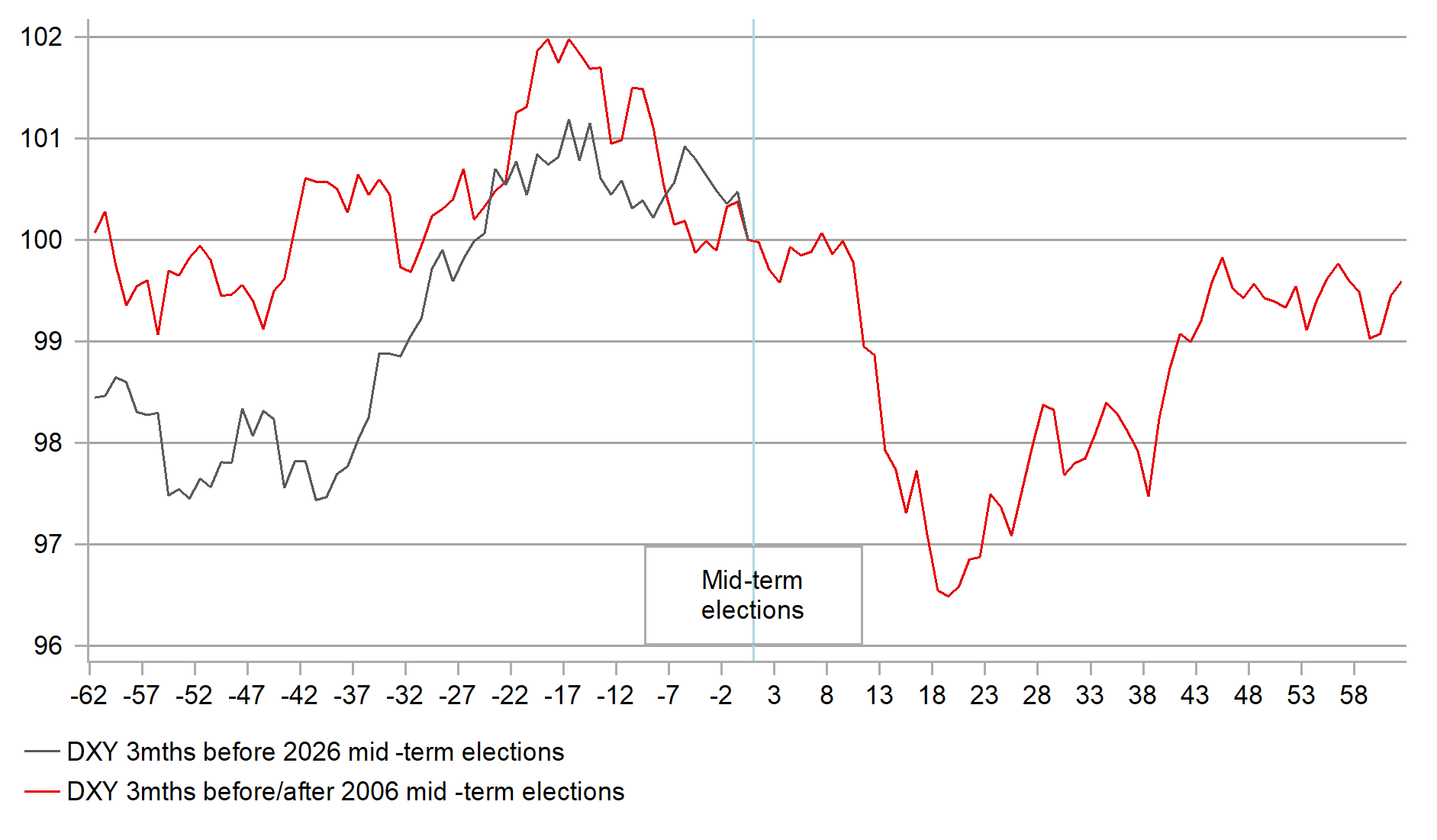
USD PERFORMANCE 2026 VS 2006 – THE LAST TIME DEMOCRATS WON BACK BOTH THE HOUSE & SENATE IN MID-TERMS
Source: MUFG Research, Macrobond, Bloomberg
JPY: Lagging yen as intervention levels approach
The mid-term election results in the US is unlikely to impact the US-Japan relationship and the strong message emanating from Washington over its opposition to the continued weakness of the yen. Unless President Trump looks to reshuffle his cabinet and remove Scott Bessent (very unlikely, but Pete Hegseth is vulnerable) then the expectations of continued resistance from Washington to yen weakness will persist. The yen managed some respite recently due to the correction of global yields after the AI-related equity market correction. What we can see once again though is that the reprieve for the yen is marginal (today’s gain is USD-related) with the rates/FX link for the yen still relatively weak. The 2-year UST bond yield is now down 35bps from the intra-day high set on 29th September. Over the same period, USD/JPY is one big figure higher. Intervention in last July / early August has distorted the link with rates but what the movement of the yen does indicate is that there are still some structural flows that continue to weigh on yen performance and those flows could well be slow to change. Wobbles in risk, like we saw in October, are not of a scale to provide support for the yen. There were some days when the yen looked to be befitting from risk-off and certainly a large risk-off would likely lift the yen. Finance Minister Katayama spoke on Monday and warned once again that Japan would act in the markets “based on the US-Japan joint statement”.
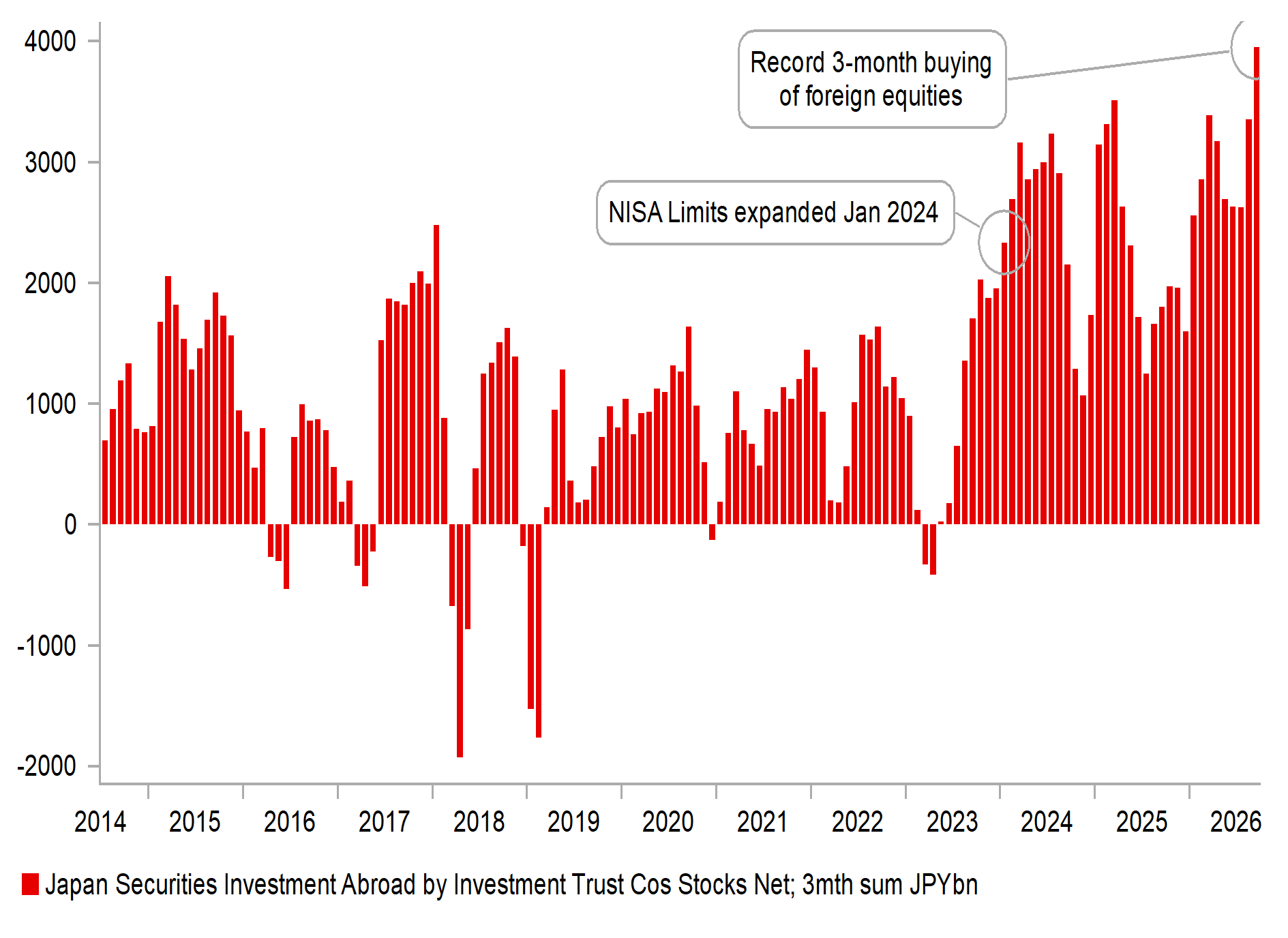
Two aspects of yen flows that continue to weigh on the yen have less to do with rate spreads. The first relates to the policy decision made by the government to triple the size of the NISA limit for Japanese households. That massive increase in the tax-free savings limit has seen a sharp increase in outflows from Japan. The latest data available shows on a 3mth sum basis to September saw foreign equity purchases of JPY 3,949bn, close to JPY 16trn on an annual basis or a little over USD 100bn. This expanded NISA limit will likely mean this scale of outflow persists given the erosion of savings held in deposit savings due to higher inflation and given strong equity market returns, in particular in the US. 47% of household wealth in Japan is in cash deposits.
The second aspect relates to FDI flows. This is another flow that is a lot less about rates and more about structural changes in Japan’s economy. The BoJ’s full edition of the ‘Outlook for Economic Activity and Prices’ was released on Monday and made reference to the acceleration in Japan’s population decline, which fell 2.5% in 2025 versus 2020, the largest 5-year decline on record in data back to 1920. FDI outflows as businesses look to expand in growing markets abroad continues to act as a bigger drag on the yen. The 12mth sum of net FDI outflows has been running between JPY 24trn and JPY 28trn per year (USD 155bn to USD 180bn) for the last three years.
We still suspect the yen is close to a turning point and market rates and/or policies by the government to encourage greater sums of capital to remain in Japan should have a positive impact on the yen. Rate spreads still matter for the yen, but as can be seen from rates and FX moves since late September, not always.
JAPAN INVESTMENT TRUST BUYING OF FOREIGN EQUITIES ON A 3MTH SUM BASIS HAS RECORDED 4 RECORD TOTAL SINCE NISA LIMIT TRIPLED
Source: Bloomberg, Macrobond, MUFG Research
KEY RELEASES AND EVENTS
Country | GMT | Indicator/Event | Period | Consensus | Previous | Mkt Moving |
GB | 09:30 | Composite PMI | (Oct) | 53.1 | 52 | ! |
NO | 10:00 | House Price Index (YoY) | (Oct) | 2.40% | ! | |
EU | 10:00 | CPI (YoY) | (Oct) | 4.00% | 3.80% | !! |
EU | 10:00 | Core CPI (YoY) | (Oct) | 2.50% | 2.50% | !! |
EU | 10:00 | CPI (MoM) | (Oct) | 0.60% | !! | |
EU | 10:00 | CPI, n.s.a | (Oct) | 104.31 | ! | |
EU | 10:00 | HICP ex Energy & Food (YoY) | (Oct) | 2.20% | ! | |
EU | 10:00 | Core CPI (MoM) | (Oct) | 0.20% | !! | |
EU | 10:00 | HICP ex Energy and Food (MoM) | (Oct) | 0.20% | ! | |
US | 13:15 | ADP Nonfarm Employment Change | (Oct) | 67K | 90K | ! |
US | 13:30 | Trade Balance | (Sep) | -107.90B | -105.60B | ! |
US | 13:30 | Exports | (Sep) |
| 315.20B | ! |
Source: Bloomberg & Investing.com