

To read the full report, please download PDF.
Fixed income selling can lift safe haven FX further
FX View:
The sell-off in fixed income eased Thursday, Friday as a spike in volatility across broader markets pushed front-end yields lower on rate hike pricing partially reversed. The blowout in the OAT/Bund spread has been much larger than expected and that leaves the euro more vulnerable to a further drop from here. The OAT selling does look like forced selling so if broader fixed income markets stabilise it might prompt some reversal. We see it as probable that the budget in France passes and RN fiscal policies (aggressive government spending cuts) could ultimately prove bond supportive. ECB action still looks a way off but an early step would be to talk back some of the hikes priced in the market – a EUR negative scenario. There is also beyond the euro of an FX impact from the OAT move and broader fixed income move. FX carry has seen some big unwinds in LatAm while the Swiss franc has benefitted most from the turmoil. The OAT price action looks overdone but near-term risks remain given the potential for further forced selling. Foreign investors could well be driving the move as the largest holder of OATs.
CHF & JPY TOP PERFORMERS AS RISK AVERSION INTENSIFIES
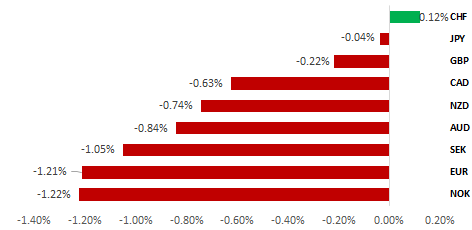
Source: Bloomberg, as of 2nd October 14:15 BST (Weekly % Change vs. USD
Trade Ideas:
We are recommending a new short EUR/JPY trade idea and maintaining our long USD/SEK trade recommendation.
JPY Flows:
This week we analyse the higher frequency or fast money flows. The MoF weekly cross border flows revealed signs of risk aversion with foreign investors heavy sellers of Japanese equities.
FX Weekly Options Flow Report:
Flows have rotated into one of the most EUR-negative readings observed in recent periods, this is consistent with the market pricing a sustained rather than transient French political risk premium.
FX Views
EUR: France vulnerability in global fixed income sell-off
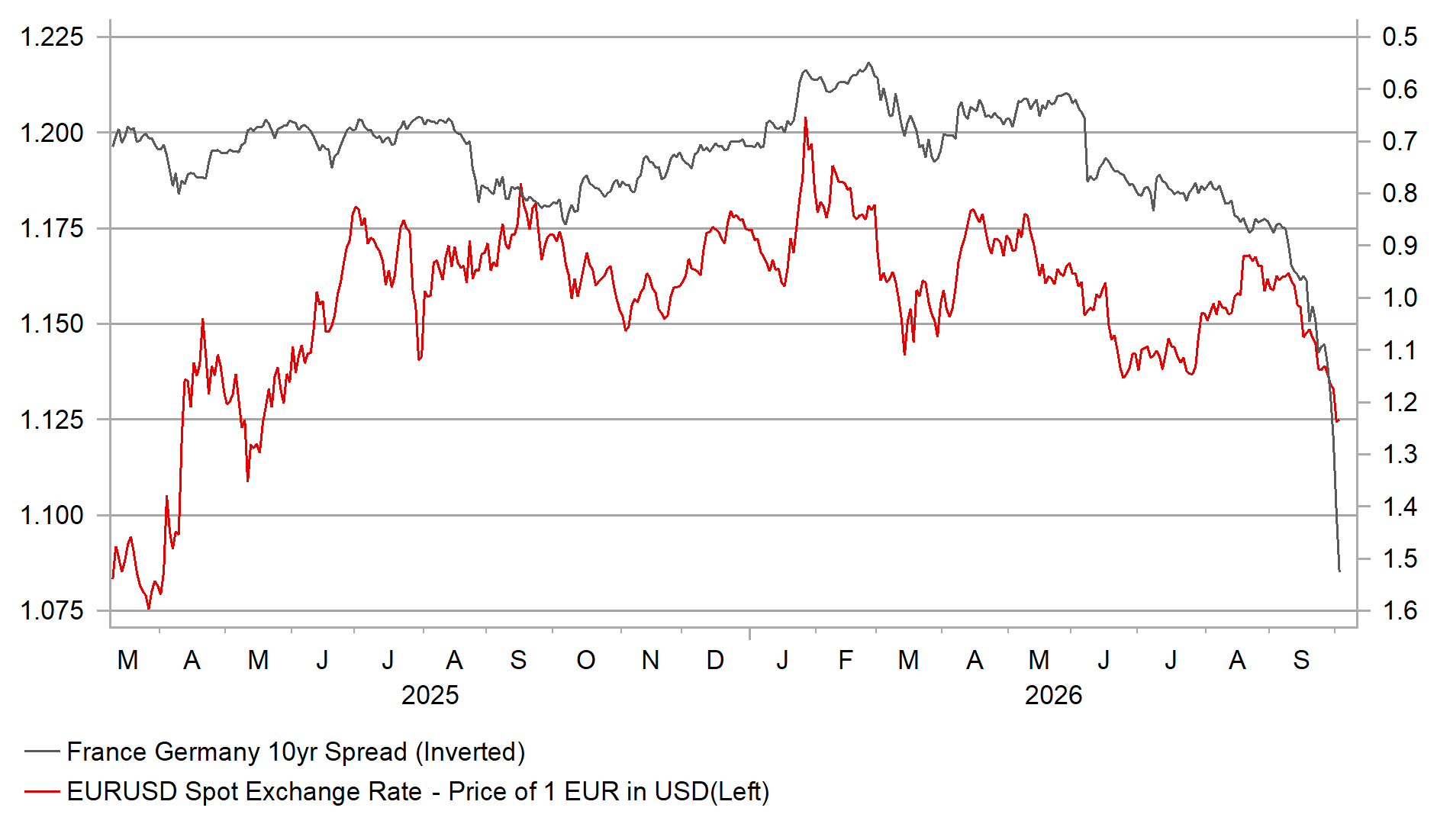
The euro performance is at the bottom of the G10 table this week versus the US dollar with the global fixed income sell-off hitting the euro-zone’ weakest link at the moment. Years of political gridlock, weak economic growth and fiscal slippage had already made global investors more sceptical of progress being made and then attempting this when we are undergoing such a brutal global fixed income sell-off. We did not expect such a sharp widening of the OAT/Bund spread in such a short period of time and the implications are clearly negative for the macro backdrop in the euro-zone. While the OAT move is the most brutal, spreads have widened sharply in Spain, Greece, Portugal and elsewhere. What are the consequences and possible actions going forward and what will the FX implications be?
The blowout in spreads is risk-off and we have been highlighting that the risks are elevated that fixed income selling spreads to wider markets. The Swiss franc and the yen are the top performing G10 currencies this week underlining the shift in momentum from higher front-end yields to lower yields. The most important factor in this chain is global equities and for now equities remain resilient although signs of risk-off are spreading. The CAC 40 is down 6% since the start of September while the S&P 500 is just 0.5% lower. Equity risks are contained for now. The first near-term implication could be the reining back of pricing on ECB rate hikes. Tightening financial market conditions due to higher longer-term yields means there is less urgency for ECB rate hikes. We abandoned our view of an ECB rate hike in October based in part on communication from President Lagarde. On 28th September Lagarde stated that higher long-term yields “will slow growth and reduce pass-through by more than projected in our September exercise”. This is the first clear communication talking back some of the rate hikes priced – the pricing of rate hikes by mid-2027 is now down 30bps from the peak on 23rd September. We’d expect more concerted communication along those lines if the fixed income sell-off resumes and that would likely exert further downward pressure on the euro initially.
Another possible implication of continued spread widening would be increased speculation on the ECB going further – altering its QT program to ease upward pressure on rates and then triggering the ‘Transmission Protection Instrument’. The passive QT program continues with the ECB allowing all maturing bonds from APP (PSPP for sovereigns) and PEPP rolling off the balance sheet. From October through to the end of next year, the ECB estimates that EUR 267.5bn will mature from PSPP and a further EUR 180.2bn from PEPP. A combined EUR 448bn of added supply to the markets over the next 15mths is considerable and any changes to its passive QT policy would have a meaningful impact on fixed income sentiment in Europe. This still seems some way off though and it is hard to envisage action like this in circumstances when the ECB’s bias is to raise rates further given upside inflation risks. A half-way house could be more likely which would involve greater flexibility within the PEPP program. Given this already allows flexibility country to country it would offer the ECB some scope to provide support where fixed income stress is greatest. Again, while more plausible it’s a scenario that would only follow the talking back of rate hikes and a notable drop in front-end yields. It would add to downward EUR pressure not only from a rates perspective but also regarding the blurring of lines on ECB independence. TPI would certainly be the last port of call. There are clear guidelines on utilising the program and while they could be fudged it would take evidence of wider turmoil in the euro-zone for that program to be engaged. It would again blur the lines of ECB independence.
JAPANESE INVESTORS HAVE REDUCED OAT EXPOSURE
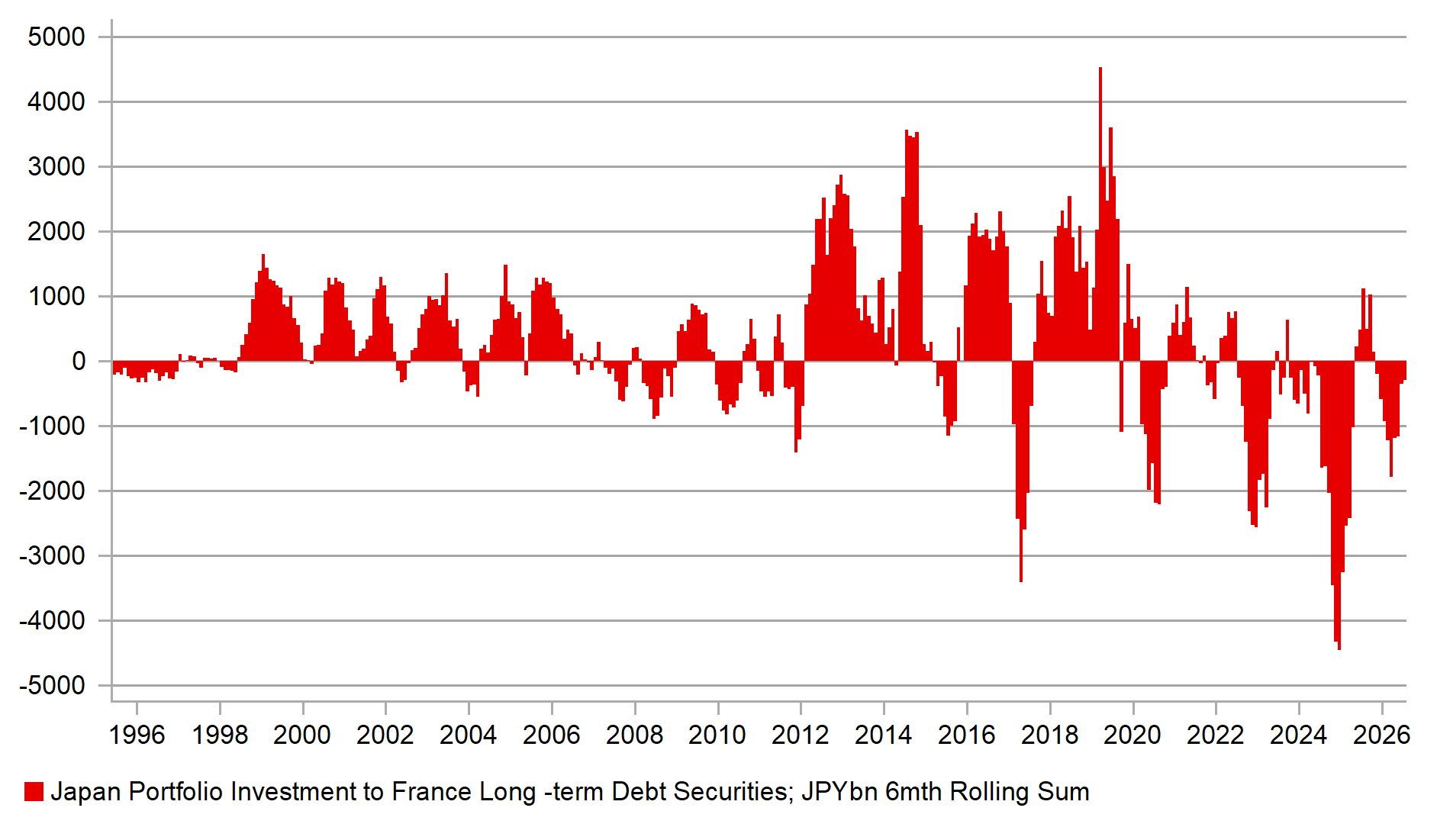
Source: FFAJ & MUFG GMR; July 2026 latest data
ECB APP & PEPP REDEMPTIONS TO DEC 27 (EURMN)
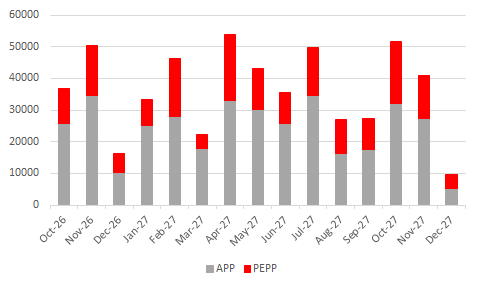
Source: ECB & MUFG GMR
With balance sheet shrinkage comes reduced liquidity and one sign of stress related to continued fixed income selling and spread widening would be fears over liquidity. The 3mth Euribor / ESTR spread would be one gauge of potential stress but there is no compelling evidence of that yet. The spread did briefly hit a high not seen since covid earlier in September, but it has declined since and has been within normal recent ranges. Banque de France data for Q1 2026 indicate that the largest exposure to OAT selling is not French banks but foreign investors. Resident banks hold 9% of the market while foreign investors hold 56%. French banks also hold a large portion on a hold-to-maturity basis and hence a much less exposed to daily market moves. Still, if the turmoil continues there are certainly risks of reduction in liquidity conditions given the overall decline in liquidity related to ECB balance sheet shrinkage.
The passing of the 2027 budget will very much depend on Marine Le Pen and RN. Le Pen has already indicated last week that she would be willing to support a less than perfect budget in order to avoid a bond market crisis. That makes sense and politically Le Pen would have little to gain from that ahead of the presidential elections in April/May next year. In a newspaper article yesterday, Le Pen promised to introduce a ‘Golden Rule’ into the constitution that would force a 0.5ppt reduction in the deficit-to-GDP ratio each year until a level is achieved that “allows the debt-to-GDP ratio to decline each year”. RN also advocate government spending cuts of EUR 125bn or 4% of GDP that would certainly help improve fixed income sentiment. That is some way off and investors may question that being achieved. Nonetheless, an election result that removes policy gridlock could ultimately be welcomed by investors. For now, the focus is on near-term risks and the continued blowout in the OAT/Bund spread today will only reinforce speculation on ECB action that will in turn ensure continued downward pressure on the euro.
3MTH EURIBOR / ESTR SPREAD RECENTLY SPIKED
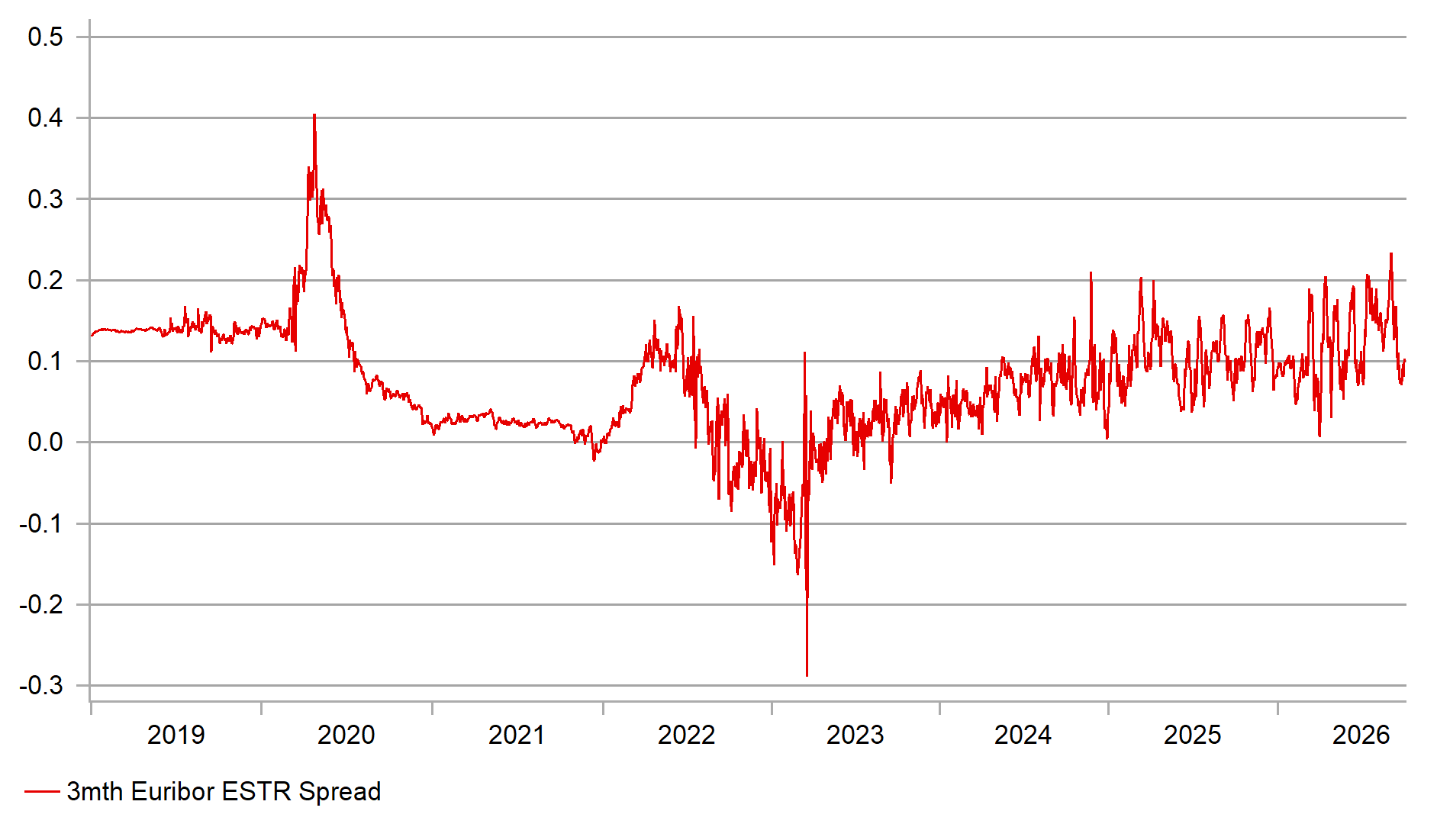
Source: Bloomberg, Macrobond & MUFG GMR
EUR PRESSURED LOWER BY OAT SELL-OFF
Source: Bloomberg, Macrobond & MUFG GMR
FX: Spillovers into FX market from rising bond yields are building
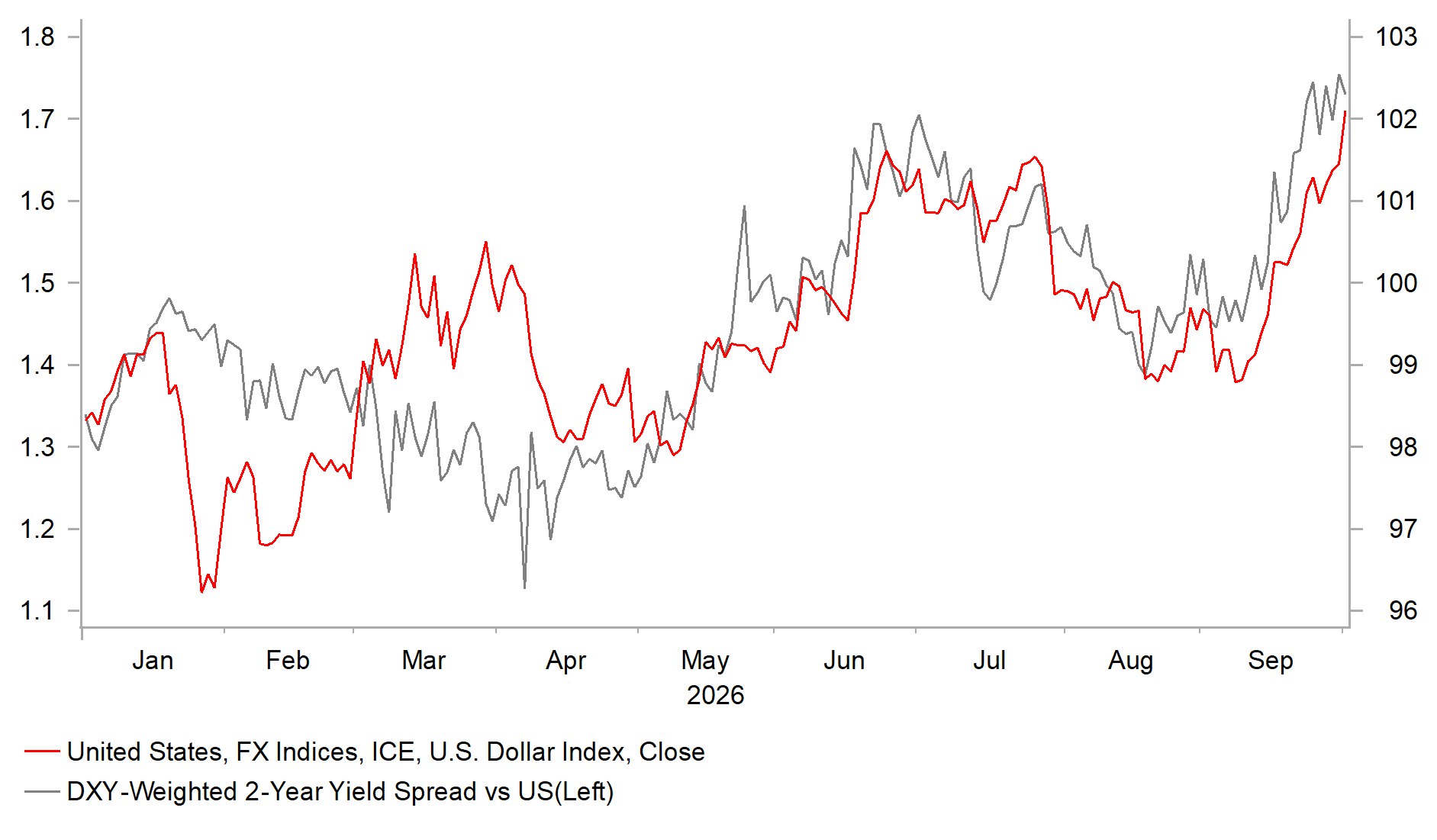
The main focus in financial markets since the summer has been the ongoing sell-off in global bond markets. Over the past week, government bond yields at the long end of the curve have reached fresh highs, moving above the peak levels seen prior to the global financial crisis in 2007. Throughout the summer, the FX market remained relatively stable as spillovers from rising bond yields were limited, but that is now beginning to change. The main beneficiary has been the USD, which has risen to fresh year-to-date highs this week, driven primarily by an abrupt hawkish repricing of Fed rate expectations. Resilient US growth and still-elevated energy prices have encouraged market participants to price in a further three to four Fed rate hikes during the current tightening cycle.
Even cautious comments from Fed officials this week on the need for further tightening, alongside softer US inflation data, have failed to significantly dampen the USD’s upward momentum. The probability of a back-to-back Fed rate hike this month has declined after New York Fed President Williams and Vice Chair Jefferson indicated that policymakers can afford to take their time before deciding whether another rate increase will be necessary later this year. In addition, methodological changes to the calculation of the PCE deflator resulted in a more pronounced slowdown in core inflation over the summer, providing some reassurance to the Fed. The core PCE deflator slowed to an annualised rate of 2.0% in the three months to August. While recent developments do not completely rule out another rate hike as soon as this month, it now appears less likely.
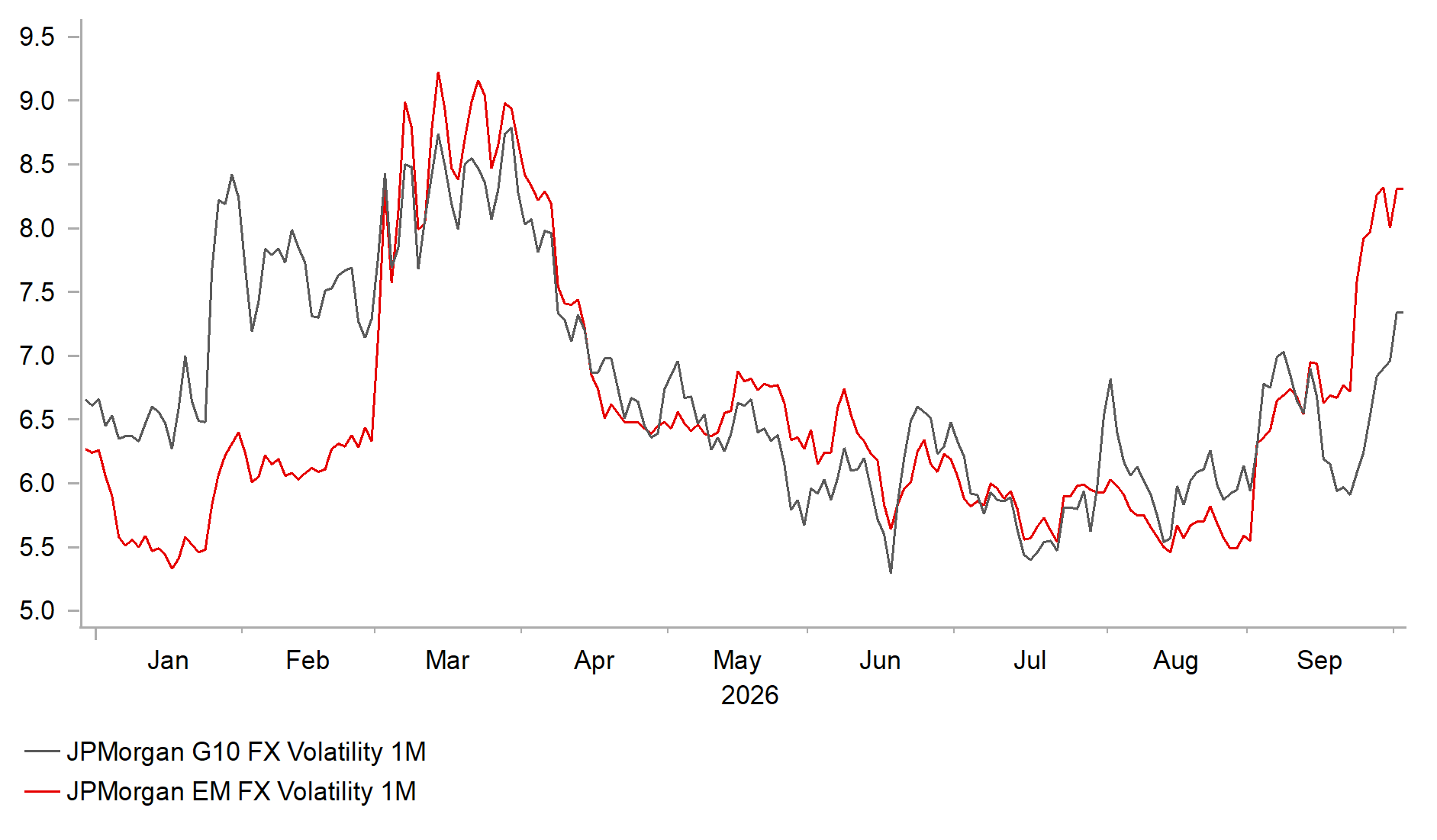
Rising bond yields are also beginning to trigger a pick-up in FX market volatility, making conditions more challenging for carry trades in the near term. The sharpest increase in volatility has been in emerging market currencies, where volatility has climbed to its highest level since the onset of the US-Iran conflict in April. Among emerging market currencies, the CLP and MXN have been hit the hardest this month. After USD/MXN threatened to break below the 17.00 level at the start of the month, it has since risen sharply, reaching a high of 18.432 this week. The MXN sell-off has been reinforced by the forced liquidation of sizeable long speculative positions that had built up ahead of the latest FOMC meeting, when the Fed resumed raising interest rates. The latest IMM positioning report revealed that long MXN positions held by leveraged funds had reached their highest level since the end of 2022. The current move higher in USD/MXN (+9.1%) is already larger than the rally triggered by the US-Iran shock earlier this year (+6.3%).
USD RISES TO FRESH YEAR-TO-DATE HIGHS
Source: Bloomberg, Macrobond & MUFG
HIGHER VOLATILITY DISRUPTS FX CARRY TRADES
Source: Bloomberg, Macrobond & MUFG
In contrast, other high-yielding emerging market currencies, such as the BRL, have held up better so far. Support has come from improving terms of trade driven by higher commodity and energy prices, as well as growing investor optimism surrounding this month’s presidential election. The perceived likelihood of President Lula winning re-election has declined, helping to ease investor concerns over the future direction of fiscal policy in Brazil.
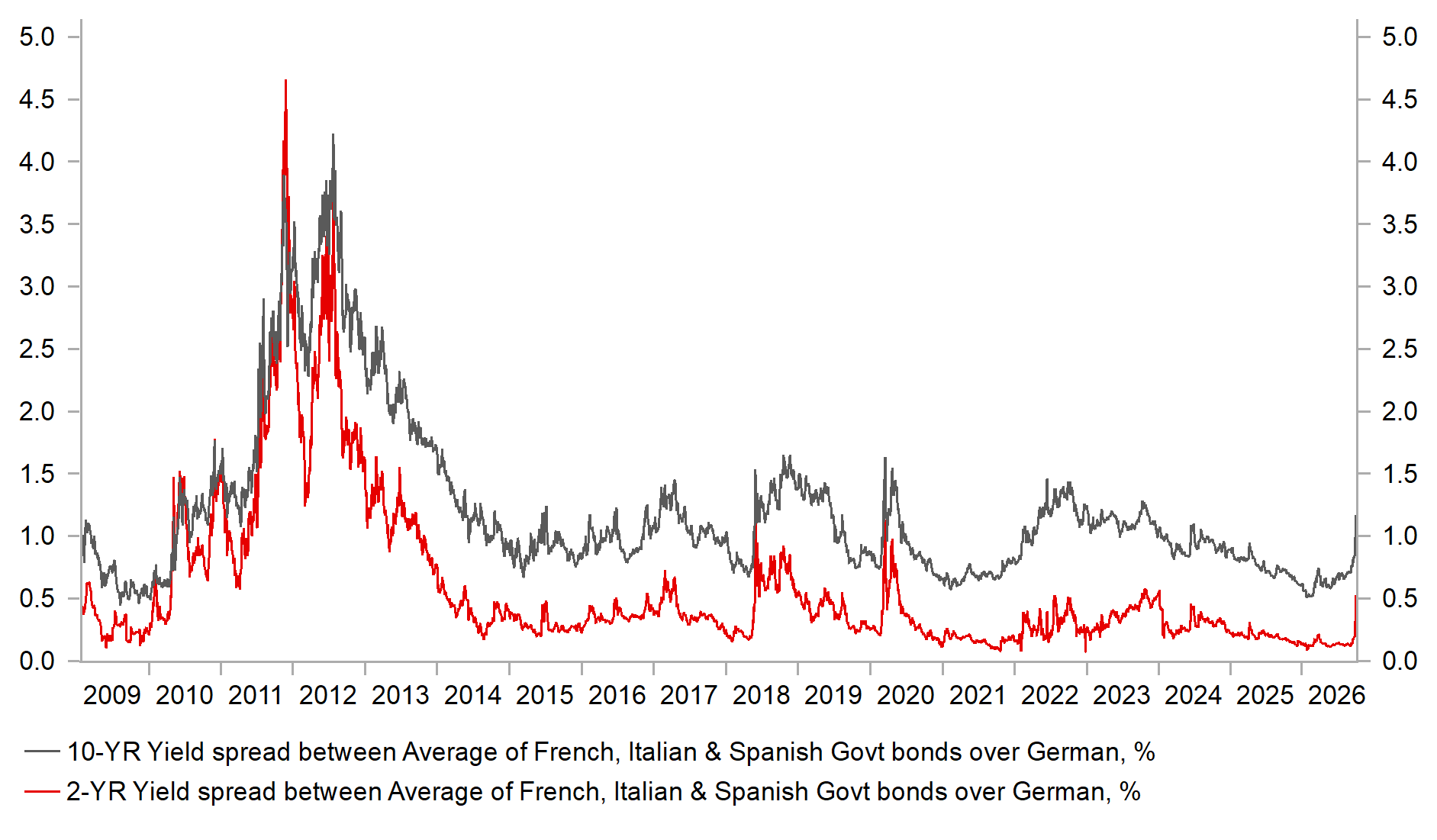
One other channel through which rising bond yields are beginning to have a greater impact on the FX market is by reigniting concerns over fragmentation risk in the euro area. French government bonds have been at the epicentre of the global bond market sell-off. The yield spread between 10-year French and German government bonds has widened sharply towards 150bps and has almost doubled over the past month. It is now trading at its widest level since the most intense phase of the euro-area sovereign debt crisis in 2011. Furthermore, yield spreads have also started to widen at shorter maturities and across other European countries, including Italy. If this widening continues to broaden, it will heighten concerns among both market participants and the ECB over fragmentation risk.
President Lagarde noted earlier this week that the rise in long-term bond yields since last month’s policy meeting “will slow growth and reduce pass-through by more than projected in our September exercise”. As a result, we no longer expect the ECB to raise rates again as soon as this month, even though euro-area inflation surprised to the upside in September, rising to a fresh high of 3.8%. In the ECB’s adverse scenario published in September, updated staff projections showed inflation peaking at just above 4.0% if energy prices remain close to current levels.
Higher bond yields are helping to do some of the ECB’s work by tightening financial conditions across the euro area. This supports our view that euro-area rate markets had gone too far in pricing in three to four additional ECB rate hikes. An abrupt reassessment is now underway, resulting in the 2-year German government bond yield falling sharply, by around 35bps from last week’s high of 3.35%.
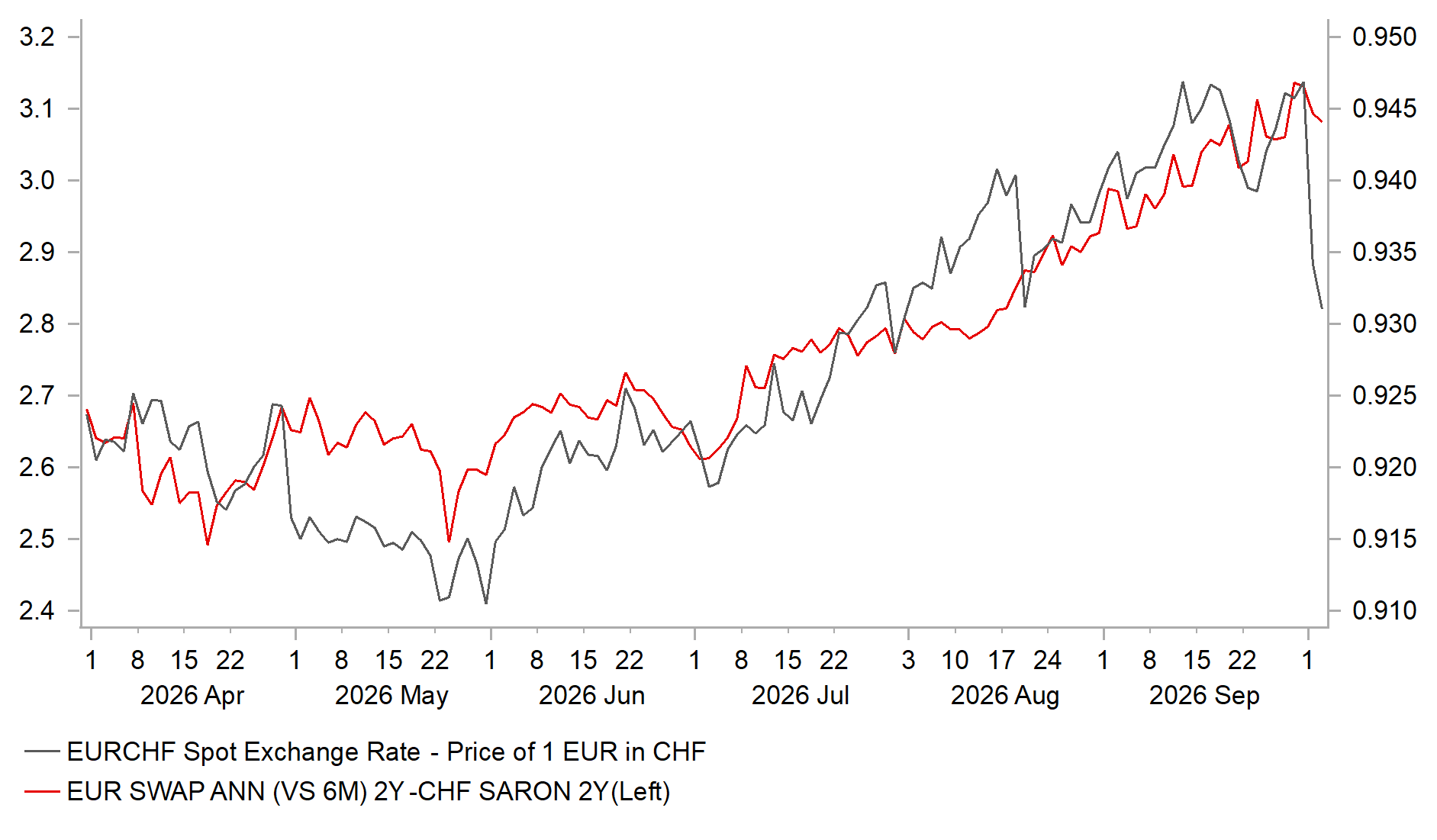
The decline in short-term yields is one reason why the EUR has weakened over the past week. It has been the second-worst performing G10 currency, alongside the other European currencies, the NOK and SEK. In contrast, the traditional regional safe-haven currency, the CHF, has outperformed. This marks a sharp reversal for the CHF, which had weakened over the previous four months. The SNB’s reluctance to raise rates had made the franc an increasingly attractive funding currency, but renewed concerns over fragmentation risk in Europe have since triggered a reversal of that trend. Market participants will now be watching closely to see how policymakers in Europe respond to these risks.
ASESSING BROADER FRAGMENTATION RISK
Source: Bloomberg, Macrobond & MUFG
SAFE HAVEN DEMAND TRIGGERS CHF REVERSAL
Source: Bloomberg, Macrobond & MUFG GMR
Weekly Calendar
Ccy | Date | BST | Indicator/Event | Period | Consensus | Previous | Mkt Moving |
EUR | 05/10/2026 | 09:00 | ECB's Lane Speaks | !!! | |||
EUR | 05/10/2026 | 09:00 | S&P Global Eurozone Services PMI | Sep F | -- | 53.0 | !! |
EUR | 05/10/2026 | 09:30 | Sentix Investor Confidence | Oct | -- | 5.1 | !! |
GBP | 05/10/2026 | 09:30 | S&P Global UK Services PMI | Sep F | -- | 51.7 | !! |
EUR | 05/10/2026 | 10:00 | ECB'S Schnabel Speaks | !!! | |||
USD | 05/10/2026 | 15:00 | ISM Services Index | Sep | 55.0 | 55.4 | !!! |
EUR | 06/10/2026 | 07:00 | Germany Factory Orders MoM | Aug | -- | 2.5% | !! |
EUR | 06/10/2026 | 07:45 | France Industrial Production MoM | Aug | -- | -0.4% | !! |
EUR | 06/10/2026 | 10:00 | Retail Sales MoM | Aug | -- | -0.6% | !! |
USD | 06/10/2026 | 13:30 | Trade Balance | Aug | -$83.8b | -$88.6b | !! |
CAD | 06/10/2026 | 13:30 | Int'l Merchandise Trade | Aug | -- | 0.77b | !! |
USD | 06/10/2026 | 14:05 | Fed's Williams Moderates Panel | !!! | |||
JPY | 07/10/2026 | 00:30 | Labor Cash Earnings YoY | Aug | 3.7% | 4.3% | !! |
SEK | 07/10/2026 | 07:00 | CPI YoY | Sep P | -- | 0.3% | !! |
EUR | 07/10/2026 | 07:00 | Germany Industrial Production SA MoM | Aug | -- | -1.1% | !! |
USD | 07/10/2026 | 19:00 | FOMC Meeting Minutes | -- | -- | !!! | |
JPY | 08/10/2026 | 00:50 | BoP Current Account Balance | Aug | ¥3224.6b | ¥2988.9b | !! |
EUR | 08/10/2026 | 07:00 | Germany Trade Balance SA | Aug | -- | 21.1b | !! |
GBP | 08/10/2026 | 09:30 | BoE Credit Conditions Surveys | !! | |||
EUR | 08/10/2026 | 11:00 | ECB's Lane Speaks | !! | |||
EUR | 08/10/2026 | 12:30 | ECB Publishes Account of Sept Meeting | !! | |||
GBP | 08/10/2026 | 13:15 | Governor Bailey Speaks | !!! | |||
USD | 08/10/2026 | 13:30 | Initial Jobless Claims | -- | -- | !! | |
USD | 08/10/2026 | 18:40 | Fed's Musalem Speaks | !!! | |||
NOK | 09/10/2026 | 07:00 | CPI Underlying YoY | Sep | -- | 3.0% | !! |
CAD | 09/10/2026 | 13:30 | Net Change in Employment | Sep | 5.0k | -41.7k | !!! |
USD | 09/10/2026 | 15:00 | U. of Mich. Sentiment | Oct P | 48.0 | 48.1 | !! |
Source: Bloomberg & MUFG GMR
Key Events:
The economic calendar for the week ahead is relatively quiet, with no major economic data releases or central bank policy decisions scheduled. However, the outlook for Fed policy is likely to remain a key focus for markets following the release of the September nonfarm payrolls report. New York Fed President Williams has indicated that there is no urgent need for further rate hikes following the Fed’s first increase this month, supporting the case for policymakers to leave rates on hold at the upcoming meeting.
The release of the minutes from the September FOMC meeting should provide further insight into policymakers’ thinking on the future path of policy tightening. In addition, remarks from New York Fed President Williams, St. Louis Fed President Musalem, and Dallas Fed President Logan are all scheduled in the week ahead and could offer further guidance on the policy outlook.
On the data front, the main US release will be the ISM services survey for September. Business confidence strengthened over the summer, with the latest US PMI survey showing activity at multi-year highs in September. This has helped to reinforce investor confidence that the US economy is holding up better than expected in Q3. The latest GDP data also revealed that the economy has expanded at an annual pace of just over 2% over the past year.
Outside the US, market participants will also be closely monitoring comments from ECB and BoE officials. ECB President Lagarde has pushed back against expectations of another rate hike as soon as this month, despite September inflation surprising to the upside. Instead, she has highlighted the tightening in financial conditions resulting from higher bond yields as a growing restraint on economic activity and inflation.
BoE Governor Bailey has already indicated that it is becoming increasingly difficult to ignore upside inflation risks. We expect the BoE to deliver its first rate hike in November. Policymakers are also likely to pay close attention to the UK government's Autumn Budget, which is scheduled for 28 October. Details of the government's fiscal plans could begin to emerge through media leaks in the coming weeks. At the same time, the sharp rise in gilt yields over the summer has reduced the government's room for manoeuvre on fiscal policy, increasing the importance of the Budget for both the rates and currency markets.