

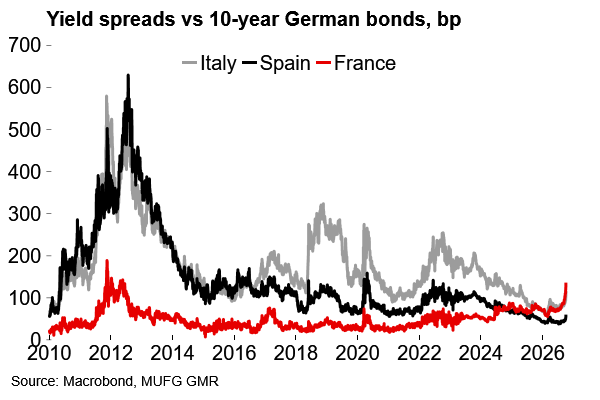
The French government has now set its draft budget for 2027, the last before next year's presidential election, against a difficult backdrop of soaring borrowing costs, stalling growth and rising inflation. The 10Y yield spread over Germany has risen to 150bp, the highest since 2012.
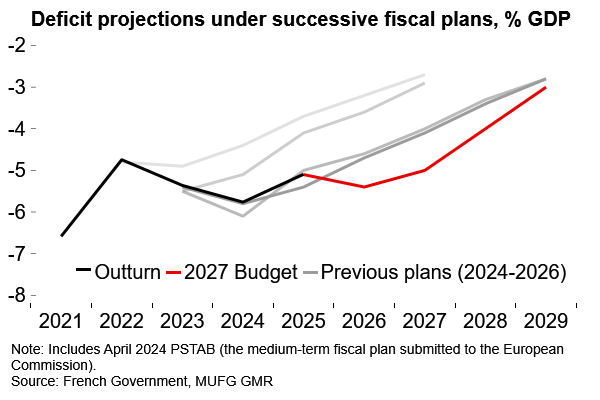
The government is targeting a deficit reduction from 5.4% of GDP in 2026 to 5.0% in 2027, with a return to the EU's 3% threshold by 2029, underpinned by a consolidation effort split roughly 60/40 between spending cuts and revenue measures.
This should be treated as an opening bid in the context of the fragmented parliament, with all measures open for negotiation. Le Pen's apparent embrace of fiscal consolidation and the proximity of the 2027 election suggest a less obstructive stance than in recent years. The first revenue vote on 20 October will be an early indication of whether there is some landing ground.
We are sceptical on both the planned pace of adjustment and the macro assumptions. The government's forecast of growth accelerating from 0.5% to 1.0% in 2027 looks optimistic against a backdrop of political uncertainty, fiscal drag and rising borrowing costs. We see risks skewed to the downside relative to our own 0.7% estimate for 2026.
On the ECB, we certainly see a high bar for direct intervention. Spreads, while elevated, reflect identifiable fiscal and political risks rather than market dysfunction, and the ECB will be reluctant to act in a way that could be perceived as supportive of France ahead of the election.
France ultimately requires a multi-year fiscal consolidation challenge in a fragmented political environment and at a time of rising borrowing costs. The budget process ahead will be a test of market tolerance for slippage.
The government makes its opening bid
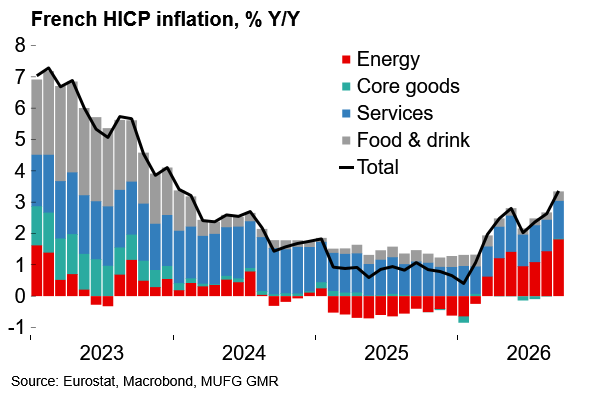
The French government presented its final draft budget before next year’s presidential election. It certainly comes at a difficult moment with soaring borrowing costs, growth stalling and inflation picking up to a two-year high. The 10-year yield spread over German bonds has moved towards 150bp, the widest since the eurozone crisis.
The government is targeting a reduction in the deficit from 5.4% of GDP in 2026 to 5.0% in 2027, while maintaining its objective of returning to the EU's 3% threshold by 2029. To achieve this, it has announced a consolidation package worth €54bn, including €43bn of new measures. Roughly 60% of the adjustment comes from spending measures and 40% from revenue measures. The plan involves reducing pension uprating, freezing public sector wages and an extended levy on large companies.
This should of course be seen as an opening bid rather than the final package given the fragmented nature of parliament. Finance minister Lescure has stated that all measures are open for negotiation.
In terms of the next steps, the budget now enters the parliamentary phase. Full debate in the National Assembly on the revenue section begins on 13 October, before moving on to spending measures and the social security budget. Various procedural steps will fall in November and December before the hard deadline for adoption of year-end. If that proves unachievable, emergency fallback arrangements would again be required. That means either a special law as a bridging mechanism to buy time, at the cost of fiscal slippage, or the extreme, unprecedented fallback of forcing the budget by ordinance.
French spreads have reached long-term highs
Inflation is rising, primarily due to energy
The politics – can the government find tolerance in a divided parliament?
Our base case remains that a somewhat modified version of the budget will eventually be adopted with the government using Article 49.3 to push through parts without a formal vote, mirroring the process in recent years. If recent history is any guide, it will be a bumpy process. Looking at the initial reaction from other parties, there has been notable scepticism from the left on the scale of planned spending restraint, including from the Socialists whose decision not to support a censure motion ultimately allowed the last budget to pass earlier this year.
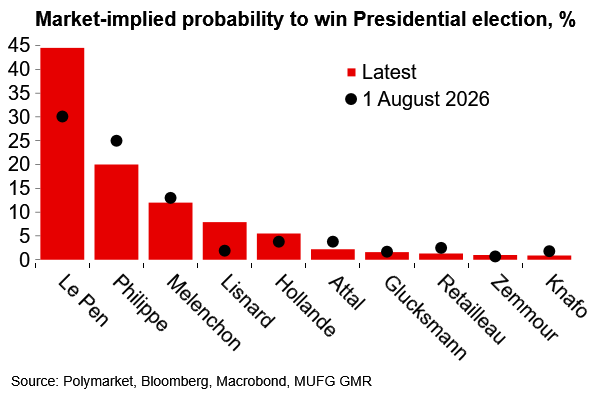
The government may instead seek tolerance from Marine Le Pen’s RN party. RN has previously been obstructive – e.g. when toppling Barnier’s government in December 2024 – but the proximity of the election changes the dynamic. We wrote some initial thoughts on the 2027 election in July (see here). Since then, polling suggests Le Pen is in a better position to be the next President of France. Polymarket now implies a probability of close to 45%. Le Pen will be aware that slippage and uncertainty would only make the fiscal inheritance even more difficult. That could point to a less obstructive approach.
Indeed, in an editorial published yesterday Le Pen seemed to embrace consolidation, arguing that the current debt trajectory is unsustainable. She set out a ‘golden rule’ of a minimum 0.5pp annual reduction to the deficit. This would be somewhat slower – but arguably more plausible – than the government’s proposal, e.g. 3.9% vs 3.0% in 2029. That suggests there could be some room for compromise and it does seem possible that Marine Le Pen’s National Rally party will eventually facilitate the passage of the budget, or something like it, to indicate fiscal responsibility and a readiness to govern. The first vote, on the revenue section, will be held on 20 October and will give an indication of how the land lies.
Le Pen is the front-runner to win the presidential election
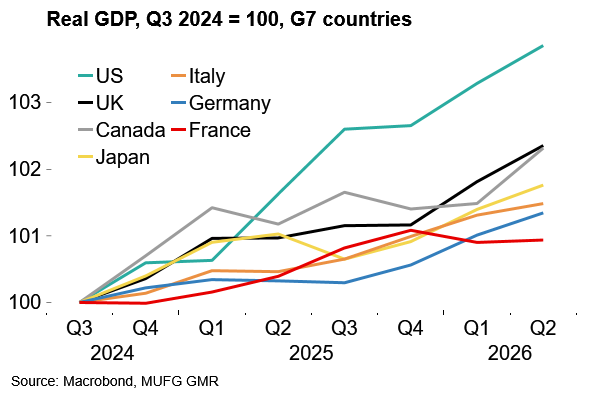
French growth has underperformed G7 peers since the snap election
Where does the growth come from?
Turning back to the budget itself, we are sceptical about both the appetite for the planned pace of deficit reduction (roughly 2pp between 2027 and 2029) in parliament and the macroeconomic assumptions underpinning it. We share the concern of France's independent fiscal watchdog, the HCFP, that the growth assumptions underpinning the plan look optimistic. The government’s scenario assumes growth accelerates from 0.5% in 2026 to 1.0% in 2027. We have a figure of 0.7% in 2026 – and judge that risks around that are skewed to the downside. The government stated that domestic demand is expected to become the principal driver of growth, in particular through consumption and business investment. That certainly seems a tough sell against a backdrop of political uncertainty, fiscal consolidation, rising inflation and the recent uptick in borrowing costs. Since the 2024 snap election the French economy has underperformed all other G7 countries. Persistent political uncertainty, repeated budget disputes and looming consolidation have weighed on confidence and investment.
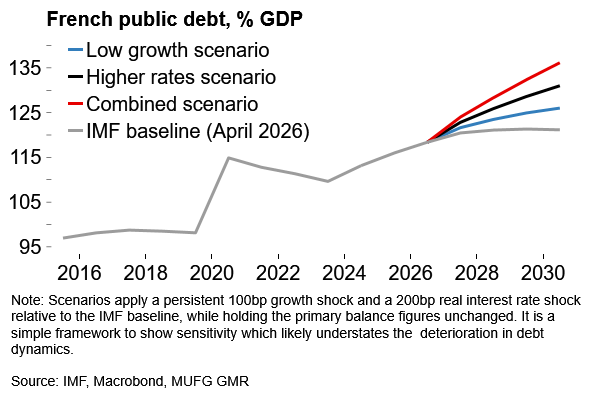
While we see a path for this budget to be adopted in some form, we stress that it’s only part of the story. To restore fiscal credibility in France will require a multi-year fiscal adjustment in a fragmented political environment. There’s not much room for error. The government estimates that a 100bp increase in interest rates would add around €3bn to debt servicing costs in the first year and €12bn after two years. That illustrates the sensitivity of the fiscal outlook to financing conditions. Another way to look at it is using a simple debt dynamics framework. Using the IMF’s projections as a starting point, a persistent 200bp increase in real borrowing costs would push the debt ratio above 130% by 2030, even assuming no deterioration in the primary balance.
Fiscal consolidation has been repeatedly deferred
Debt stabilisation – there is little room for error
A high bar for ECB intervention
It’s certainly a challenging situation but to our minds it remains a high bar for direct ECB intervention. While French spreads have widened materially over the past year, they remain below the levels seen during previous episodes of stress in other euro area countries and can be reasonably attributed to fiscal and political risks rather than obvious market dysfunction. France is still funding itself comfortably with recent auctions being well covered. It would be a tough sell to claim that monetary policy transmission is being impaired in the way envisaged by instruments such as the TPI. Some adjustments to the QT process would be more likely, however the ECB will be reluctant to be seen as adjusting policy in a manner that could be seen as supportive for France ahead of the presidential election. Lagarde’s nationality is an additional factor here. But the fact we are even talking about this is another indication of how difficult France’s fiscal position has become.
For now, ECB officials have started to point to tighter financial conditions as doing some of the tightening work for them which has taken out some market pricing for hikes this year (see here).