

UK GDP came in at 0.7% Q/Q in Q3, up from 0.5% in Q2 and in line with our forecast and the consensus. Business services remained the standout performer with the ONS explicitly flagging AI and cloud computing as drivers. This dynamic certainly helps put a shine on the headline numbers, but the details suggest that UK growth is broader than a simple AI story.
The consumer side remains the key risk. Energy bill increases in January will push headline inflation to a peak of around 4.5% on current tracking. Still, the economy is carrying a good degree of momentum and the wider theme of UK resilience looks intact heading into next year. We expect GDP growth of 1.6% in both 2026 and 2027, somewhat above current consensus.
The release does not materially change the BoE outlook. The 0.7% print was in line with the MPC's own projection published last week and policymakers will remain focused on underlying inflation pressures. We expect some evidence of firmer core inflation over coming months as indirect effects from the energy shock start to emerge, but, ultimately, we expect second-round pressures will remain contained. One further 25bp rate hike to 4.25% remains our base case and we continue to lean towards February over December.
Business services continue to drive the UK economy
The UK economy expanded by 0.7% Q/Q in Q3, up from 0.5% in Q2, in line with our expectations and the consensus. On an annual basis, growth reached 1.9%. It’s an encouraging set of numbers. Over the course of this year, the UK has broadly kept pace with the US and outperformed G7 European economies.
In terms of the details, there remains a strong business services narrative with growth of 1.0% Q/Q (versus 0.5% for consumer-facing services). Within that, administrative and support services, information and communication, and professional/scientific/technical activities were the largest contributors to growth.
There is no doubt that there is a big AI element to this. The ONS explicitly noted that many of the firms reporting the strongest turnover growth are involved in activities related to artificial intelligence and cloud computing. This follows the BoE’s assessment last week that AI-related activities could account for around a fifth of UK growth this year. Monthly data for September showed some pullback in information and communication activity. However, this remains one of the strongest-performing sectors over the quarter as a whole and monthly GDP data are notoriously volatile.
Looking across the numbers, it does look broader than just an AI/business-services story, however. Growth was broad-based from an expenditure perspective. As well as strong investment (1.7% Q/Q), both household and government consumption rose by 0.6% Q/Q. On the production side it’s also worth noting that manufacturing has quietly been a better spell as well (0.9% Q/Q), helped along by the global capex cycle. The main blemish remains construction where output fell by 0.7% Q/Q, despite dry weather over the summer, with higher financing costs likely still weighing on parts of the sector.
UK growth has remained firm through the year
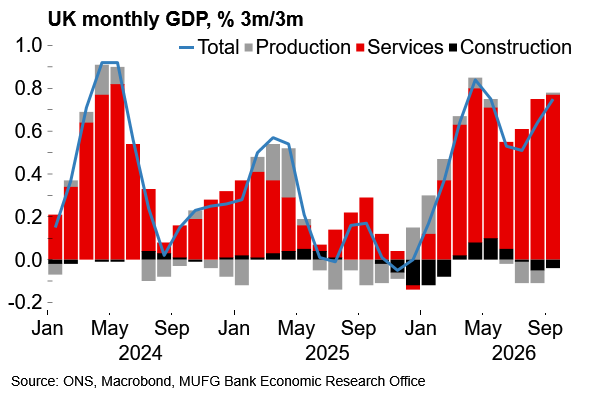
Business services continue to drive activity
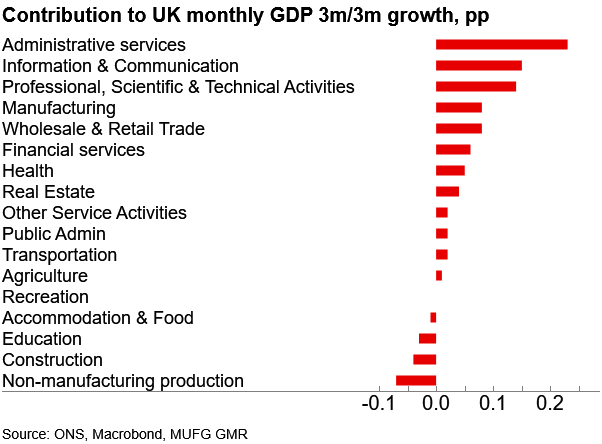
We expect the theme of resilience will continue
Looking ahead, recent survey evidence has remained encouraging. The October PMI showed that services activity continued to expand, despite Budget uncertainty, while manufacturing sentiment also improved further. As things stand there seems to be reasonably solid momentum heading into 2027.
The obvious headwind will be on the consumer side. Consumer sentiment already weakened sharply in October which probably reflected rising energy prices and Budget uncertainty. Wholesale energy prices have since retreated somewhat after the US mid terms and UK fuel prices have moved off their recent highs. However, the UK’s lagged household price cap system means that energy costs will rise sharply in January (by ~25%), pushing headline inflation to a peak of ~4.5% on our tracking and weighing on spending power.
The government has announced modest and targeted energy bill support to help cushion the impact. We have also noted tentative signs of stabilisation in the labour market in recent months, which could also help to support consumer sentiment. While energy bills will certainly be a drag, we expect household spending to continue to show some resilience.
Looking ahead, the latest data reinforces our view that the UK economy is entering 2027 with a reasonable degree of momentum. We expect UK GDP growth of 1.6% in both 2026 and 2027, leaving us somewhat above consensus forecasts, although we expect the gap will narrow after today’s GDP release.
The BoE can remain focused on inflation
There are obvious risks to the outlook, of which energy pricing remains the most important. That is both in terms of the potential for direct headwind for consumers and businesses and through the scenario in which the BoE is required to push policy further into restrictive territory.
On monetary policy, we don’t see this GDP release as materially altering the outlook for the BoE. The headline 0.7% figure was in line with the BoE’s expectation published last week. A resilient economy means that policymakers can remain focused on inflation expectations, survey-based wage indicators including annual pay settlements for 2027, and firms’ pricing intentions.
While headline inflation will rise, as noted above, it remains predominantly an energy story. We do expect to see some evidence of firmer core inflation over coming months. We are now getting to 9-12 months on from the initial Iran-related energy shock, which is when indirect and second-round effects are likely to start to appear more clearly in the data. However, our central case remains that the degree of slack in the UK labour market should ultimately help to contain second-round pressures. A BoE staff blog published today seems to support this view. We continue to expect one more BoE rate hike to a terminal rate of 4.25% (see here). On timing, we still lean towards the projection meeting in February rather than the next meeting in December.
AI may be amplifying the UK’s services advantage
Returning to the discussion above, there is a question about whether we should worry about the apparent ‘narrowness’ in UK growth. We’re not too troubled by it – growth might be concentrated in business services, but this is traditionally a key part of the UK economy. Indeed, it certainly seems possible that AI is amplifying the UK’s existing comparative advantages. We have written about the broader growth story previously e.g. here. The data today reinforces the sense that AI diffusion into the UK economy is happening quickly and the early signals from sectors most readily adopting AI tools are encouraging in terms of productivity effects.
Of course, productivity is hard to measure (and indeed prone to revision). It’s likely that there has been a cyclical increase related to a reversal of pandemic-related labour market hoarding, as well as the uptick in UK business investment as headwinds from e.g. Brexit uncertainty faded. However, we do expect a more structural boost from AI in the UK’s services-orientated economy. The OBR has previously suggested that AI could add around 0.2pp to annual productivity growth over time – that seems rather modest to us given recent evidence.
Whether there is a structural productivity boost or not, we assume that AI-related tailwinds to activity will continue to help offset weakness elsewhere in the economy over coming quarters. As noted, the wider growth outlook is not without risks, but we think the theme of resilience seen since the US-Iran shock is likely to remain valid over coming quarters.