

UK inflation came in at 3.6% in October, in line with consensus and up from 3.5% previously. The move was mostly driven by energy. The details were reassuring with core holding at 2.8% and services inflation unchanged. Food inflation also eased to the lowest mark since 2021. Relative to the BoE’s recent projections, headline, core and services all printed lower. UK inflation will rise as household energy costs move higher in January, but on our current tracking the peak looks likely to be closer to 4.5% than the BoE’s figure of almost 5%.
The UK labour market is stabilising at fairly soft levels. Unemployment fell to 4.6% but payrolls fell in October and vacancies declined further. Private sector pay held at 3.1% while forward-looking indicators continue to point to annual pay settlements of ~3.5%, which would be target-consistent. The latest productivity data pointed to marked improvement, suggesting that the economy’s ‘speed limit’ could be higher than previously assumed.
On the BoE outlook, this week’s data has done little to strengthen the hawkish case. Another hike has been signalled but it is a question of timing. To us it still seems like a toss-up between a back-to-back move in December and a skip to the projection meeting in February. Bailey’s comments today support the sense the policymakers want to retain plenty of flexibility. On balance we continue to favour February, marginally, on the basis that energy prices have become more manageable and second-round risks still appear contained. The degree of urgency will be determined by developments in pay settlements, November CPI and energy pricing ahead of the next meeting on 17 December.
Rising UK inflation, but underlying pressures still look contained
This week's data has done little to change our broad view on the UK economy. Headline inflation moved higher, as expected, while the labour market continues to look relatively soft. More importantly, there remains little evidence that higher energy prices are feeding through into broader domestic inflation pressures.
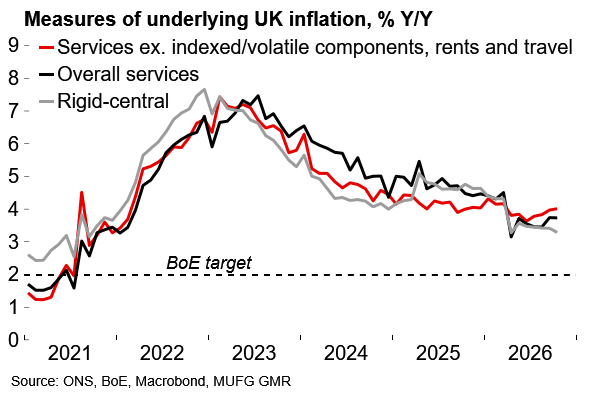
On CPI, the headline rate increased from 3.5% to 3.6% in October (cons: 3.6%). The main driver was fuel prices (33.2% Y/Y, from 29.8% previously) and there was also an upward effect from tobacco following a duty change. Otherwise, the details were generally reassuring. Core CPI was unchanged at 2.8%. Both the headline services rate and a measure excluding indexed and volatile components were also unchanged, at 3.7% and 4.0% respectively, while on our calculations the BoE’s new ‘rigid central’ gauge may have eased lower. Food inflation – which can be salient for household expectations – also eased, from 1.3% to 0.9%, the lowest rate since 2021.
So there were no nasty surprises here. The UK inflation story remains overwhelmingly an energy one, with still-limited evidence of either indirect pass-through into the wider CPI basket or meaningful second-round effects. Relative to the BoE’s projections, headline CPI printed at 3.60% versus the BoE's 3.73%. Core (2.77% vs 2.89%) and services (3.73% vs 3.90%) also came in lower.
Further ahead the November MPR projection showed CPI rising to a peak of 4.9% in Q2 next year. A reading above 4% is inevitable, with the Ofgem price cap set to move ~25% higher in January (the exact figure will be announced on 25 November). But the BoE’s peak of almost 5% looks too high. Those projections were conditioned on market pricing averaged over the 15 working days to 27 October. Since then, wholesale energy prices have retraced with Brent almost 20% down and fuel prices now also lower at the pump. We have been tracking a peak inflation rate of ~4.5% on the assumption that energy prices remain around current levels. The benign details in today's release, particularly on services and food inflation, have strengthened our conviction that the peak will be lower than the BoE projection.
Little evidence of broadening domestic inflation pressures
Payroll employment points to continued labour market slack
The UK labour market is stabilising – but at weak levels
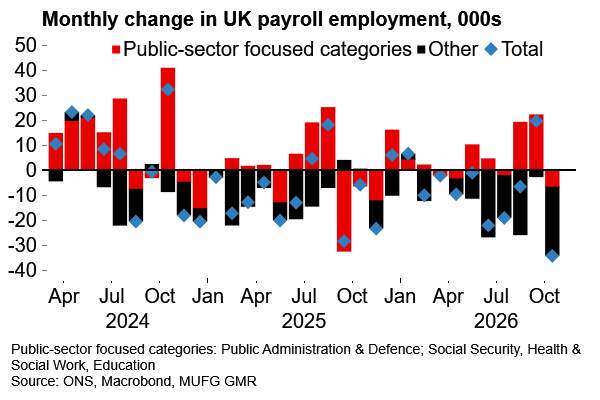
Meanwhile, yesterday’s labour market data showed the unemployment rate fell to 4.6%, below the BoE’s assumption of 4.7%. That was the most hawkish part of the release. It supports the argument that UK labour market slack is no longer widening, but at best it seems to be a case of stabilisation at somewhat weak levels. It’s certainly not a story of tightening. Payrolls employment fell by 34k in October. The payroll numbers are volatile and prone to revision, and the figure may have been affected by Budget-related uncertainty, but private-sector focused categories have declined every month since January. Meanwhile vacancies declined by a further 22k to 690k, the lowest level outside the pandemic period since 2014.
On wages, private sector regular pay held at 3.1%, in line with the BoE’s projection. Looking ahead, survey-based measures continue to point to wage growth of ~3.5%. As we get closer to year-end and the pay settlement period for 2027 these numbers will become more significant as policymakers gauge whether higher energy prices are materially influencing the bargaining process. The current indications are that settlements are likely to remain broadly target-consistent. On that point, the ONS released a productivity update yesterday, with the previously-announced methodology change, showing that output per hour increased by a strong 2.5% Y/Y in Q3. This further supports the sense that the economy's non-inflationary 'speed limit' could be somewhat higher than previously assumed.
BoE implications – We continue to lean towards February, but it's a close call
On the BoE outlook, policymakers have made it abundantly clear that more tightening is coming after the hawkish MPC meeting this month (see here). We see it as a toss-up whether the move comes at the next meeting in December or at the following projection meeting in February.
We waited until after Governor Bailey’s speech today before releasing this note. There are no significant signal changes – he summarises what we’ve discussed above, noting clear direct effects from energy prices but “limited evidence of knock-on effects on other prices and wages”. He is not ruling out a December hike, repeatedly emphasising that the MPC will assess the evidence at each meeting. He also links the policy outlook quite directly to energy: “Let me also emphasise a key point here. The longer the conflict in the Middle East persists and elevates energy prices, the more likely persistent inflationary effects will take hold and the higher the level of interest rates will need to be”.
For now, we continue to lean towards February, albeit only marginally, on the basis that energy prices have become more manageable since the November MPR and second-round risks still appear contained.
Based on the comments in the November statement, and subsequent speeches, there is a majority on the MPC for another hike, but not necessarily for a back-to-back move. We would say that Mann, Pill and Greene will likely vote for a hike next time out. We are less sure of Lombardelli. She sounded quite hawkish in her MPC paragraph before stating that the BoE should “proceed gradually” at last week’s BoE Watchers event. She is possibly more aligned with the core of Bailey, Ramsden and Breeden who all seem flexible and genuinely data/development dependent. Meanwhile, the dovish duo of Taylor and Dhingra are likely to see less urgency to tighten again immediately provided evidence of second-round effects remains limited.
Upcoming speeches from officials could start to provide more of a steer, but policymakers are likely to want to retain flexibility given the data released immediately before the decision and the potential for significant energy market developments.
The key dates are:
· 23 November: Flash PMI
· 04 December: DMP survey
· 11 December: BoE Agents' survey & October GDP
· 15 December: Labour market report
· 16 December: November CPI
· 17 December: BoE policy decision
Within those we will be watching the survey evidence closely for any signs of an uptick in wage pressures as we move into the settlement period for 2027. As noted above, figures of ~3.5% would be seen as tolerable/target-consistent, but any indication of pay settlements coming in closer to 4% would bolster the hawkish argument for urgency. The November CPI print could also cement a December move if there are signs of broadening price pressures (it’s worth noting that the BoE projection has a 0.1pp easing in the services rate, albeit to a higher rate than we saw today).
But the most decisive factor remains energy pricing. If the retracement in wholesale prices seen this month reverses, or worse, that would almost certainly push the MPC into a back-to-back hike. Conversely, if energy prices remain around current levels, and pay settlement indicators remain close to 3.5% and services inflation continues to behave, the MPC might dial back the urgency somewhat. Official may judge there is little cost in waiting until February. We would stress that it’s a question of timing rather than direction – the communication from the BoE has made it clear that at least one more hike is coming. Our current call is for one more 25bp move, to 4.25%.