

UK inflation surprised modestly to the upside in September, with headline CPI rising to 3.5%. The increase was driven primarily by higher fuel prices. With January's energy price cap increase still to come, we expect headline inflation to rise above 4% in early 2027. Beyond energy, the picture is more nuanced. There remains little evidence of broad-based second-round effects and much of the rise in services inflation reflected transport-related volatility, but underlying measures suggest domestic inflationary pressures remain uncomfortably high.
Separate data yesterday showed a modest uptick in private sector wage growth. There were also broader signs that the UK labour market is now stabilising with a pick-up in payroll employment. This week's releases follow relatively buoyant UK activity data, with growth momentum holding up well into the autumn. Taken together, the combination of firmer activity, a stabilising labour market, and a persistent energy shock reinforces the case for BoE action. We expect a 25bp hike in November, with a further move likely in early 2027 to lean against risks of broadening price pressures.
Energy costs are driving UK inflation higher again
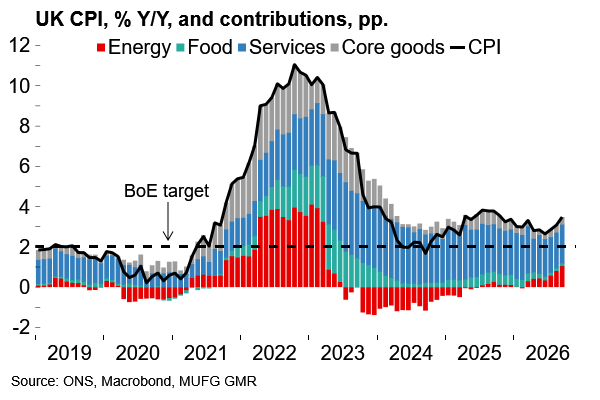
UK inflation increased 0.4pp to 3.5% in September (cons: 3.4%, MUFG: 3.5%). The uptick was primarily driven by higher fuel prices. There is more to come: headline inflation is set to rise above 4% in early 2027 following January's increase in the household energy price cap.
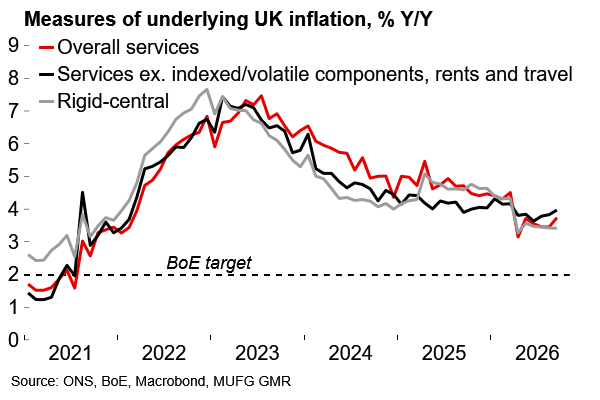
Beyond energy, the picture is still somewhat mixed. There is little evidence at this stage of a broadening in second-round inflation effects. Headline services inflation increased from 3.4% to 3.7%, but much of that reflects transport services, with airfares boosted by a base effect. However, services inflation excluding indexed and volatile components, rents and travel rose to 4.0%, suggesting underlying price pressures remain uncomfortably high. At the same time, the BoE's newly introduced 'rigid-central' inflation measure, which aims to capture more persistent inflation trends (see here), was broadly unchanged on our calculations.
Taken together, the latest figures certainly don’t point to any sharp uptick in non-energy components. But neither do they provide much evidence that underlying inflation pressures are continuing to ease from uncomfortably high levels. So at best, the disinflation process appears to have stalled, and at worst there are signs that some underlying inflationary pressures are beginning to edge higher again.
The uptick in UK inflation is energy-driven…
…but underlying inflation remains stubbornly high
The labour market is stabilising
Today's upside surprise on inflation comes after yesterday's labour market release, which indicated that conditions have stabilised in recent months, consistent with signals from a range of business surveys. Payroll employment increased by 13k in September, while the August decline was revised away entirely (from -26k to +1k). Private-sector focused categories recorded their strongest monthly increase since late 2023. The unemployment rate also fell from 4.9% to 4.7%, although we remain cautious about placing too much weight on that signal given ongoing issues with the Labour Force Survey.
The main soft spot was the vacancies data. On a three-month basis, vacancies fell to 691k, the lowest level since early 2021 and the lowest since 2014 if the pandemic period is excluded. Notably, the decline appears to have been concentrated entirely among firms with fewer than 10 employees. Vacancies in this category fell by more than 20% in Q2. One possibility is that prolonged uncertainty around energy costs, government policy and financing conditions has weighed disproportionately on hiring intentions among smaller businesses. If so, this could strengthen the case for targeted support measures in the upcoming Budget.
Still, the broader labour market story increasingly looks like one of stabilisation rather than a sharp rise in slack. As noted above, survey indicators have improved in recent months, redundancy notifications have stabilised, and the broader growth backdrop has become more encouraging (see our note here). The release should ease concerns within the MPC about labour market fragility.
On pay, private sector regular wage growth increased from 2.9% to 3.0% in the three months to August, marking the first acceleration since late 2024. While modest, the increase leaves wage growth running slightly above the pace assumed in the BoE's July projections. The flash PAYE-based single-month measure also picked up in September, rising to 4.4%.
The energy shock is too persistent for policymakers to ignore
This week's inflation and labour market reports come on the back of some relatively buoyant UK activity data last week. Taken together, it all reinforces our view that the BoE will tighten policy in November. Yes, second-round inflation effects remain absent. But the combination of firmer activity data, a stabilising labour market, and the duration of the energy shock means that the MPC is unlikely to be comfortable in waiting for complete clarity before acting. Our central view remains that the BoE will deliver a 25bp hike in November followed by another move in early 2027 – we continue to think that a proactive but measured risk management response to the persistent energy shock is appropriate.