
The UK government heads into next week's Budget against a more challenging fiscal backdrop, with higher borrowing costs, energy prices rising again and investors paying closer attention to fiscal sustainability across advanced economies. Against that backdrop the new PM and Chancellor appear determined to make this a low-key event, favouring a package of targeted support and modest revenue-raising measures over any major policy shift.
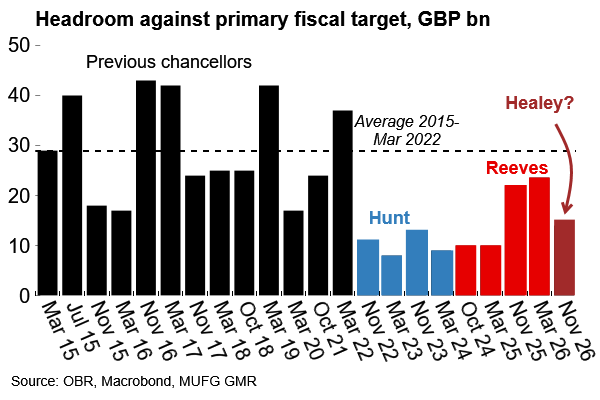
Our central expectation is that the Chancellor emerges with around £14bn of headroom against the primary fiscal rule. The deterioration since the Spring Statement is overwhelmingly an interest rate story, with higher borrowing costs accounting for roughly £11bn of headroom erosion. The tax base has remained relatively resilient, supported by solid growth.
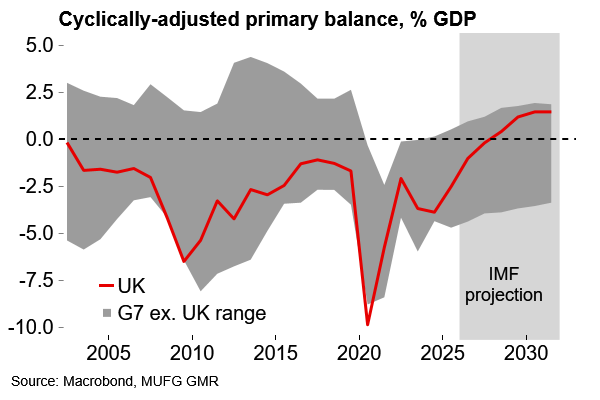
Markets are likely to focus less on the precise headroom figure and more on the credibility of the medium-term fiscal trajectory. While the IMF has sounded relatively constructive on the outlook, we remain sceptical of the degree of backloaded consolidation embedded in the forecasts and the political feasibility of delivering it as the next election approaches.
Leaving reduced headroom seems unlikely to trigger a significant market reaction in its own right. But we question whether this is the right point to be running down hard-won fiscal space. The economy has proven resilient to various headwinds. With elevated geopolitical uncertainty, rising defence spending pressures and jittery bond markets, we think there is a good case for keeping a little more in the way of fiscal buffers.
Tiptoeing through a challenging fiscal backdrop
On paper next week’s Budget ought to be another challenging one for the government with investors paying closer attention to fiscal sustainability across advanced economies. Higher energy prices and the surge in borrowing costs have complicated the fiscal outlook. We expect that the headroom against the primary fiscal rule, already fairly thin by historical standards, has been reduced by around 10bn.
But the new PM and chancellor seem determined to tiptoe through and make this a low-key event. There has been nothing reported, no trial balloons, to point to any major policy shifts. Our expectation is for a package which offsets some support for households with relatively modest revenue-raising measures elsewhere. We assume this will be close to fiscally neutral. On the spending side, the emphasis is likely to remain on temporary and targeted interventions. Additional support for households facing higher energy costs appears more likely than any broad-based stimulus package. On the revenue side, a higher banking sector levy seems the most likely significant lever.
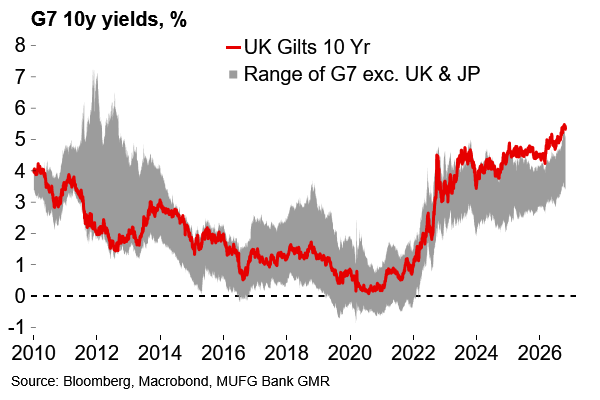
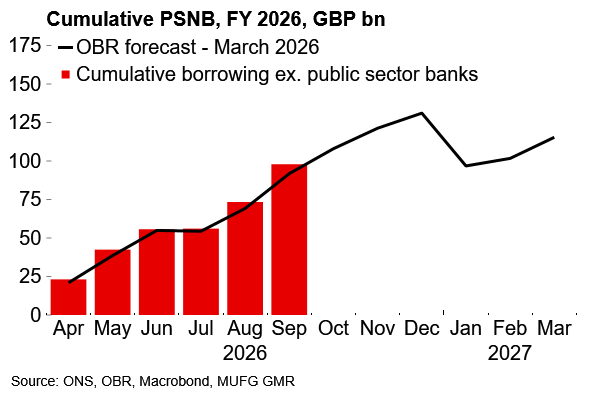
Putting this together, our expectation is that the Chancellor will emerge from the Budget with ~£14bn of fiscal headroom. The starting point from the Spring Statement is £23.6bn. The deterioration since then has been overwhelmingly an interest rate story. Market borrowing costs have risen materially, by around 80bp, which translates to a ~11bn hit. The tax base looks OK. Receipts have remained relatively robust, which tracks with resilient activity data and, more recently, signs of a stabilising labour market. Indeed, we have pencilled in a modest boost from favourable OBR forecast revisions, perhaps in terms of earnings assumptions, which could add a little back to the headroom.
UK borrowing costs remain elevated relative to peers
Higher borrowing costs have driven fiscal slippage
Headroom matters less than credibility…
As always there is substantial uncertainty around headroom estimates with small changes in OBR’s assumptions potentially moving the numbers by several billion in either direction. We try not to fixate on it too much. For markets the focus is less on the headroom figure and more on whether or not the government is offering a credible, medium-term path for deficit reduction.
The IMF sounded quite constructive on the outlook last week, which seemed a bit overdone to our minds. There is a lot of what we see as ‘fiscal fiction’ in the government’s plans. The public finances improve materially in the outer years, but this relies on spending restraint that has yet to be specified in detail, and can reasonably be assumed to be politically difficult to deliver as the next election approaches.
Still, the UK has made at least some progress on deficit reduction in recent years – unlike some notable peer countries – and that should be recognised. Full-year borrowing in FY2025/26 came in at 4.4% of GDP, broadly in line with the OBR's 4.3% forecast, while borrowing between April and September stands at 3.1% of GDP, 0.3pp below the same period last year.
Meanwhile, the new PM and Chancellor have generally been making the right noises about maintaining fiscal discipline. The announced reform to the state pension triple lock system also helped support the government’s credibility. The fiscal benefits of that accrue only gradually (it’s more about putting expenditure on a predictable path), but the willingness to tackle a politically sensitive issue won some credit.
…but is this the time to be dipping into the buffers?
So leaving a smaller headroom is unlikely to be fatal from a markets perspective if the government does indeed play it safe on policy and doesn’t bungle the communication. However, we do question whether this is the right point to be tapping into hard-won fiscal space under the current framework. Yes, the rise in energy prices is proving more persistent than expected and consumer sentiment is fragile. We also believe that fiscal policy should be conducted with a degree of flexibility rather than being in hock, so to speak, to an arbitrary rule. But the economy has demonstrated considerable resilience this year. Fiscal slippage has been driven largely by higher borrowing costs rather than weaker activity.
The bottom line is that the UK government might well succeed in delivering the quiet, low-key Budget it seems to be seeking – but operating with limited headroom in a world of more frequent geopolitical shocks, building defence spending pressures and jittery bond markets doesn’t seem especially prudent to our minds.
The IMF is optimistic on the scope for UK fiscal repair
The chancellor seems set to leave lower headroom