

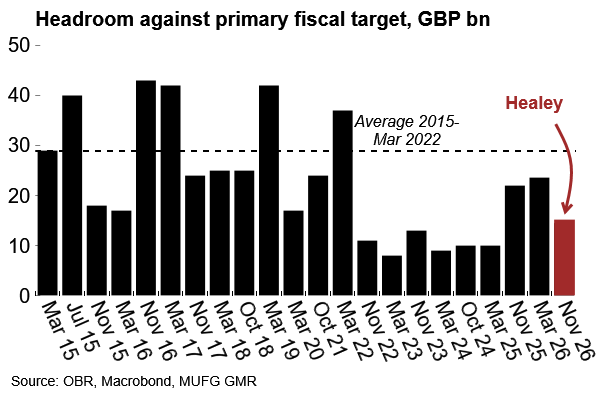
The UK government has delivered a deliberately cautious Budget. Fiscal headroom against the primary rule has been reduced to £14.5bn, with the deterioration driven by higher borrowing rather than new spending decisions.
A fairly modest package of energy support for households was announced. As expected, measures are time-limited and temporary. Policy is loosened slightly in the near term but is broadly neutral further ahead.
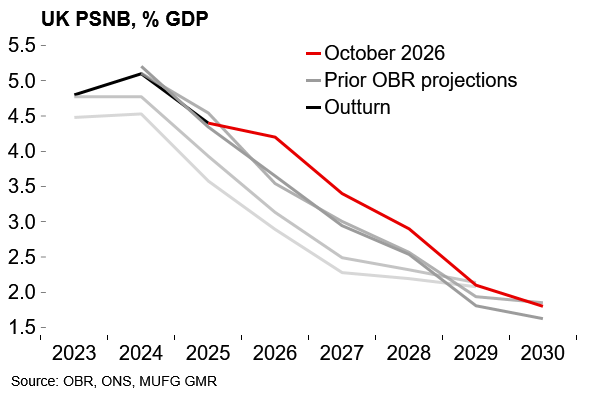
The OBR now projects borrowing of 4.2% of GDP in 2026-27, materially above the 3.6% anticipated in March, but still modest progress on last year. We are also modestly more optimistic than the OBR on growth, seeing scope for 1.5% in both 2026 and 2027 against the OBR's 1.2% and 1.0% respectively.
Medium-term decisions remain deferred to next year's Spending Review. The OBR highlighted some of the pressures in the current plans. The current medium-term path continue to look politically unrealistic and the government faces hard choices ahead.
The market reaction was muted – gilt yields nudged 2-3bps lower and sterling was little changed. The updated DMO remit is broadly in line with consensus. The Budget was designed not to scare the horses, and on that measure it succeeded.
For the BoE, we think the direct monetary policy implications are limited. The Budget does not materially alter the outlook for growth or inflation, and the 3.9% National Living Wage increase is tolerably close to likely annual pay settlements. We continue to expect 50bp of tightening on a risk management basis, starting with a hike next week.
A placeholder Budget which leaves hard choices ahead
Today’s UK Budget was as low-key as expected (see our preview here). The chancellor played it safe against a backdrop of higher energy prices and jittery bond markets. Headroom against the primary fiscal rule was reduced to £14.5bn, in line with our expectations, with the deterioration predominantly driven by the sharp increase in borrowing rather than discretionary policy choices, with stronger receipts providing something of an offset.
In terms of new policy measures, it all looks quite modest. The chancellor focused on targeted and time-limited support to households to help with energy-related cost pressures. The overall package amounts to around £3.9bn in FY 2026-27, or just 0.1% of GDP, dominated by a direct energy payment to some households (totalling £2.6bn) and the extension of fuel duty and electricity VAT relief. Overall, policy is loosened modestly in the near term (by around 0.25% of GDP in 2026-27), but that loosening is then offset over time, leaving the package broadly neutral later in the forecast horizon. The main revenue lever used today is a temporary 3pp increase to the bank surcharge for 15 months from January, which is estimated to generate £1.5bn, alongside support from smaller measures and compliance initiatives.
The result of this is a familiar story of near-term fiscal slippage with consolidation left for the future. The OBR now expects public sector net borrowing of 4.2% of GDP in 2026-27, only marginally below the projected 4.4% in 2025-26 and materially above the 3.6% anticipated in the March forecast. Still, it’s notable that at least some progress on the deficit is expected, despite challenging external conditions and the introduction of some fiscal giveaways.
The OBR also appears somewhat cautious on growth. Despite the range of headwinds, projections of 1.2% and 1.0% for 2026 and 2027 respectively still look a little pessimistic to us. We continue to see scope for growth closer to 1.5% in both years (see here), which would help ease some fiscal pressures.
The government is operating with a smaller fiscal buffer
A slower pace of deficit reduction this year
The spending review looms large on the horizon
Looking further ahead, most of the important medium-term decisions are still deferred until next year’s Spending Review. The government has essentially provided support where political pressure to do so is acute, but not much else. As things stand, the OBR notes that ‘unprotected’ areas of spending which have not been exempt from cuts could face a 2.6%/year real terms reduction in spending across the final three years of the forecast. That is just not politically realistic and underlines the sense that there is a lot of ‘fiscal fiction’ in the plans and hard choices on spending ahead. It’s certainly difficult to see what more can be done on tax. Despite relatively few headline tax increases in this Budget, tax revenues are still projected to reach 38.6% of GDP, another post-war high, reflecting frozen thresholds and previously announced measures.
Nothing to spook market participants at this stage
All told, it feels like a placeholder Budget which was designed not to scare the horses. The market reaction was certainly muted. The 10-year Gilt yield has nudged lower by 2-3bps with the DMO’s projected supply of Gilts estimated at GBP 250.6bn, close to the market consensus of GBP 249.2bn. As noted, this budget leaves medium-term fiscal risks in place, but an event risk has passed and the benign reaction can be viewed by the government as a case of job done.
Instead the pound will likely take direction from the more important upcoming events – the FOMC meeting tonight, the ECB meeting tomorrow and then of course the BoE meeting next week (we expect a 25bp hike, which is almost fully priced).
In terms of the wider BoE outlook, the direct implications for monetary policy from the Budget are limited. While specific measures may affect the inflation profile at the margin, we don’t see much announced today which significantly alters the broad outlook for growth, inflation or the likely path of Bank Rate. The 3.9% increase in the National Living Wage looks manageable and is only marginally above the 3.5% or so we expect to see in annual pay settlements for the economy as a whole next year. Indeed, second round effects have generally remained contained (see here) but we expect 50bp of tightening in total on a risk management basis to lean against risks of broadening pressures. The OBR now sees headline inflation at 3.1% this year and 3.4% next year and it will be hard for policymakers to look past that sort of deviation from target.