

Macro focus – The challenges ahead for the next ECB president: The process to replace Lagarde as ECB president seems to have been relatively smooth by European standards, with recent reporting pointing to frontrunner Pablo Hernández de Cos taking the top job as part of a wider package of appointments. De Cos is a pragmatic centrist with a dovish tilt, but broadly speaking we see him as a continuity candidate. There will be precious little time to settle in: we currently pencil in a 25bp hike in March, the first meeting under new leadership, while developments in France could revive questions around sovereign spreads and the ECB’s toolkit. More broadly, a world of more frequent supply shocks and uncertainty around the neutral rate will demand flexibility, nimbleness and a clear communication framework. While the succession itself seems to have been quite straightforward, the policy environment looks anything but – so the new president will have to find their feet quickly.
What we’re watching next week: The flash PMIs are the main data highlights for both the euro area and UK. The ECB minutes from October and the first November inflation readings from France and Spain will also be in focus.
ECB succession – The challenges ahead for the next president
De Cos closes in on the top job
The ECB succession process appears close to completion. The 6 November nomination deadline passed and the race to replace Lagarde formally narrowed to just two candidates: Klaas Knot, the long-serving former Dutch central bank governor, and Pablo Hernández de Cos, Bank of Spain governor from 2018-24 and now head of the Bank for International Settlements.
Reports have since suggested that euro area governments have converged on de Cos to succeed Lagarde when she departs on 7 February. The appointment would be part of a package deal that would see the German economist Markus Brunnermeier replace Philip Lane as Chief Economist and a French candidate take over Isabel Schnabel's Markets portfolio when she leaves for the IMF. De Cos would not be a surprising appointment – we wrote back in February that the Spaniard was the most straightforward pick for the presidency given various obstacles for other frontrunners (see here). Indeed, the process seems to have been relatively smooth by the standards of European institutional appointments.
De Cos is generally perceived as somewhat dovish, which is fair relative to Knot and some of the other names in the frame. In a May 2022 speech, before the ECB started raising rates, de Cos advocated a gradual initial tightening before proceeding according to the data. That probably placed him just to the dovish side of the centre of the Governing Council. His position was broadly similar to Lagarde's Sintra speech the following month, although de Cos placed greater weight on gradualism and avoiding abrupt moves.
De Cos has also signalled openness to using more unconventional tools. He supported QE during the low-inflation years and has consistently argued for the ECB to retain a broad policy toolkit. He has also stated in the past that yield curve control might be “an option worth exploring”. But more recently de Cos has emphasised that policymakers should remain “vigilant” on inflation risks. He’s also been willing to set out a hawkish stance on fiscal risks – while governor of the national central bank he was willing to challenge the Spanish government on pension expenditure and wider public debt sustainability issues.
All told, we would frame him as a pragmatic centrist with a dovish tilt, but primarily see him as a continuity candidate as president when it comes to policy direction.
Straight into the deep end?
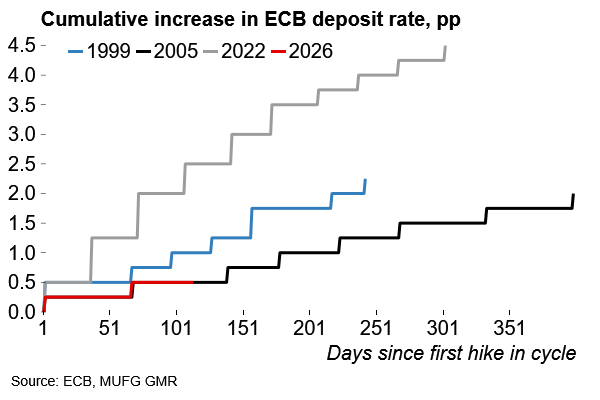
There won’t be much of a honeymoon period. The new president will inherit an active tightening cycle, albeit at a pace more akin to the gradual 2005-08 cycle than the 2022-23 episode. Our current expectation is that, following a highly likely hike in December, the ECB will raise rates by an additional 25bp in March next year (see here). That means the first meeting under the new president looks very much live.
The new president will inherit a steady rate hike cycle
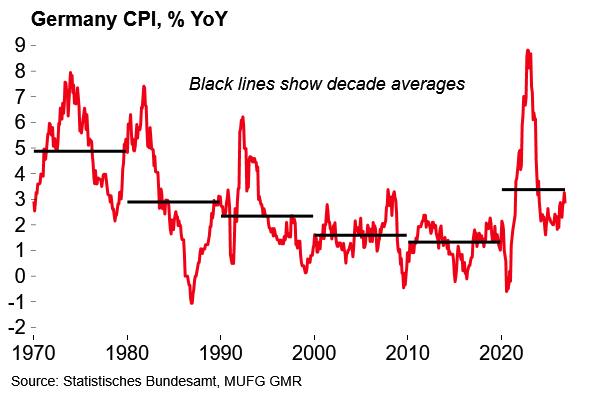
The long-term picture on inflation
Our base case is that this hike to 3.00% would mark the peak, but the outlook remains uncertain. The new president will take office roughly one year after the initial US-Iran energy shock, which is around the point at which the extent of indirect and second-round inflation effects should become clearer in the data. The ECB expects some broadening in price pressures, with the September projections showing core inflation reaching a manageable 2.8% in Q1. A more persistent overshoot, stronger wage effects or signs of inflation expectations becoming less well-anchored would trigger pressure from hawkish members of the Governing Council to do more.
Then there is France. The first round of the French presidential election will take place on 18 April, with the second round scheduled for 2 May. There is an ECB policy meeting sandwiched in the middle on 29 April. OAT-Bund spreads have narrowed by around 25bp from the October highs but remain elevated by historical standards at ~150bp. There are plenty of scenarios in which pressure could return before the election or following the first-round results, including budget developments, further ratings actions, higher energy prices or a broader risk-off episode.
It is therefore plausible that the new ECB president will be immediately faced with a rather unpalatable mix of widening spreads and rising underlying inflation rates. In such a scenario, the ECB’s anti-fragmentation tools would move back into focus. The bar is rather high for intervention via the TPI, but sustained stress would become increasingly difficult to ignore if it started spilling over elsewhere.
A difficult backdrop will require adaptability and pragmatism
Navigating this would pose a significant and immediate communication challenge. In that sense, de Cos's prior monetary policy experience is an obvious advantage compared with Lagarde when she arrived in 2019. Lagarde grew into her role but the market reaction to her early “not here to close spreads” remark highlighted the difficulties of learning on the job.
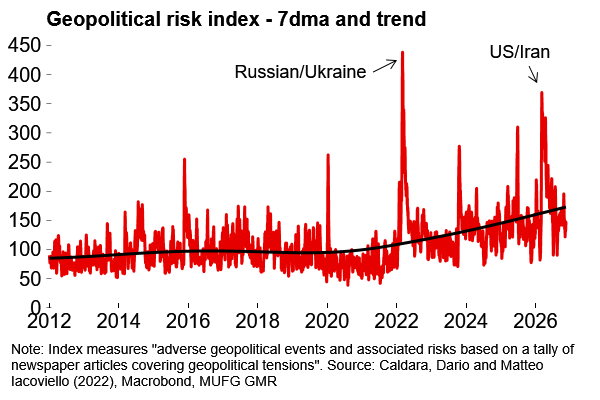
More broadly, it does seem to be a less predictable policy environment with supply shocks becoming more frequent and potentially overlapping. De Cos comes with a reputation for consensus-building and pragmatism which could serve him well here. There’s also an active debate around ‘neutral’. Greater investment demand around defence, energy and AI provides good reason to think the neutral rate has risen, but uncertainty makes calibrating policy more difficult.
Against that backdrop, less rigid forward guidance, greater use of scenarios and better modelling of supply shocks are all in vogue right now among central bankers. It’s not especially radical stuff but it is sensible and we expect de Cos would lean into this sort of approach too. While the succession process itself looks to have been relatively straightforward, the policy environment the new president is set to inherit looks anything but. There won’t be much time to settle in.
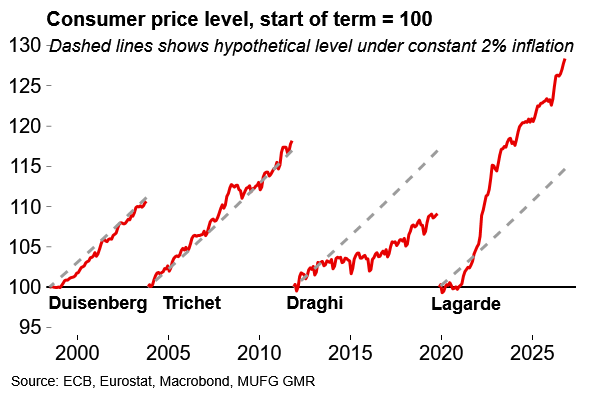
Price stability has become harder to achieve
A world of more frequent shocks
What we’re watching next week
Survey data in focus
The flash PMIs on Monday will be the data highlight of the week for both the euro area and the UK. As well as the activity signals, the price components will be watched for any sign that the energy shock is feeding more broadly into selling-price pressures. In the euro area, we will watch to see whether the divergence between a firmer German economy and weakness in France persists. The reliable German Ifo survey will also be released, alongside the European Commission’s confidence survey.
Meanwhile, the minutes of the ECB’s last meeting will be scanned for any further signposting of a December hike and the Governing Council’s assessment of risks beyond that. Friday then brings the first November inflation readings from France and Spain (we expect some moderation in both), as well as the ECB’s consumer inflation expectations survey. Most other national inflation prints, as well as the euro-area aggregate, will follow the week after.
A range of ECB and BoE speakers will also be worth monitoring. An ECB hike at the next meeting looks close to a done deal. For the BoE, however, we think the case for a December move remains less clear-cut than current market pricing implies (see here).
Key releases and events next week (23-27 November)
Day | Time | Region | Event | Period | Consensus | MUFG | Previous |
Mon 23-Nov | 08:15 | FR | S&P Global France Composite PMI | Nov P | - | 47.0 | 46.6 |
Mon 23-Nov | 08:30 | GE | S&P Global Germany Composite PMI | Nov P | 52.8 | 53.0 | 53.4 |
Mon 23-Nov | 09:00 | EC | S&P Global Eurozone Composite PMI | Nov P | 51.6 | 51.5 | 51.7 |
Mon 23-Nov | 09:30 | UK | S&P Global UK Composite PMI | Nov P | 53.1 | 53.2 | 52.9 |
Tue 24-Nov | 09:00 | GE | IFO Expectations | Nov | 92.0 | 92.2 | 91.6 |
Wed 25-Nov | 07:00 | GE | GDP SA QoQ | 3Q F | 0.2 | 0.2 | 0.2 |
Thu 26-Nov | 07:00 | GE | GfK Consumer Confidence | Dec | -29.0 | -29.9 | -30.8 |
Thu 26-Nov | 12:30 | EC | ECB Account of Oct. Policy Meeting | - | – | - | - |
Fri 27-Nov | 07:45 | FR | CPI EU Harmonized YoY | Nov P | 3.7 | 3.5 | 3.7 |
Fri 27-Nov | 08:00 | SP | CPI EU Harmonised YoY | Nov P | - | 4.7 | 4.9 |
Fri 27-Nov | 08:55 | GE | Unemployment Change (000's) | Nov | +6k | 2.0k | 4.0k |
Fri 27-Nov | 09:00 | EC | ECB 1 Year CPI Expectations | Oct | n/a | 3.2 | 3.1 |
Fri 27-Nov | 10:00 | EC | Economic Confidence | Nov | 97.2 | 96.4 | 96.9 |
Note: All times are GMT (London). Source: Bloomberg, MUFG GMR