

Macro focus – The European resilience story is being tested once again: The flash PMI for October delivered a modest disappointment, with the euro area composite falling from 53.1 to 51.9. French sentiment was unsurprisingly weighed down by political uncertainty and fiscal concerns. The German figure held up a bit better, with manufacturing continuing to benefit from recovering exports and defence-related activity. The broader survey picture for October has been one of gradually cooling confidence as higher energy costs and tighter financial conditions begin to bite. The general narrative of resilience will be tested further over the winter months. On prices, the PMI data showed the services output price gauge actually eased in October in another sign that second-round inflation effects remain contained. Elsewhere, the UK was a notable bright spot – the composite PMI rose to 53.1, its highest since February, with new orders at their strongest in over two years and employment returning to growth. This follows stronger activity data in other releases in recent weeks. It seems the UK economy is entering the Budget period with stronger momentum than has been the case in recent years.
What we’re watching next week: It will be a busy week with the ECB meeting, euro area GDP and inflation data, and the UK Budget. On the ECB, we expect no change in rates. The focus will be on Lagarde's communication around risks to the outlook, and how she addresses the French situation. In terms of data, flash national inflation numbers for October will be released the following day. The first estimate of Q3 GDP will also be released, alongside other survey indicators which will give a further read on momentum in Q4. In the UK, the Budget is the big focus. We expect a relatively low-key package with the government treading carefully to avoid rocking the boat. Otherwise it’s a quiet week of data, although the BoE's DMP survey will be watched closely for any sign of broadening price pressures.
The European resilience story is being tested once again
Survey evidence suggests that the euro area economy is losing momentum
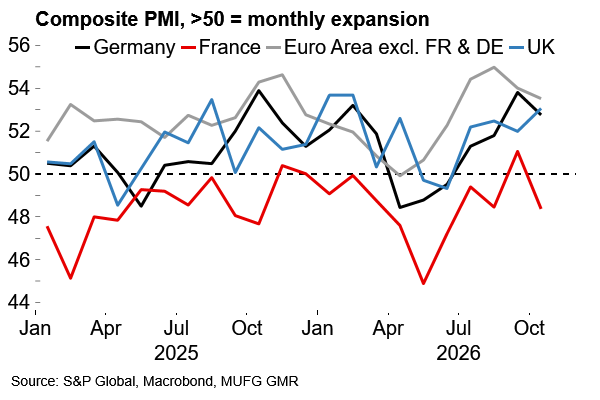
The flash PMI for October fell short of expectations with the composite euro area figure falling from 53.1 to 51.9 (cons: 52.7, MUFG: 52.0). Both the manufacturing and services components softened. France was a source of weakness, unsurprisingly. Amid headwinds from political/fiscal uncertainty and social unrest, the French composite figure fell back below the breakeven threshold to 48.4. However, we would note that this is essentially a return to the August level and feels like a correction after the odd-looking uptick last month. Elsewhere, the German figure also softened, to a 2-month low, but remains at relatively firm 52.8. The release noted that German manufacturing continues to benefit from recovering exports, infrastructure spending and increased defence-related activity which provides some encouragement given the challenging backdrop.
The weaker PMIs come on the back of other surveys also showing signs of cooling this month. Germany's ZEW expectations index fell for the first time since April, while the Sentix survey also weakened. Although neither signalled a collapse in activity, surveys are pointing to growing unease around the outlook again. The energy backdrop has certainly become materially more challenging. Brent crude has pushed above $110/bbl, while TTF gas is currently trading above €90/MWh, for the first time since 2022. Our colleague wrote a good note on Europe’s gas vulnerabilities here.
The ECB also released an interesting blog on the resilience story this week (see here), highlighting that the economy “has become structurally less exposed to fluctuations in fossil energy commodity prices”. While the latest survey evidence suggests that the euro area economy is losing some momentum in Q4, we don’t see it as enough yet to fundamentally challenge the broader story of resilience that has characterised the year since the US-Iran shock. We expect Q3 growth of ~0.2% Q/Q and the annual average to come in at 1.0% across 2026 as a whole, which would be a respectable enough outcome in the circumstances.
Of course, resilience is not quite the same thing as acceleration. With energy costs rising again, households are set to feel renewed pressure on real incomes over the coming months, while financing conditions have become tighter. Political uncertainty is set to remain elevated with the French presidential election now less than six months away. Taken together, it is difficult to see a compelling catalyst for growth to accelerate materially from here. We therefore continue to assume growth of around 1% in 2027.
Euro area weakness was led by France; UK looks better
Services-sector output prices do not look alarming
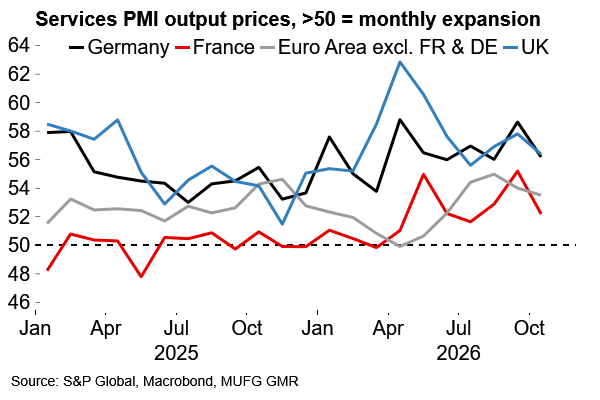
Signs of broadening inflation pressures remain limited
On the price components of the PMI, manufacturing firms reported a sharp acceleration in input cost inflation, largely reflecting higher energy, fuel and transport costs. This is not yet translating into a broad-based acceleration in selling prices. In fact, services sector output prices fell back in October, suggesting that second-round effects remain contained. That would provide some comfort to policymakers at the ECB, and likewise with today’s consumer survey which showed medium and long-term household inflation expectations unchanged (although the year-ahead measure did edge up to 3.1%). With acknowledgement from officials that tighter financial conditions are weighing on price pressures (see here), and little to ring alarm bells in the surveys, the ECB is showing little urgency to raise rates again, despite renewed energy price pressures. As such, rates are set to be left unchanged next week (we will release our full meeting preview on Monday).
The UK economy enters the Budget period with firmer momentum
Turning back to the PMIs, there was a notable contrast between the weakness in the euro area and the UK flash figure which strengthened to 53.1, its highest level since February. New orders recorded their strongest increase in more than two years and employment returned to growth for the first time since 2024. Survey respondents cited resilient demand, AI-related investment and improving export conditions, which tallies with other evidence. Last week we noted that UK activity has been resilient and AI adoption could be boosting the supply-side relatively quickly (see here). The UK's more services-orientated economic structure may also help explain some of the divergence with more energy-intensive manufacturing economies at present.
So the UK economy is carrying notably firmer momentum into Q4 than has been the case in recent years. The government is aiming for a relatively low-key Budget next week (see our preview here) in the hope that speculation about possible measures does not undermine confidence. While the PMI release still notes some fiscal-related headwinds, the headline survey numbers suggest that speculation has been less damaging this year.
On prices, it’s a similar story to the euro area – manufacturing costs have risen but the services output price component actually eased. As we note here, we think recent data has reinforced the case for BoE action, but the lack of any clear signs of broadening inflation pressures means that any hikes would be on a proactive risk management basis.
What we’re watching next week
ECB, euro area data and the UK Budget
Next week brings a busy run of events and data across Europe. The ECB will meet against a backdrop of rising energy prices, tighter financial conditions, unsettled bond markets and still little compelling evidence that inflation pressures are broadening. Policy is set to be left unchanged. The focus will instead be on the communication around risks, and how Lagarde navigates questions on the French situation, financial conditions and her own future.
Flash national inflation numbers for October will be released the following day. Policy measures in some countries, such as Germany and Spain, should help cushion part of the pass-through from rising energy prices for now, and broader second-round effects appear to remain relatively contained as mentioned above. The aggregate euro area figure will be released on 4 November – we are currently tracking headline HICP inflation at 3.9% Y/Y, up from 3.8% previously.
Next week we will also receive the first estimate of Q3 GDP, where we expect aggregate euro area growth of 0.2% Q/Q. Looking ahead, a fresh batch of survey evidence, including the reliable German ifo and the European Commission's confidence indicators, will provide another steer on the degree of momentum heading into Q4.
In the UK, the Budget on 28 October will be the main focus. As discussed in our preview, we expect a relatively low-key package that leaves the government operating with reduced fiscal buffers. On the data front, it will be a quieter week. We will be watching the BoE's DMP survey closely for any signs that firms' pricing expectations are beginning to respond more clearly to the recent rise in energy prices.
Key data releases and events (commencing Monday 26 October)
Day | Time | Region | Event | Period | Consensus | MUFG | Previous |
Mon 26 Oct | 09:00 | GE | IFO Business Climate | Oct | 90.1 | 88.5 | 89.9 |
Wed 28 Oct | 07:00 | GE | GfK Consumer Confidence | Nov | -29 | -31.0 | -30.6 |
Wed 28 Oct | 12:30 | UK | UK Budget | - | - | - | - |
Thu 29 Oct | 10:00 | EC | Economic Confidence | Oct | 97.8 | 97.0 | 97.9 |
Thu 29 Oct | 13:15 | EC | ECB Deposit Facility Rate | 29-Oct | 2.50 | 2.50 | 2.50 |
Fri 30 Oct | 06:30 | FR | GDP QoQ | 3Q P | 0.1 | 0.1 | 0.0 |
Fri 30 Oct | 07:45 | FR | CPI EU Harmonized YoY | Oct P | 3.6 | 3.6 | 3.4 |
Fri 30 Oct | 08:55 | GE | Unemployment Change (000's) | Oct | 5.0k | 8k | 12.0k |
Fri 30 Oct | 09:00 | IT | GDP WDA QoQ | 3Q P | 0.1 | 0.2 | 0.2 |
Fri 30 Oct | 09:00 | GE | GDP SA QoQ | 3Q P | 0.1 | 0.0 | 0.3 |
Fri 30 Oct | 09:30 | UK | DMP 3M Output Price Expectations | Oct | 3.8 | 3.8 | 3.7 |
Fri 30 Oct | 10:00 | EC | GDP SA QoQ | 3Q A | 0.2 | 0.2 | 0.6 |
Fri 30 Oct | 10:00 | IT | CPI EU Harmonized YoY | Oct P | 4.5 | 4.6 | 4.2 |
Fri 30 Oct | 10:00 | EC | Unemployment Rate | Sep | 6.4 | 6.4 | 6.4 |
Fri 30 Oct | 13:00 | GE | CPI EU Harmonized YoY | Oct P | 3.1 | 3.2 | 3.3 |
Note: All times are GMT (London). Source: Bloomberg, MUFG GMR