

Macro focus – Germany’s industrial recovery gains traction: The recent flow of German manufacturing data suggests that muted Q3 GDP likely understated the underlying momentum in the economy. After temporary headwinds (e.g. low Rhine water levels and extended summer shutdowns in the automotive sector) weighed on activity over the summer, a marked improvement in Q4 looks increasingly likely. This week's factory orders and industrial production releases were both encouraging, with particularly strong gains in capital goods output. Recent survey data has reinforced the recovery narrative. The improvement is consistent with a broader global capex upswing driven by defence spending and AI-related investment, areas where German industry remains well positioned to benefit. We expect annual average GDP growth of 1.1% in 2026 and 1.3% in 2027, slightly above consensus, leaving Germany on course to outperform France, Italy and the euro area aggregate for the first time since 2017.
What we’re watching next week: The UK Q3 GDP release is the data highlight. We expect growth of 0.7% Q/Q, in line with both consensus and the Bank of England's latest projection. Recent activity data has generally surprised to the upside and the details should provide a guide on the degree of momentum carried into Q4. Elsewhere, a busy slate of speeches from ECB and BoE policymakers will be closely watched, particularly for any assessment of the recent retracement in oil and gas prices and whether tighter financial conditions alter the policy outlook ahead of the next meetings in December.
Germany’s industrial recovery gains traction
Q3 weakness likely overstated the underlying trend
As noted last week, German Q3 GDP surprised mildly to the upside at 0.2% Q/Q (see here), but there are good reasons to think that the underlying growth trend is stronger after various one-off factors weighed on activity. Recent activity and survey data have looked more constructive and suggest that the German economy will carry a reasonable degree of momentum into 2027, supported by an uptick in capex.
Let’s start with the temporary headwinds. Activity in Q3 was affected by what the Bundesbank characterised as “temporary stress factors”. These included lower Rhine water levels disrupting transport and production, extended summer shutdowns weighing on auto production and changes in fuel taxes distorting retail spending. Despite those headwinds, the economy still eked out a bit of growth.
Looking ahead, the Bundesbank expects economic output to improve “markedly” in Q4, and more timely data is certainly somewhat encouraging. Manufacturing surveys have improved in October with the expectation components of the ifo survey at the highest levels since 2018 once the pandemic rebound period is excluded, while capacity utilisation is gradually increasing from previously depressed levels. There was also a sizeable fall in the share of manufacturers citing weak demand as a constraint on activity in the European Commission survey.
Today’s industrial production release reinforced the sense of improvement. On a quarterly basis, output was down 0.4% Q/Q. But there was growth of 0.7% M/M in September, after 1.0% in August, which implies a solid carryover of 0.8pp into the Q4 figure. On the details, headline IP growth came in at 0.7% M/M, but within that there was a 1.7% rise in manufacturing and a 3.0% rise in the capital goods component. Yesterday’s factory orders data were also encouraging. Orders rose by 4.4% M/M. Excluding large orders, growth was higher (5.1%), and machinery and capital goods remain on an upward trend.
That fits with a broader global capex story, with increased defence spending and AI-related investment supporting demand for machinery and capital goods. Germany remains well positioned to benefit. For all the structural challenges from increased Chinese competition and relatively high energy costs, German manufacturers retain competitive strengths in many higher value-add sectors.
Surveys suggest a move from stabilisation to recovery
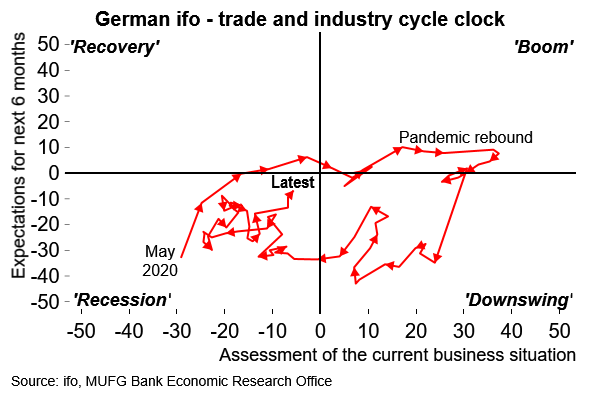
The period of German underperformance is ending
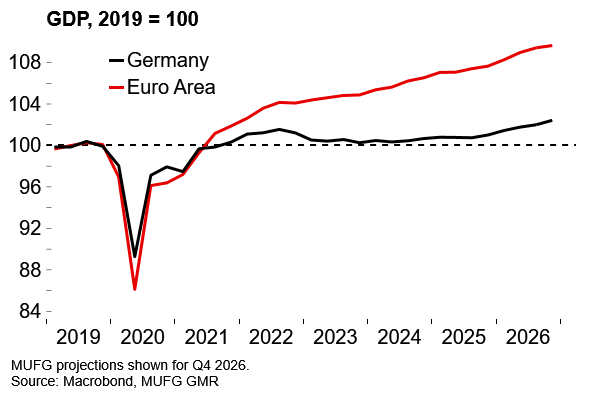
Market conditions also look somewhat more favourable. The recent depreciation of the euro (see here) should provide an extra boost for exporters. Energy market developments will be more critical. While it has largely been a story of resilience since the onset of the US-Iran conflict, helped by efficiency gains in natural gas consumption, today’s IP release showed that energy-intensive production is still down a sizeable 1.9% Y/Y. In recent days there has been a sizeable retracement in wholesale energy prices following hopes that the outcome of the US midterm elections might be supportive for a diplomatic resolution to the US-Iran conflict. Brent crude is back below USD100/bbl while TTF gas prices have fallen below EUR90/MWh.
Lower energy prices would not only support industrial activity directly but also reduce the risk that the ECB ultimately needs to tighten policy significantly beyond our current expectations (see here), which would help investment and financing conditions. If the recent retracement in prices is sustained, the winter period would look considerably less challenging than appeared likely just a few months ago, although of course this year's volatility cautions against too much optimism here.
Over the longer-term, higher defence spending, infrastructure investment and broader public expenditure should provide a persistent source of support for activity over coming years after Germany moved decisively away from its tight fiscal framework. We remain cautious about overstating the near-term impact – infrastructure spending will be rolled out gradually and implementation challenges will remain, while the impact on quarterly GDP from defence investment could be volatile. But it is still a timely source of support, especially in the context of longer-term structural challenges, and certainly gives greater confidence that the current upswing will prove more durable than previous false starts.
No longer a brake on euro area activity
Taking a wider view, there is a contrast here with the rest of Europe. Market attention remains focused on French fiscal challenges. Weak French growth and survey data have not helped with that. French GDP contracted in Q3 and the October PMI was revised markedly lower this week from its flash estimate. Momentum in Italy, the euro area's second-largest manufacturing economy, is also weaker. The national statistics agency noted that industry weighed on Q3 GDP, while the manufacturing PMI slipped further below the breakeven mark in October and reached its lowest level since the US-Iran conflict began.
Looking ahead, the Q3 GDP print likely understated the underlying momentum in the economy. With temporary headwinds fading, surveys improving and industrial demand strengthening, we expect firmer growth ahead. We see annual average growth at 1.1% in 2026 and 1.3% in 2027, which is slightly above consensus. Germany is therefore on course to outperform France, Italy (and indeed the euro area aggregate) for the first time since 2017. While not about to become the euro area's dominant growth engine overnight (Spain retains that mantle), Germany is no longer acting as a brake on regional growth, with numerous indicators pointing towards a genuine cyclical recovery in industry.
What we’re watching next week
UK GDP and central bank speakers in focus
Next week’s calendar is relatively light in terms of data releases. The main event is the UK Q3 GDP release on Thursday. We are tracking a figure of 0.7% Q/Q, in line with the consensus and the BoE’s estimate presented yesterday. UK activity data has been on a good run of late (see here), and Budget speculation has been less of a H2 drag than in previous years after the government deliberately tiptoed through the process (see here). The breakdown of Q3 growth and the monthly figures for September will provide further insight into the degree of momentum into Q4 as well as the underlying drivers of growth. Evidence continues to mount that AI-related activity has provided a notable tailwind this year – the BoE estimated yesterday that it has contributed around a fifth to UK growth this year.
Elsewhere, a busy slate of speeches by ECB and BoE policymakers will be closely watched. Market participants will be particularly interested in any indication that recent developments since the latest policy meetings, namely the equity market sell-off and the sharp retracement in oil and gas prices, might have altered the policy outlook.
Key releases and events next week (9-13 November)
Day | Time | Region | Event | Period | Consensus | MUFG | Previous |
Mon 09-Nov | 00:01 | UK | KPMG/REC UK Report on Jobs | Oct | - | - | - |
Mon 09-Nov | 09:30 | EZ | Sentix Investor Confidence | Nov | 2.0 | 3.2 | 2.7 |
Mon 09-Nov | 17:25 | UK | BOE Governor Bailey Speaks | - | - | - | - |
Tue 10-Nov | 16:45 | EZ | ECB's Lane Speaks | - | - | - | - |
Tue 10-Nov | 18:30 | UK | BOE Chief Economist Pill Speaks | - | - | - | - |
Wed 11-Nov | 09:00 | IT | Industrial Production MoM | Sep | 1.0 | 1.4 | -1.3 |
Thu 12-Nov | 07:00 | UK | GDP QoQ (Preliminary) | 3Q P | 0.7 | 0.7 | 0.5 |
Thu 12-Nov | 09:00 | EZ | ECB Economic Bulletin | - | - | - |
|
Note: All times are GMT (London). Source: Bloomberg, MUFG GMR