
To read the full report, please download the PDF above.
Middle East Daily
EDWARD BELL
Head of Research
DIFC Branch – Dubai
T: +971 (4)387 5033
E: soojin.kim@ae.mufg.jp
SOOJIN KIM
Research Analyst
DIFC Branch – Dubai
T: +971 (4)387 5031
E: soojin.kim@ae.mufg.jp
MUFG Bank, Ltd. and MUFG Securities plc
A member of MUFG, a global financial group
Middle East Daily
COMMODITIES / ENERGY
Oil holds near USD 98/b as supply recovery remains uncertain. Oil steadied with Brent near USD 98/b and WTI around USD 90/b as traders assessed whether the recovery in Middle East supply can be sustained. Regional oil flows have returned close to pre-war levels, with around 23mb/d estimated to have left the Middle East over the past week through Hormuz and alternative routes including the Red Sea. However, refined-product supply remains significantly tighter, supporting crude demand as refineries maximize throughput. US data reinforced the shortage, with distillate inventories at their lowest seasonal level on record and Midwest gasoline stocks also at record lows. Meanwhile, US-Iran negotiations have made little progress toward fully reopening Hormuz, while uncertainty persists over potential US restrictions on diesel exports. Recovering Gulf crude flows should limit upward pressure on oil prices, but persistent fuel shortages, uncertain Hormuz access and regional security risks are likely to keep physical markets tight and volatility elevated.
Gold holds near USD 4,155/oz as rate-hike bets ease. Gold steadied around USD 4,155/oz, as softer US inflation data reduced expectations for another near-term Fed rate hike. Core PCE inflation rose 0.2% m/m in August, below expectations, while the previous month was revised lower, helping push the probability of an October hike to around 34% from almost 70% earlier in the week. However, long-dated Treasury yields climbed to multi-decade highs as resilient consumer spending and concerns over government debt supported expectations that interest rates could remain elevated. Softer inflation provides some support for gold, but elevated yields and lingering tightening risks remain key headwinds, with Friday’s US payrolls report the next major catalyst for the Fed outlook.
MIDDLE EAST - CREDIT TRADING
End of day comment – 30 September 2026. Another weak session. The worrying things were that the cash market didn't react at all to the overnight 5bp move higher in the UST curve. So 5bp wider we started. Once the UST came off, cash prices moved lower and we close broadly about 3bp wider. Month end flows were light but reasonably two ways. What has gone though and completely reversed is the bid for duration bonds. It is quite the opposite now, ADGB 51s closes -0.50pt/+3bp. OMAN is another name where long end bonds have been weak without any support lately, today OMAN 48s closes -1pt/+6bp. Another name away from sovgn under pressure is DPWDU, since their double tranche deal the market struggles to recycle bonds, 36s today closed -0.50pt/+7bp and over a week are 20bp wider. Not many places to hide. (Source: Dominik Roth, Credit Trader)
MIDDLE EAST - MACRO / MARKETS
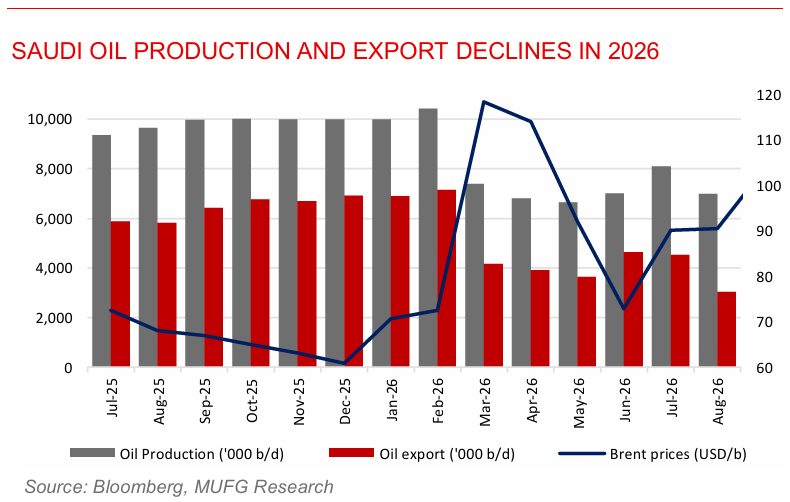
Saudi Arabia widens 2026 deficit forecast as war raises spending. Saudi Arabia raised its 2026 budget deficit forecast to 4.9% of GDP from 3.3%, as the government increases defence and infrastructure spending to cushion the economic impact of the regional conflict while maintaining its diversification agenda. Expenditure is now projected at around SAR 1.4tn (USD 380bn), while revenue is expected to reach SAR 1.2tn, supported by Brent trading near USD 100/b and record non-oil receipts. Despite the wider shortfall, the deficit remains below its 2025 level and is projected to narrow to 3.6% of GDP in 2027 as spending moderates. The government also sharply revised its 2026 real GDP forecast to a 3.6% contraction from 4.6% growth previously, reflecting lower oil activity and production disruptions linked to the conflict. Higher crude prices and Saudi Arabia’s ability to gradually restore alternative export routes have partly cushioned the shock, with oil revenues reaching a near two-year high in Q2. KSA intends to preserve priority investment and diversification spending while using domestic and international borrowing to finance the larger fiscal gap, maintaining flexibility to adjust expenditure as geopolitical conditions evolve.
Morocco growth slows to 4.0% as non-agriculture activity weakens. Morocco’s economy expanded 4.0% y/y in Q2 2026, slowing from 5.8% y/y as a strong agricultural rebound was offset by significantly weaker non-agricultural activity. Agricultural value added surged 21.2%, up from 8.3% in Q2 2025, while fisheries expanded 15.9%, lifting overall primary-sector growth to 20.9%. By contrast, non-agricultural growth slowed sharply to 1.5% from 4.9%, with the secondary sector contracting 3.9% after growing 5.8% a year earlier. Mining and extractive activity fell 28.6% and manufacturing declined 3.2%, while construction growth moderated to 2.8%. Services remained comparatively resilient, although growth eased to 4.0% from 4.5%. Domestic demand remained the main growth driver, while inflationary pressures were subdued, with the GDP price measure rising just 0.4%. The increasingly agriculture-led growth profile highlights weaker underlying momentum, with a recovery in manufacturing, mining and investment-sensitive sectors likely to be important for sustaining growth through the remainder of 2026.