
To read the full report, please download the PDF above.
Middle East Daily
EDWARD BELL
Head of Research
DIFC Branch – Dubai
T: +971 (4)387 5033
E: edward.bell@ae.mufg.jp
SOOJIN KIM
Research Analyst
DIFC Branch – Dubai
T: +971 (4)387 5031
E: soojin.kim@ae.mufg.jp
MUFG Bank, Ltd. and MUFG Securities plc
A member of MUFG, a global financial group
Middle East Daily
COMMODITIES / ENERGY
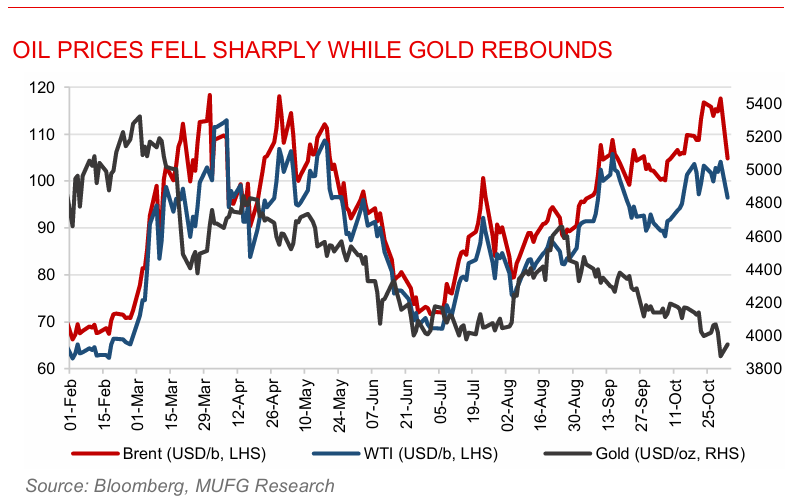
Oil slumps as prospect of US-Iran diplomacy eases geopolitical risk premium. Oil prices fell sharply overnight with Brent for January 2027 losing more than 7.6% to close out at USD 104.77/b with prices steadying in early trade today. The immediate catalyst for the sharp sell off has been a renewed emphasis on diplomacy between the US and Iran with both US President Donald Trump and Iranian President Masoud Pezeshkian giving constructive signals on the possibility of talks. At the same time, however, the US carried out air strikes against Qeshm Island, an Iranian island in the Strait of Hormuz. Time spreads have narrowed sharply since the start of the week with the prompt spread falling to a backwardation of USD 3/b from USD 4/b at the end of last week. The US midterms will be held today with the prospect for regional security in focus for the coming days. Oil exports from the region have moved back closer to pre-conflict levels but could be at risk in a renewed offensive against Iran. In Europe, natural gas prices have pulled back from recent highs of more than EUR 100MWh though incoming cooler weather for Europe could squeeze prices higher in the short-term.
Gold rebounds as falling energy prices ease inflation fears. Gold prices gained 1.9% overnight and are trading slightly lower at USD 3,925/troy oz in early trade today. The sharp sell-off in energy prices has helped to push back against inflation fears, providing some room for gold to perform. However, there are few other strong catalysts for gold between now and the end of the year. The Fed is still priced in for another hike at the December meeting which will keep short-term Treasury yields elevated, sapping interest from non-interest bearing gold.
MIDDLE EAST - CREDIT TRADING
End of day comment – 02 November 2026. One would be forgiven to think GCC bonds should have been trading well today. After all the weekend news was diplomatic efforts up, which meant oil down to start and risk on across credit indices and equities. That was further reinforced by today's newsflow about Iran greenlighting talks. However, the MENA market never got going. From the start flows were skewed to selling by ETFs and RM. The previously strong bid in duration bonds was not seen today as higher cash prices brought sellers out. KSA outperformed a touch closing broadly unch in spread terms with a small steepening bias. KUWIB also saw some short covering flows in 36s closing +0.5pt/-1bp. The rest was wider. In sovgn especially QATAR which had buyers of 36s (+0.375pt/+1bp) vs selling long end 49s/50s (-0.25pt/+8bp). ADGB was quiet but also a touch steeper with spreads 2/4bp wider. The ugly parts of the market remain fins and corps. AT1s were again for sale, today Saudi names caught up with the weakness like Alinma 6.625 perps closing -0.625pt/+20bp. HY corps remain weak as well, DAMACR 29s closed -1.5pt. The market feels on edge overall, dealers continue to look for bids trying to exit/cut positions and there were no natural buyers in the last two trading sessions. (Source: Dominik Roth, Credit Trader)
MIDDLE EAST - MACRO / MARKETS
Mixed PMI signals across Saudi Arabia, Egypt and Turkey. Business conditions across the region remained mixed in October, with Saudi Arabia’s non-oil economy continuing to expand while Egypt and Turkey stayed in contraction. Saudi Arabia’s PMI eased to 54.0 from 55.3 in September, with domestic demand continuing to support activity despite weaker export sales and geopolitical uncertainty weighing on expectations. Cost pressures also increased, driven by higher shipping, insurance, energy and raw material costs, although firms had limited scope to pass these increases on to customers. In Egypt, the PMI remained at 47.2 for a second consecutive month, as weak domestic demand, regional conflict and higher prices weighed on activity. Input costs rose sharply on higher shipping and energy costs, with firms passing more of these increases on to consumers, adding to persistent inflation pressures that contributed to the Central Bank of Egypt’s surprise rate hike last month. Meanwhile, Turkey’s PMI fell to 47.3 from 47.9, marking the sharpest deterioration since June and extending the downturn to 31 consecutive months. Weak demand continued to weigh on new orders, exports and employment, while higher oil and raw material prices and adverse FX movements kept input cost pressures elevated.
Saudi Aramco’s Q3 profit rises 9% on higher oil prices. Saudi Aramco reported a 9% y/y rise in adjusted net income to USD 31.2bn in Q3 2026, beating expectations of USD 28.7bn, supported by higher oil prices and resilient exports. Brent rose more than 40% during the quarter amid supply concerns linked to Strait of Hormuz disruptions. Aramco increased shipments through Ras Tanura following disruptions to the East-West pipeline and Yanbu terminal. Higher oil prices and resilient exports should support profitability and Saudi Arabia’s fiscal position, though continued attacks on energy infrastructure remain a key risk.