
To read the full report, please download the PDF above.
Middle East Daily
EDWARD BELL
Head of Research
DIFC Branch – Dubai
T: +971 (4)387 5033
E: edward.bell@ae.mufg.jp
SOOJIN KIM
Research Analyst
DIFC Branch – Dubai
T: +971 (4)387 5031
E: soojin.kim@ae.mufg.jp
MUFG Bank, Ltd. and MUFG Securities plc
A member of MUFG, a global financial group
Middle East Daily
COMMODITIES / ENERGY
Oil extends decline as US-Iran diplomacy gains momentum. Oil prices are holding several days of losses as the market focuses on the possibility of a diplomatic outcome between Iran and the US. Brent futures are trading below USD 104/b in early trade while WTI is holding around USD 96/b. Both Iran and the US continue to exchange proposals via intermediaries while US President Donald Trump said in press commentary that there may be “no need” for a renewed offensive against Iran. As the political focus shifts from the US midterms, there may be a stronger effort from the US to push Iran towards a deal either by ratcheting up the economic pressure on the country or via a targeted military campaign. Saudi Aramco plans to increase production to maximum levels in Q4 2026 which would bring output to more than 10m b/d if achieved, close to levels produced in January and February this year. In the US, the API reported a draw in US crude stockpiles of 5.3m bbl last week while gasoline inventories built. Distillate stockpiles were lower. European natural gas prices are holding at elevated levels above EUR 90/MWh though near-term moves will likely track oil and geopolitical headlines from the Middle East.
Gold edges higher as lower yields and oil ease inflation concerns. Gold prices are pushing modestly higher in early trade, unwinding overnight losses. Democrats are poised to take control over Congress which could limit fiscal expansion as policymaking grinds amid mixed Executive and Legislative bodies. US Treasury yields are dropped modestly in the wake of the incoming election results which should provide some near-term support for gold prices.
MIDDLE EAST - CREDIT TRADING
End of day comment – 03 November 2026. Another day where the market ignored most headlines and closed a touch wider. With the UST weakness post London close, cash prices adjusted to the left to start with spreads broadly unchanged. The day had a lot of headlines on the US/ Iran talks but the market neither reacted to good ones nor to bad ones. In fact, the flows remained somewhat heavy, but turnover was low ahead of the midterms. If anything, there was a tendency from RM and dealers to reduce risk. As result spreads are going out anywhere from -1bp to +3bp. KUWIB outperformed as the short covering in new 36s continued closing -0.125pt/-1bp. At the other end of the spectrum long end KSA saw some selling after its recent outperformance, 56s closing -0.75pt/+3bp. Away from sovgn flows some financial AT1 and T2 started to see more two-way flows, mainly in the top tier banks. FABUH 34s, 35s and 36s found some buyers today closing unchanged, also seen first buyers of the 5.875 perps. However, second tier fins and corps still feel offered with the marginal seller moving prices lower. Not much else to report, overall volumes look 30% of a normal day, the market is looking for a new trigger. (Source: Dominik Roth, Credit Trader)
MIDDLE EAST - MACRO / MARKETS
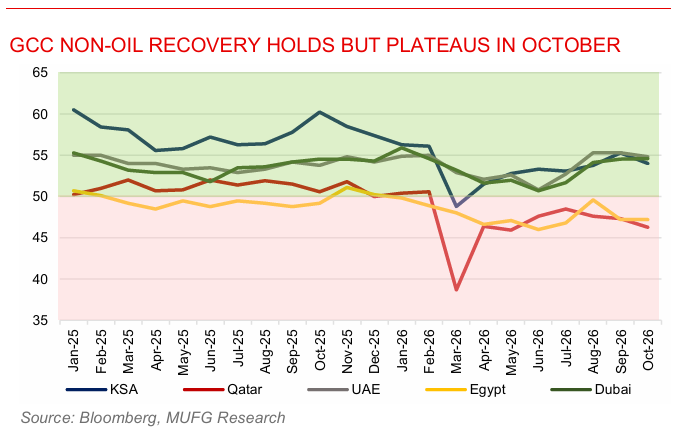
UAE non-oil growth remains resilient as Qatar’s business activity contracts. The UAE’s non-oil private sector continued to expand in October, with the S&P Global PMI easing to 54.8 from 55.3 in September, supported by stronger new orders and the fastest growth in export demand in two years. Meanwhile, Dubai’s PMI increased to an eight-month high of 54.6, reflecting sustained momentum in construction, retail, tourism and manufacturing. However, inflationary pressures intensified, with UAE selling prices rising at the fastest pace since the survey began in 2009, driven by higher raw material, energy and freight costs, while employment declined marginally amid cost-control measures. In contrast, Qatar’s non-energy PMI fell to 46.3 from 47.3, signalling a deeper contraction as business activity weakened and new orders declined for the 11th consecutive month. Construction recorded the sharpest deterioration, while employment fell for the first time since July 2024. The divergence highlights the UAE’s stronger non-oil resilience amid regional uncertainty, although record price pressures could weigh on demand, while Qatar’s prolonged weakness suggests a more challenging recovery ahead.
Saudi fiscal deficit widens sharply as oil revenues fall. Saudi Arabia’s Ministry of Finance reported a deficit of SAR 84.3bn in Q3 2026, an increase of 145% q/q. Government revenue fell 23.5% q/q to SAR 259bn in Q3 with oil revenues lower by 37% q/q and down 23% y/y. Overall expenditure was also lower q/q at SAR 343bn but there was a strong increase in financing expenses thanks to a growing stock of public debt. Social benefit spending also increased substantially in Q3. For the first nine months of 2026, Saudi Arabia has already exceeded its budgeted deficit by nearly 50% with all the shortfall met by borrowing. Saudi Arabia’s pre-budget plan for 2027 revised its estimate of the 2026 deficit to nearly 5% of GDP from 3.3% originally planned. For 2027, the ministry of finance still projects a deficit at 3.6% of GDP.