
To read the full report, please download the PDF above.
Middle East Daily
SOOJIN KIM
Research Analyst
DIFC Branch – Dubai
T: +44(4)387 5031
E: soojin.kim@ae.mufg.jp
MUFG Bank, Ltd. and MUFG Securities plc
A member of MUFG, a global financial group
Middle East Daily
COMMODITIES / ENERGY
Oil rises as US-Iran tanker attacks renew Hormuz supply risks. Oil advanced as escalating US-Iran attacks on tankers and Iran’s threat to establish a new restricted maritime zone intensified concerns over energy flows through the Strait of Hormuz. Brent traded near USD 97/b, while WTI was around USD 92/b, extending gains after last week’s renewed hostilities. The US said it struck three Iranian oil tankers over the weekend, sinking one and disabling two others, in retaliation for Iranian missile attacks on US naval vessels. The escalation comes as the US maintains its naval blockade aimed at restricting Iranian oil exports while facilitating commercial passage through Hormuz. With tanker traffic increasingly exposed to direct military action and restrictions around the strait potentially widening, risks to Gulf energy exports remain elevated, keeping a substantial geopolitical premium embedded in oil prices.
Gold extends decline as strong US jobs data boosts rate-hike bets. Gold extended losses, briefly falling below USD 4,400/oz, as stronger-than-expected US employment data and renewed Middle East tensions reinforced expectations that the Fed could raise rates next week. Gold fell as much as 0.9% after declining 1% in the previous session, while markets raised the probability of a September rate hike to around 60% following robust August payroll growth and a steady unemployment rate. A firmer dollar added pressure, while escalating US-Iran hostilities presented a mixed backdrop for gold. Gold has remained volatile around USD 4,400 after recovering from July lows near USD 4,000/oz, supported by renewed central-bank buying and portfolio-hedging demand. This week’s US inflation data will be critical in determining whether the Fed tightens policy at its September 15–16 meeting, with persistent price pressures likely to remain a near-term headwind for gold.
MIDDLE EAST - CREDIT TRADING
End of day comment – 04 September 2026. It was a long day as no one traded before NFP and everyone went on a long weekend after NFP. Away from my GCC universe new issues showed some activity, but there is still no sign of any UAE/ QATAR or OMAN issuance. Spreads look tighter post NFP but like with Jackson Hole last Friday the market most likely will reprice a bit post labour day. All said rates market remain relatively calm with no bigger increase in rate hike odds and only a small flattening bias in the UST curve. Nevertheless, some RM sold shorter end bonds mainly in fins/ quasis and corps. But the market seems happy to get these on board just over 5% yield so there was no measurable price impact. With that price stickiness spreads are going out -1/-3bp today. (Source: Domonik Roth, Credit Trader)
MIDDLE EAST - MACRO / MARKETS
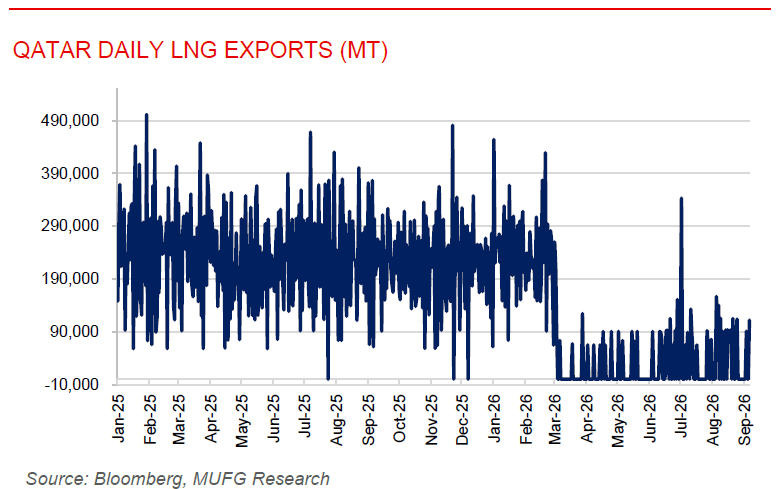
Qatar and UAE ratings remain supported by strong financial buffers. Fitch affirmed Qatar’s sovereign rating at AA and removed it from Rating Watch Negative, while maintaining a Negative Outlook due to continued risks from disruptions to LNG exports through the Strait of Hormuz and damage to part of its LNG infrastructure. Despite an expected sharp economic contraction in 2026, Qatar’s rating remains supported by its exceptionally strong sovereign wealth assets, large net foreign asset position, and anticipated gains from the North Field gas expansion once exports normalise. Fitch expects temporary fiscal and current account deficits and higher government debt but projects a strong recovery from 2027 onward as LNG exports resume and gas production increases. Meanwhile, S&P affirmed the UAE’s AA ratings with a Stable Outlook, citing its substantial fiscal and external buffers, low government debt, and strong sovereign wealth fund assets. Although the ongoing regional conflict and trade disruptions may weigh on non-oil sectors in 2026, S&P expects the UAE’s economic resilience to be supported by rising oil production capacity, diversified export routes, infrastructure expansion, and business-friendly policies. Both countries benefit from strong balance sheets and financial reserves, but their outlooks remain influenced by the potential for further disruptions to energy exports and critical infrastructure.
Tunisia’s inflation accelerates as food prices rise. Tunisia’s annual inflation accelerated to 5.4% y/y in August from 5.1% y/y in July as food-price pressures intensified, reversing several months of gradual disinflation. Food inflation rose to 7.8% from 6.8%, driven by sharp increases in poultry, meat, fruit and fresh fish prices, while core inflation edged only slightly higher to 4.9% from 4.8%, suggesting that the renewed pickup remains relatively concentrated in volatile food categories. Manufactured-goods inflation stood at 4.7% and services at 4.3%, while non-regulated prices increased 6.5% y/y, substantially faster than the 1.3% rise in administered prices. The latest reading leaves inflation slightly above the government’s roughly 5.3% full-year target and complicates the outlook for monetary easing. Persistent food-price pressures and core inflation near 5% are likely to keep the Central Bank of Tunisia (BCT) cautious, with the evolution of agricultural supply and domestic price pressures determining whether disinflation resumes later this year.