
To read the full report, please download the PDF above.
Middle East Daily
EDWARD BELL
Head of Research
DIFC Branch – Dubai
T: +971 (4)387 5033
E: edward.bell@ae.mufg.jp
SOOJIN KIM
Research Analyst
DIFC Branch – Dubai
T: +971 (4)387 5031
E: soojin.kim@ae.mufg.jp
MUFG Bank, Ltd. and MUFG Securities plc
A member of MUFG, a global financial group
Middle East Daily
COMMODITIES / ENERGY
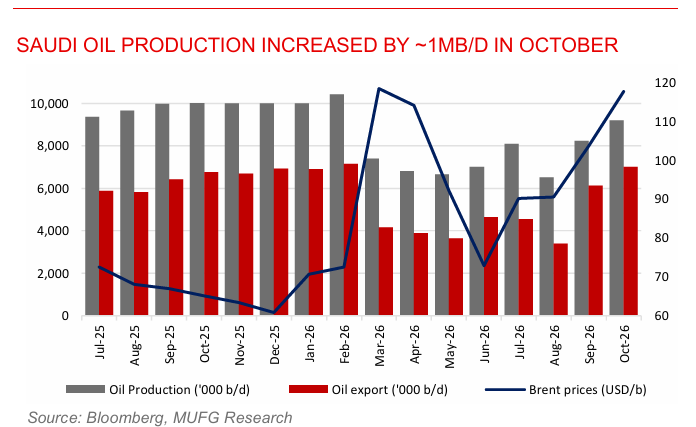
Oil slides as US-Iran diplomacy eases geopolitical premium. Oil prices are easing back in early trading today with Brent January futures at USD 97.40/b while WTI is pushing closer to USD 90/b. US President Donald Trump said it was “highly unlikely” that he would order renewed strikes against Iran while negotiations are underway while Trump is due to meet with the Prime Minister of Qatar, who has been a primary mediator between the US and Iran. Market estimates of OPEC production showed aggregated output at nearly 90% of pre-conflict levels as of October at 22.8m b/d according to Bloomberg. Saudi Arabia’s production increased by nearly 1m b/d last month to 9.2m b/d. Elsewhere market signals are flashing more signs of easing strain in oil markets. Front month spreads have fallen to a backwardation of USD 2.60/b from nearly USD 4/b at the end of last week while physical prices are trading below futures. In natural gas markets, TTF futures are holding the sharp losses from the end of last week with December futures are EUR 86.67/MWh.
Gold extends gains as lower energy prices ease inflation fears. Gold prices are extending last week’s gains with spot gold up 1.3% at USD 4,123/troy oz. The pullback in energy prices last week is helping to quell inflation anxieties and will set out a flatter path for rate hikes from central banks. Pricing for the December FOMC is at 20bps or roughly 80% with a second hike only full priced in by Q3 next year. Gold has managed to push higher even as the US jobs report at the end of last week showed much stronger than expected print for November. The US CPI report for October will be released on 10 November and will be the next major catalyst for gold prices.
MIDDLE EAST - CREDIT TRADING
End of day comment – 06 November 2026. Very quiet Friday as it seems that in terms of trading Friday’s have become part of the weekend. There was no panic/ selling in the morning following on the equity sell off overnight and in Asia. A hotter NFP also failed to move the market either side. Spreads are broadly closing unchanged. In terms of news flow there were reports on US/Iran being close to an agreement, but here as well that didn't bring any market reaction with it. The one credit which has traded a bit heavy today was OMAN, especially the short end/ belly which is not a part of the curve which is always active. Seen sellers in 32s closing them -0.25pt/+3bp. Going out, macro markets are starting to find their feet with credit indices moving a touch tighter and equities in the green. Absent any bigger macro moves, the GCC markets next week should focus again on the US/Iran situation. A mandate should be given Sunday to form an Israeli government which could affect the dynamics of the diplomatic efforts as well. (Source: Dominik Roth, Credit Trader)
MIDDLE EAST - MACRO / MARKETS
UAE non-oil trade surges as exports drive growth. The UAE’s non-oil trade rose 10% y/y in the first three quarters of 2026 to AED 2.9trn (USD 789.7bn). Non-oil exports increased by 22% to AED 706bn (USD 192.2bn) while imports rose by 11% to AED 1.7trn (USD 462.9bn). The UAE reported strong growth in trade outside of its top 10 trading partners, with rest of world trading increasing by 12% compared with 8% among major trading partners. The strong performance in the UAE’s trade tracks with commentary from firms reporting to monthly PMI surveys who have noted that export orders have supporting growth in 2026 while the economy has shown the ability to quickly adapt supply chains amid the regional conflict.
Saudi Arabia’s consumer spending rebounds 30.8%. Saudi Arabia’s consumer spending rebounded sharply in the week ending October 31, with point-of-sale (POS) transactions rising 30.8% w/w to SAR 15.41bn (USD 4.1bn), reversing two consecutive weeks of declines, according to the Saudi Central Bank (SAMA). Transaction volumes increased 15.6% to 264.93mn, reflecting broad-based growth across sectors and cities, largely supported by salary payments and deferred household purchases. Education spending recorded the strongest increase, surging 81.5% w/w, and food and beverage spending rose 39.6% to SAR2.8bn. Geographically, Riyadh accounted for the largest share of spending at SAR 5.33bn, up 26.5%, followed by Jeddah at SAR 1.97bn (+23.2%). The broad-based recovery suggests resilient near-term consumer demand, although the sharp increase appears largely driven by payday-related spending patterns rather than a sustained acceleration in underlying consumption.