
To read the full report, please download the PDF above.
Middle East Daily
EDWARD BELL
Head of Research
DIFC Branch – Dubai
T: +971 (4)387 5033
E: edward.bell@ae.mufg.jp
SOOJIN KIM
Research Analyst
DIFC Branch – Dubai
T: +971 (4)387 5031
E: soojin.kim@ae.mufg.jp
MUFG Bank, Ltd. and MUFG Securities plc
A member of MUFG, a global financial group
Middle East Daily
COMMODITIES / ENERGY
Oil retreats as Trump comments cools Iran strike expectations. Oil prices are trading on the backfoot following comments from US President Donald Trump saying the US would not attack Iran before the midterm elections in November. Brent futures are trading below USD 103/b while WTI is back at a USD 90/b handle after surges overnight in response to media reports that the US was actively considering new operations against Iran. Ongoing fighting between Saudi Arabia and its allies against the Houthis are keeping the geopolitical risk in oil markets elevated while shipping in the Gulf and Strait of Hormuz continues to be threatened. Time spreads in the Brent market continue to stay wide, however, with the 1-2 month spread in a backwardation of USD 3/b. Hurricane Isaias in the US Gulf Coast has also impacted production with around 500k b/d of capacity at risk from the storm. European natural gas is following crude lower with prices down 2.6% at EUR 76.75/MWh after pushing above EUR 80/MWh overnight.
Gold advances as lower yields support safe-haven demand. Gold prices are pushing higher with spot just below USD 4,200/troy oz after a day of consolidation overnight. A strong auction of 30yr US Treasuries helped to pull bond yields lower and divert attention toward gold. The drop in oil prices and modest pullback inflation fears is also helping to support gold: 10yr breakevens in the US dropped from a one-week high overnight and are holding near flat today. Inflation expectations due out later today will be the next major catalyst for gold: University of Michigan year-ahead inflation expectations are expected to rise to 4.8% from 4.6% a month earlier.
MIDDLE EAST - CREDIT TRADING
End of day comment – 08 October 2026. The resilience of GCC bonds in light of increased macro weakness continued today. Especially in the morning with UST weakness, oil higher and equities down flows were still reasonably balanced. To be sure, volumes remain low, so it is a bit a low buying/ low selling environment. But spreads are overall tighter on average by 2bp and cash prices in sovgn bonds anywhere from unch to +0.25pt. ADGB was strong, in the short end seen buyers up to 2031s with 29s the preferred bonds closing +0.10pt/-4bp. In the long end 47s had the strongest buying interest closing +0.375pt/-2bp. QATAR drifted a touch wider in the new 36s on the other hand closing unch/+2bp. In higher betas MOROC EUR curve continued its gyrations, today with good buying in 34s closing +0.25pt/-7bp. The one area of weakness away from sovgn remain fins AT1s. Selling resumed and many bonds have not found clearing levels, closing both EBIUH 6.25 perps -0.25pt/+3bp. (Source: Dominik Roth, Credit Trader)
MIDDLE EAST - MACRO / MARKETS
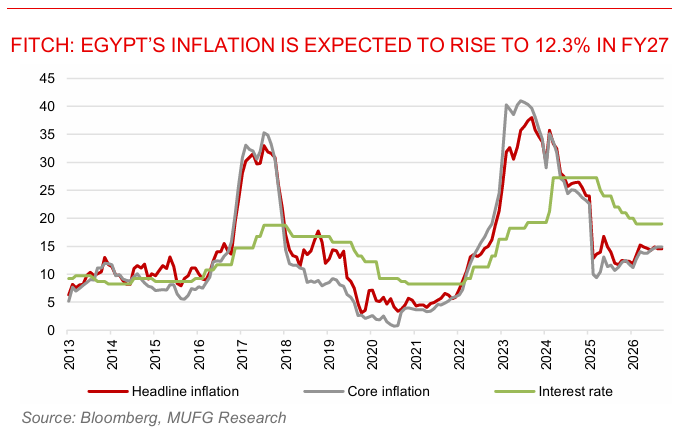
Fitch affirms Egypt at ‘B’ with stable outlook. Fitch Ratings affirmed Egypt’s Rating at ‘B’ with a Stable Outlook, citing resilient external buffers, strong multilateral support and solid growth prospects despite persistent fiscal vulnerabilities. Egypt’s flexible exchange rate regime weathered significant capital outflows following the Iran war, with foreign investors subsequently returning and the pound recovering most of its initial depreciation. Fitch estimates the current account deficit widened to 5.1% of GDP in FY26, driven by higher energy import costs, before narrowing below 3.5% by FY28 as tourism receipts and trade balances improve. GDP growth is projected to moderate from 5.1% in FY26 to 4.7% in FY27, while inflation is expected to rise to 12.3% in FY27 before easing below 10% in FY28. Meanwhile, the fiscal deficit is forecast to widen to 5.8% of GDP in FY27, although public debt should decline to 72% of GDP by FY28. Continued fiscal consolidation, exchange rate flexibility and external financing support should underpin credit stability, although elevated debt-servicing costs, inflation and geopolitical uncertainty remain key rating constraints.
Iraq turns to Syria for alternative oil exports as Hormuz risks persist. Iraq is preparing to export crude oil through Syria’s Mediterranean port of Baniyas, seeking to reduce its dependence on the Strait of Hormuz amid persistent shipping disruptions. The arrangement, expected to begin by mid-October, could involve more than 1,000 trucks daily, each carrying around 220 barrels, building on existing fuel oil shipments through Syria. However, the volumes would remain modest relative to Iraq’s total crude exports of approximately 2.7mb/d in September. Meanwhile, Syria plans to expand domestic crude production from 110kb/d to 250kb/d by end-2027, alongside refinery upgrades that would raise Baniyas processing capacity to 130kb/d and Homs to 70kb/d. The government is also attracting international energy suppliers and investors to rebuild its war-damaged infrastructure. While trucking offers Iraq limited near-term export flexibility, pipeline rehabilitation and Syrian infrastructure investment could provide a more substantial alternative to Hormuz over the medium term.