
To read the full report, please download the PDF above.
Middle East Daily
EDWARD BELL
Head of Research
DIFC Branch – Dubai
T: +971 (4)387 5033
E: edward.bell@ae.mufg.jp
SOOJIN KIM
Research Analyst
DIFC Branch – Dubai
T: +971 (4)387 5031
E: soojin.kim@ae.mufg.jp
MUFG Bank, Ltd. and MUFG Securities plc
A member of MUFG, a global financial group
Middle East Daily
COMMODITIES / ENERGY
Oil rebounds from August lows as markets reassess Iran risks. Oil prices have recovered some ground after two days of selloff with Brent futures at one point dipping below USD 90/b, their lowest level since August. Brent is currently up around 1% at USD 92.50/b while WTI has added 0.7% to USD 86.68/b. The market is still closely focusing on conditions between Iran and the US with President Trump saying earlier in the week that no further attacks against Iran were likely though there has likewise been little tangible evidence of diplomatic progress. In oil market fundamentals, the API reported a build in US crude inventories of 9m bbl last week along with increases in gasoline and diesel stockpiles. The EIA kept its forecast for US oil production in 2027 unchanged at 14.3m b/d. Time spreads are holding steady at slightly more than a USD 2/b backwardation in Brent front months and WTI at USD 1.20/b/b. European natural gas prices are extending an overnight gain with prices up 1% today to EUR 85.60/MWh.
Gold slides as hotter US inflation fuels Fed hike bets. Gold prices dropped overnight in response to faster than expected inflation data from the US. Spot gold fell 2.6% to USD 4,033/troy oz and are holding close to those levels in early trade today. Expectations of a larger than 25bps hike for the December FOMC are becoming more embedded in the market with 29bps of hike priced in following comments from Governor Waller saying that “stronger policy” moves may be needed. Prices were higher across the rest of the precious metals complex with silver adding 1.6% in early trading today.
MIDDLE EAST - CREDIT TRADING
End of day comment – 10 November 2026. Rates fear is back post CPI. With the magnitude of the UST sell off G-spreads tightened sharply today. We know it will take a few days to normalise eventually. But there was strong demand in the morning which carried the market through the afternoon UST sell off. The GCC bond market cheered overnight headlines of Trump again playing down the likelihood of renewed military confrontation despite still haven't found any common ground/ agreement. Cash prices were higher and spreads up to -5bp into CPI. Afterwards cash prices adjusted slowly to the left and on average we are going out -10bp. Again, this will most likely normalise in coming days, but there was still a strong bid into the close like for QATAR 36s (-0.25pt/-9bp) or TAQAUH 36s (-0.125pt/-10bp). There were also yield buyers in front end bonds despite the 17bp move in 2y, however into the close you see more and more sellers in up to 2030s maturity bonds across market sectors. The broader question will be now how increased rate hike expectations will affect credit markets going forward. (Source: Dominik Roth, Credit Trader)
MIDDLE EAST - MACRO / MARKETS
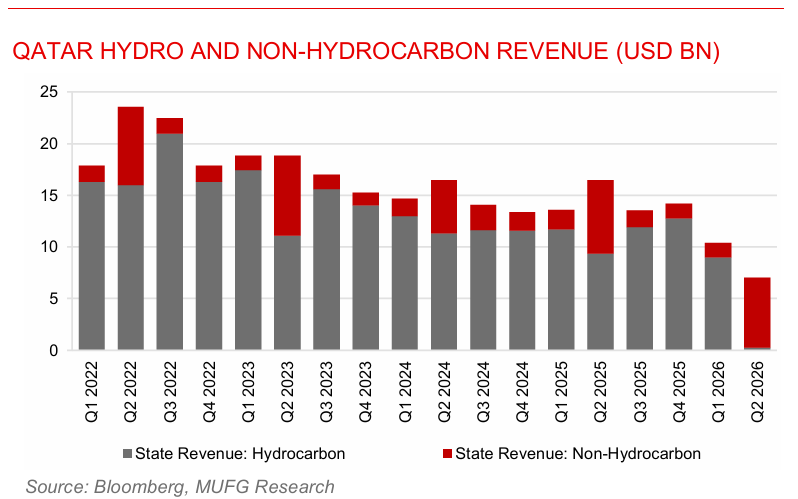
Qatar’s LNG shipments gradually recover despite Hormuz disruptions. Qatar’s LNG shipments have increased in early November, signalling a gradual recovery in export activity despite persistent security risks around the Strait of Hormuz. LNG loadings at Ras Laffan rose to 13–15 shipments on a 10-day moving average basis, compared with around 11 in October, although volumes remain roughly half their pre-war levels. However, the increase in loadings has yet to translate into stronger exports through Hormuz, with only 11 laden Qatari LNG tankers exiting the strait during the 10 days through November 8. The recovery comes ahead of peak winter demand, when competition between European and Asian buyers could intensify, while European gas prices remain more than twice their pre-war levels despite recent declines. Although improving LNG loadings could gradually ease global supply constraints, sustained export recovery remains dependent on safe passage through Hormuz, with persistent geopolitical tensions and shipping disruptions posing significant downside risks.
Fitch highlights Iraq’s fiscal pressures despite recovering oil production. Fitch Ratings highlighted Iraq’s significant fiscal and external vulnerabilities amid ongoing regional conflict, despite recovering oil production and substantial foreign exchange reserves. Real GDP is forecast to contract 9.0% in 2026 before rebounding 17.7% in 2027, supported by recovering oil output, which reached 4.4mb/d in September following a sharp decline earlier in the year. Meanwhile, FX reserves fell to USD 81bn in October from ~USD 100bn before the conflict, although reserve coverage remains relatively strong at an estimated 9.9 months of external payments. The fiscal deficit is projected to widen to 6.5% of GDP in 2026 from 5.2% in 2025, reflecting weaker oil revenues and substantial export discounts, before narrowing to 0.5% in 2027. While recovering oil production and substantial reserves support economic stabilisation, persistent fiscal rigidities, heavy hydrocarbon dependence and geopolitical uncertainty remain key constraints.