
To read the full report, please download the PDF above.
Middle East Daily
SOOJIN KIM
Research Analyst
DIFC Branch – Dubai
T: +44(4)387 5031
E: soojin.kim@ae.mufg.jp
MUFG Bank, Ltd. and MUFG Securities plc
A member of MUFG, a global financial group
Middle East Daily
COMMODITIES / ENERGY
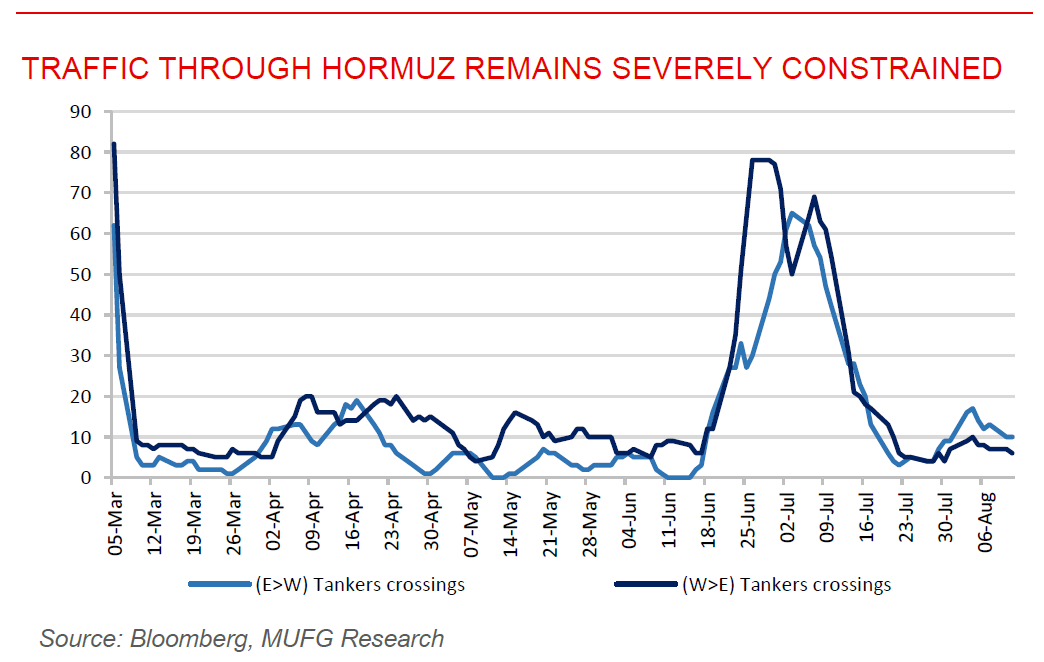
Oil extends rally as uncertainty over Hormuz deal persists. Brent crude rose above USD89/b, while WTI traded near USD84/b, extending gains for s sixth consecutive session as markets remained skeptical that a deal to restore normal shipping through the Strait of Hormuz is imminent. Officials indicated that Iran-Oman talks were at an advanced stage, while President Trump hardened his stance toward Iran and introduced additional demands. Traffic through Hormuz remains severely constrained, although some oil continues to move through the Strait with US military assistance or on vessels operating without visible transponders. Regional supply risks also remain elevated as hostilities extend into the Red Sea. Despite signs of diplomatic progress, uncertainty over the timing and terms of a Hormuz agreement is likely to keep a substantial geopolitical risk premium in oil prices, while a reported 9.1mb/d rise in US crude inventories could provide some near-term downside pressure.
Gold rebounds above USD4,400 ahead of US inflation data. Gold rose back above USD4,400/oz as investors weighed tentative progress toward reopening the Strait o Hormuz against uncertainty over the Fed rate outlook. Reports that the US and Iran may be nearing an arrangement on Hormuz offered some hope of easing regional tensions, although both sides continue to maintain tough negotiating positions. Meanwhile, renewed gains in oil prices have kept inflation concerns elevated ahead o US CPI data, with markets roughly split on the likelihood of 25bps Fed hike next month. July CPI is expected to rise just 0.1% m/m, and a softer print following weak US employment data could reduce pressure for further tightening. Gold remains supported but its near-term direction will depend heavily on US inflation data and whether energy price pressure strengthen the case for higher interest rates.
MIDDLE EAST - CREDIT TRADING
End of day comment – 11 August 2026. An uptick in action today as we opened with an apparent stale mate in the "deal/no deal" process which generally pushed spreads wider as UST went lower in price. Given the time of the year there was little resistance to this move until the Pakistani's played the role of Mr. Trump and floated the idea of a "deal is near" which gave a boost to risk assets, took the boost out of oil and turned US rates around (again.) While that headline helped macro the negative inertia in our names was hard to slow down and spreads remained wider into the afternoon even as cash prices rose. Sukuks chilled out today but remain bid through. Bahrain is a big loser in terms of spread today, today it became clear that the market seems to have covered what they want to cover and there is little impetus to cover any shorts or support spreads at these levels. I'm taking the curve out 8-12bps wider with Sukuks (duh) holding in slightly better, though the short end is more like +15-20bps. TraX volumes showing <3mm though. (Source: Matthew Dunker, Credit Trader)
MIDDLE EAST - MACRO / MARKETS
GCC debt issuance remains resilient in H1 2026. Primary bond and sukuk issuance across the GCC rose 6.5% y/y to USD102.7bn across 161 deals in H1 2026, highlighting continued access to capital markets despite heightened regional uncertainty. Saudi Arabia dominated issuance, raising USD49.3bn, or 48% of the regional total, followed by the UAE at USD25.5bn and Qatar at USD12.4bn, with Qatar recording a strong 32.3% y/y increase. Corporate issuance increased 8.4% to USD66.7bn and accounted for 64.9% of the market. Notably, conventional bonds rose 33.3% to USD73.6bn, whereas sukuk issuance declined 29.5% to USD29.1bn, suggesting that the overall expansion was driven primarily by conventional funding. Looking ahead, GCC debt issuance is likely to remain supported by sovereign and corporate funding requirements, although geopolitical volatility and the trajectory of global interest rates remain key determinants of issuance activity and funding costs.
Jordan steps up water-sector investment amid severe scarcity. Jordan is accelerating investment in water infrastructure as climate change, population growth and ageing networks intensify one of the world's most severe water shortages. Renewable water availability stands at just 84 cubic metres per person annually, far below the 500 cubic metre thresholds for absolute water scarcity, while supplies could decline by up to 30% by 2040. A World Bank-backed Water Sector Efficiency Project aims to improve services for 1.6 million people and save around 10mn cubic metres of water by reducing network losses, replacing ageing pipelines and modernising water systems. The longer-term centrepiece is the Aqaba-Amman National Water Carrier, which is designed to desalinate 300mn cubic metres annually and supply around 40% of Jordan's municipal water needs through a roughly 438km conveyance network from 2030. Going forward, successful delivery of the National Water Carrier and continued reductions in distribution losses will be critical to improving water security, while financing constraints, implementation challenges and intensifying climate pressures remain key risks to Jordan's long-term water strategy.