
To read the full report, please download the PDF above.
Middle East Daily
EDWARD BELL
Head of Research
DIFC Branch – Dubai
T: +971 (4)387 5033
E: edward.bell@ae.mufg.jp
SOOJIN KIM
Research Analyst
DIFC Branch – Dubai
T: +971 (4)387 5031
E: soojin.kim@ae.mufg.jp
MUFG Bank, Ltd. and MUFG Securities plc
A member of MUFG, a global financial group
Middle East Daily
COMMODITIES / ENERGY
Oil pulls back as Saudi security risks persist. Oil prices are pushing lower on the open after a sharp gain at the start of the week due to a widening in geopolitical risk premiums. Brent futures for December are trading at USD 105.45, down close to 1% after a near 2% gain overnight while WTI is down 1.2% at USD 92.61/b after moving close to USD 94/b overnight. Attacks on civilian infrastructure in Saudi Arabia and ongoing fighting in Yemen are keeping geopolitical anxiety high even if energy infrastructure has not been directly targeted in recent days. Saudi Arabia’s energy minister, Prince Abdulaziz bin Salman, said the country plans to increase its pipeline capacity to the western part of the country over the next several years to 10m b/d from 7m b/d at present. Saudi Aramco also plans to convert a natural gas pipeline to crude to add an additional 1.2m b/d over the next several months. Across the rest of the barrel, gasoil futures were up 0.9% at the start of trading to USD 601.70/tonne while European natural gas futures are holding at EUR 85.50/MWh.
Gold steady as inflation test looms. Gold prices continue to trade with little conviction with spot prices at USD 4,198/oz, recovering some of the modest overnight losses. US inflation for September will be released later this week with market expectation for an acceleration in both headline and core which will firm up rate expectations, at least for the end of the year. Higher bond yields will continue to pull investors away from gold amid a widening global inflationary backdrop. However, ETF flows were positive over Q3 with total ETF holdings increasing by 4.4%.
MIDDLE EAST - MACRO / MARKETS
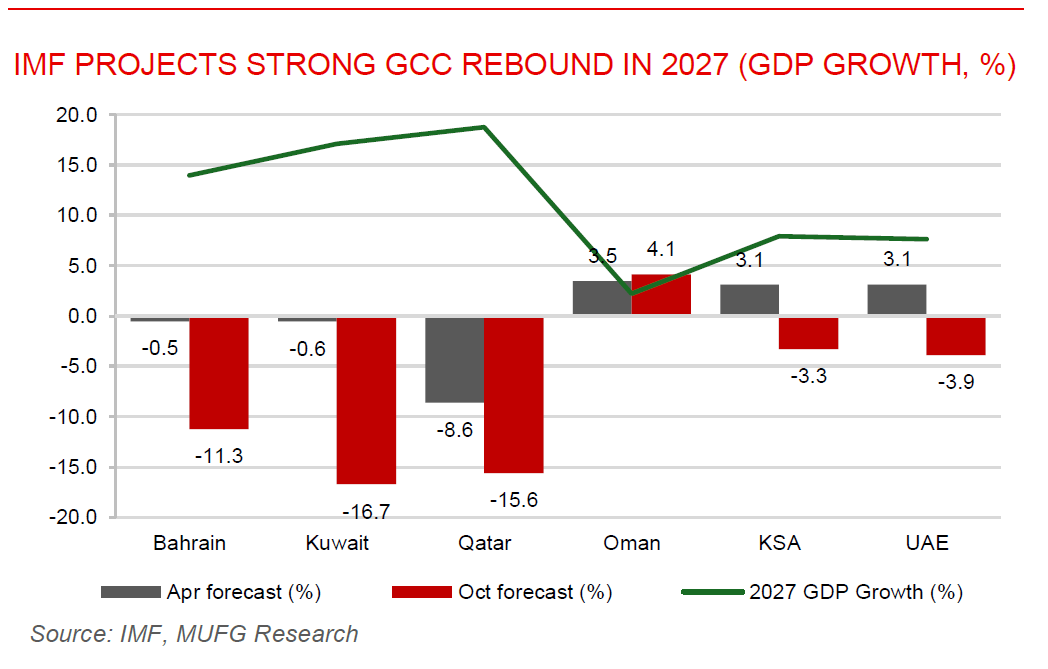
IMF projects strong GCC rebound in 2027 as Hormuz reopening drives recovery. The IMF expects a sharp rebound across GCC economies in 2027, contingent on the normalisation of shipping through the Strait of Hormuz and a recovery in hydrocarbon production following severe war-related disruptions in 2026. Qatar is projected to lead regional growth at 18.8%, followed by Kuwait (17.1%), Bahrain (13.9%), Saudi Arabia (7.9%) and the UAE (7.7%), reversing the deep contractions expected across much of the bloc this year. Saudi Arabia is expected to demonstrate greater resilience than its regional peers, supported by alternative export infrastructure that has helped sustain crude shipments despite restrictions through Hormuz. Meanwhile, the IMF revised its 2026 UAE growth forecast down by 7 percentage points, while raising its 2027 projection by 2.4 points relative to April. However, the projected rebound largely reflects recovery from a depressed base, with output potentially remaining below pre-war growth trajectories. The pace of recovery will depend on sustained shipping normalization, restoration of energy exports and the absence of renewed regional disruptions, leaving the 2027 outlook highly sensitive to geopolitical developments.
UAE approves AED292.5bn federal budget plan for 2027-2029. The UAE Cabinet approved a AED 292.5bn (USD 79.6bn) federal budget plan for 2027–2029, including AED 90.1bn (USD 24.5bn) for 2027, prioritising fiscal sustainability, social development and economic diversification. The 2027 budget allocates AED 34.6bn (38.4%) to social development and pensions, with education accounting for 18.8% of total spending, followed by healthcare at 6.7% and pensions at 6.4%. Government affairs will receive AED 29.1bn (32.3%), while federal expenses account for AED 17.8bn (19.7%). Financial investments and infrastructure-related spending are allocated AED 5.6bn and AED 3bn, respectively. The three-year framework also emphasizes digital transformation, artificial intelligence and greater public-spending efficiency, aligned with the UAE’s We the UAE 2031 strategy. The budget reflects a continued focus on human capital investment and fiscal discipline while supporting long-term economic diversification. Its emphasis on strategic spending and government efficiency should help strengthen economic resilience amid regional uncertainty and evolving global conditions.
Egypt’ balance of payments returns surplus. Egypt recorded an overall balance of payments surplus of USD 2.8bn in FY2025/26, reversing a USD 2.1bn deficit the previous year, supported by stronger foreign investment inflows. Net capital and financial account inflows more than doubled to USD 23.2bn from USD 10.2bn, driven by higher FDI inflows of USD 18bn and portfolio investment of USD 4.2bn. However, the current account deficit widened to USD 22.5bn from USD 15.4bn, reflecting a 27.1% increase in the merchandise trade deficit to USD 64.8bn, alongside higher energy imports and investment income payments. External pressures were partly offset by a 29.6% surge in remittances to USD 47.3bn, while tourism revenues rose 10.3% to USD 18.4bn and Suez Canal receipts increased 21.6% to USD 4.4bn. The return to an overall surplus signals stronger external financing capacity, although the widening trade deficit highlights Egypt’s continued dependence on capital inflows and remittances to offset structural current account pressures.