
To read the full report, please download the PDF above.
Middle East Daily
EDWARD BELL
Head of Research
DIFC Branch – Dubai
T: +971 (4)387 5033
E: edward.bell@ae.mufg.jp
SOOJIN KIM
Research Analyst
DIFC Branch – Dubai
T: +971 (4)387 5031
E: soojin.kim@ae.mufg.jp
MUFG Bank, Ltd. and MUFG Securities plc
A member of MUFG, a global financial group
Middle East Daily
COMMODITIES / ENERGY
Oil slips as demand concerns offset geopolitical risk. Oil prices are trading lower as the market is trying to calibrate its response to the geopolitical conditions in the Middle East. Brent futures are trading down nearly 1.3% at USD 104.70/b while WTI is lower by 0.8% since the open at USD 94.32/b. The ongoing conflict between Saudi Arabia and the Houthis is keeping a geopolitical premium in oil markets but energy infrastructure has not been attacked in the last several days. However, shipping remains under threat in the Strait of Hormuz with two vessels sinking over the last 24hrs. The IEA cut its oil demand estimate for 2026 to a decline of 2.6m b/d and revised lower its expectation for growth to recover in 2027 to 2m b/d, down by 600k b/d from its previous forecast. The IEA also noted that the UAE increased oil production to 5.3m b/d – including condensates – in September, a record high for the country. In the US, the API reported a draw in total crude inventories of 11.1m bbl last week though across the rest of the barrel levels were more even with a modest build in gasoline stockpiles and a draw in distillates. Official data from the EIA will be released later today.
Gold slides as hotter US inflation revives rate hike bets. Gold prices slumped by more than 1.3% overnight to USD 4,105/troy oz, their lowest level since early August. Faster than expected inflation in the US for September – core CPI accelerated to 2.6% y/y from 2.4% a month earlier – has raised market pricing for a rate hike from the Fed at the end of the month. The probability is still lower at just 29% but it has increased from just 17% at the end of last week. Treasury yields spiked on the CPI release but have since faded, helping to stabilize spot gold at around USD 4,147/troy oz.
MIDDLE EAST - CREDIT TRADING
End of day comment – 14 October 2026. Activity was slow and price action low ahead of CPI. After the hotter print and subsequent UST sell off, cash prices adjusted with the underlying rates move but flows remained well balanced. The main sovereign curves are closing 1bp tighter on average. New QATAR 36s was active post CPI closing -0.25pt/-1bp. Quasi sovgn though underperformed a touch closing +1/2bp. QPETRO still has sellers of 29s (-0.125pt/+2bp) but started to see buyers in long end, 41s closing -0.25pt/+0bp. Financial bonds are still mixed. New EIBUH 31s was well received a traded up to 100.50 in the morning from 100 r/o before closing 100.125/100.375. AT1s though are still heavy, and it doesn't feel like the repricing is done there. Seen sellers of MASQUH 6.625 perps closing -0.375pt/+3bp. Overall GCC bond continue their outperformance of macro risk moves and weathering the headline headwinds around Iran/Yemen well. Trading volumes though remain at about 50% of a normal day which shows the lack of conviction from account side. (Source: Dominik Roth, Credit Trader)
MIDDLE EAST - MACRO / MARKETS
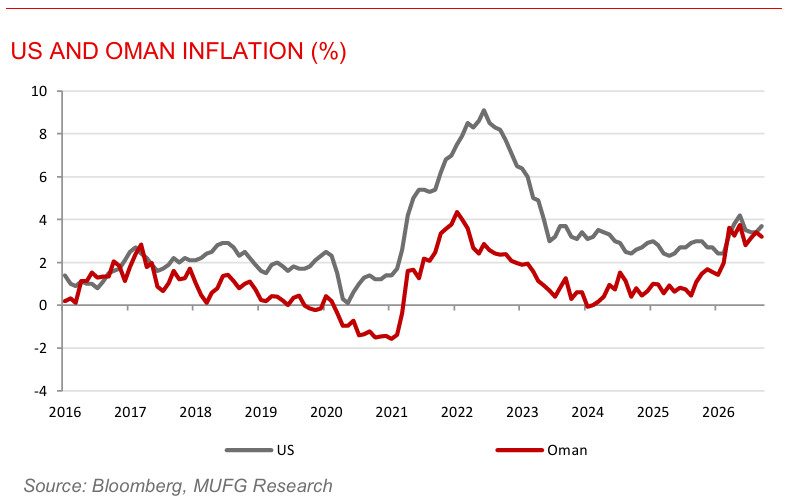
Oman inflation eases, but food prices remain under pressure. Oman’s annual inflation moderated to 3.2% y/y in September 2026 from 3.4% y/y in August, indicating a gradual easing in overall price pressures despite persistent increases in food and transport costs. Food inflation remained elevated highlighting continued pressure on household purchasing power. Transport prices increased 4.8% y/y, while miscellaneous goods and services rose 4.7%, reflecting broader cost pressures across selected consumer categories. In contrast, housing and utilities inflation remained contained at 0.1% y/y, helping offset increases elsewhere in the consumption basket. Average inflation stood at 3.0% during Jan–Sep 2026, suggesting that underlying price pressures remain manageable despite regional supply disruptions. While subdued housing costs should continue to contain headline inflation, elevated food and transport costs and imported inflation risks could limit the pace of further disinflation.
Saudi Arabia secures USD 4.3bn in energy and industrial investments. Saudi Arabia announced two major investment agreements worth a combined USD 4.3bn, supporting electricity infrastructure expansion and industrial diversification under Vision 2030. The first agreement involves a USD 2.2bn power-generation project, aimed at strengthening the Kingdom’s electricity supply capacity and meeting rising demand from industrial development and economic expansion. A separate USD 2.1bn energy-equipment manufacturing project will expand domestic production capabilities, localise supply chains and reduce reliance on imported industrial equipment. The agreements highlight continued investment momentum in strategic infrastructure and manufacturing, alongside efforts to attract foreign expertise and private-sector capital. The projects should support non-oil economic activity, strengthen domestic industrial capacity and create opportunities across local supply chains, reinforcing Saudi Arabia’s longer-term diversification objectives despite a more challenging regional economic environment.