
To read the full report, please download the PDF above.
Middle East Daily
EDWARD BELL
Head of Research
DIFC Branch – Dubai
T: +971 (4)387 5033
E: edward.bell@ae.mufg.jp
SOOJIN KIM
Research Analyst
DIFC Branch – Dubai
T: +971 (4)387 5031
E: soojin.kim@ae.mufg.jp
MUFG Bank, Ltd. and MUFG Securities plc
A member of MUFG, a global financial group
Middle East Daily
COMMODITIES / ENERGY
Oil holds above USD 105 as geopolitical risks offset demand concerns. Brent futures are trading lower from the open but have held onto levels above USD 105/b. Prices are off by about 0.6% to USD 105.33/b while WTI is trading down 0.7% at USD 97.30/b. WTI prices are on track for a near 6% gain this week as the impact of Hurricane Isaias continues to play out in the US energy sector. Weekly data from the EIA showed a 300k b/d drop in US oil production last week as the hurricane forced production shut-ins. Commercial crude stocks fell by 8.6m bbl, gasoline inventories were higher by 3.5m bbl while distillate stockpiles fell. US crude exports fell by 200k b/d as the hurricane interrupted production and shipping. In the Middle East the geopolitical backdrop continues to keep a wide premium in prices. Centcom has confirmed that Iranian attacks sunk a container vessel in the Strait of Hormuz in the last several days while US President Donald Trump said he was considering using a massive ordnance air blast bomb against Iran and that the US “might have to be back there in a year.” European natural gas futures remain elevated at EUR 85.44/MWh.
Gold holds gain as rate hike expectations ease. Gold prices are holding steady in early trade today with spot gold at USD 4,170/troy oz. Fed chair Kevin Warsh did not comment directly on monetary policy in dialogue held at the IMF meetings in Thailand, focusing his commentary on the investment outlook for the US economy. Broader volatility in risk assets has helped to lift gold in the last several days while market expectation for an October rate hike have retrenched to less than 4bps. However, with rates still set to go higher by the end of the year, the outlook for gold remains rangebound.
MIDDLE EAST - CREDIT TRADING
End of day comment – 15 October 2026. We were greeted in the morning by a reversal overnight in UST further fanned by the risk off mood in Asia. With the 15bp move lower in UST yield from London close the market opened about 5bp wider. More surprisingly though flows remained well balanced and despite higher cash/ lower yields a mix of ETF, RM and local were net buying bonds. That pushed spreads to close overall unchanged which is rather remarkable in the context of macro market weakness. In sovgn bonds one underperformer though was QATAR which had sellers into higher cash prices in new 31s (+0.375pt/+3bp) and 36s (+1pt/+3bp). On the outperformance side stood OMAN, which had buyers in long end bonds from the get-go and held the levels into some selling flows into the close, 47s closed +1.75pt/-2bp. In quasi sovgn bonds UAE names outperformed today, namely ADQABU/ADNOCM with ADQABU 35s closing +1.25pt/-4bp. Here as well Qatari names somewhat underperformed, QPETRO 29s and 31s feel available as do 51s. Financials remain a mixed bag, AT1s failed to catch a bid and still look mispriced against the senior curve, so the widening today took it a step closer to reality, MASQUH AT1s remain heavy. (Source: Dominik Roth, Credit Trader)
MIDDLE EAST - MACRO / MARKETS
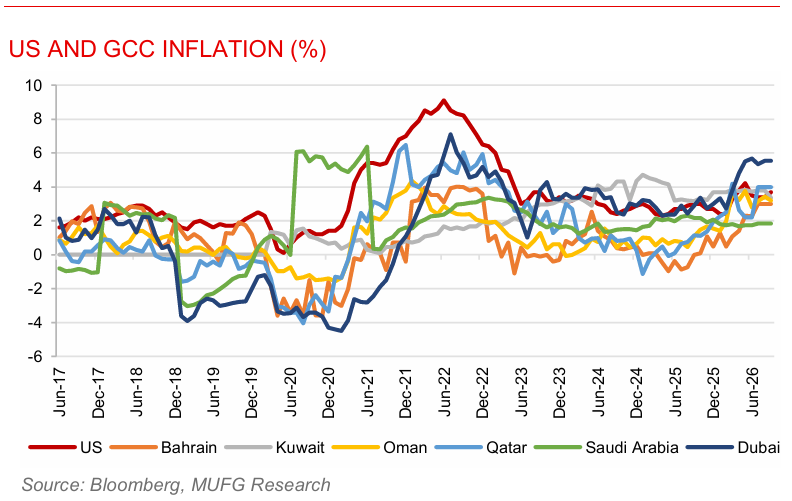
Saudi inflation stays contained as housing pressures ease. Inflation in Saudi Arabia remains contained, rising by 1.9% y/y in September and in line with its pace for the rest of the year. In the first three quarters of 2026, inflation has recorded an average of 1.8%, marginally slower than the 2% recorded for 2025 as a whole. A primary driver of the moderation in inflation in Saudi Arabia has been much slower housing inflation. Housing and utilities represent 20% of the Saudi CPI basket and inflation in the category has slowed to 3.9% so far in 2026 from more than 6% in 2025. Rents have been the main contributor with the component up by 4.5% in the first nine months of 2026 compared with 8.2% in 2025.
MENAP growth set for sharp rebound in 2027. During IMF press briefing on the Regional Economic Outlook, the IMF projected MENAP growth to contract by 1.3% in 2026 before rebounding to 6.6% in 2027, reflecting the uneven impact of the Middle East conflict. GCC economies are expected to contract 4.8% in 2026 before expanding 9.1% in 2027, assuming shipping through the Strait of Hormuz normalises in Q1 2027 and energy exports recover by midyear. Saudi Arabia and the UAE have demonstrated greater resilience through alternative export routes and financial buffers, while Kuwait, Qatar and Iraq face more severe disruptions. However, the IMF cautioned that regional output would remain below its prewar trajectory through 2030 due to infrastructure damage and lasting economic losses. Meanwhile, oil-importing economies have remained relatively resilient, supported by remittances, tourism and government measures, although inflation and financing pressures persist. The recovery remains highly dependent on geopolitical stabilization, restoration of energy trade and rebuilding fiscal buffers, with prolonged conflict posing significant downside risks.