
To read the full report, please download the PDF above.
Middle East Daily
SOOJIN KIM
Research Analyst
DIFC Branch – Dubai
T: +44(4)387 5031
E: soojin.kim@ae.mufg.jp
MUFG Bank, Ltd. and MUFG Securities plc
A member of MUFG, a global financial group
Middle East Daily
COMMODITIES / ENERGY
Oil pulls back from rally as US inventories rise. Oil prices retreated after a sharp supply-driven rally, with Brent falling toward USD 107/b, while WTI traded near USD 104/b. The pullback followed signs that the rally had become technically stretched and an API report showing US crude inventories rose 7.1mb last week, alongside increases in gasoline and distillate stocks. Nevertheless, physical supply risks remain elevated following the shutdown of Saudi Arabia’s East-West pipeline and disruptions in Libya, with Saudi Aramco delaying some deliveries to European customers. Houthi advances toward the Bab el-Mandeb Strait are adding further uncertainty, while Hormuz flows remain below pre-war levels. Shipping dislocations have also pushed US Gulf-to-China VLCC costs to a record USD 44.8mn. Although rising US inventories may temper the immediate rally, persistent disruptions to Saudi supply and risks across both Hormuz and the Red Sea should keep the oil market tight and prices volatile.
Gold rebounds as oil and Treasury yields ease ahead of Fed. Gold rebounded after two consecutive declines, rising above USD 4,340/oz, as a modest pullback in oil prices and Treasury yields provided support ahead of the Fed’s policy decision. Brent retreated toward USD 107/b after a two-day rally, slightly easing energy-driven inflation concerns, although markets are still pricing a 93% probability of a Fed rate hike following last week’s stronger than expected inflation data. Both 10-year and 2-year Treasury yields edged lower, reducing some pressure on non-interest-bearing gold after long term yields recently reached their highest levels in almost two decades. The Fed’s guidance will be critical for gold, with a more hawkish signal likely to sustain pressure through higher yields, while a less aggressive tightening path could allow gold to regain support from geopolitical uncertainty and portfolio-hedging demand.
MIDDLE EAST - CREDIT TRADING
End of day comment – 15 September 2026. We had into London close yday and overnight a 10bp roundtrip in UST yields which set up the market on the backfoot this morning. However, there wasn't a great deal of selling flows and with some macro stabilisation some RM inflows were seen. That started to lift cash prices but with an uneven outcome. The market is bid in long end bonds, especially lower cash price/DV01 bonds. ADGB long end bonds closed unch/+0.125pt/-2bp with 51s and 70s well bid. QATAR had the best bid in 46s closing +0.125pt/-3bp. The underperformer were still mostly non govt bonds in the shorter end/ belly bonds. Take EBIUH senior closing up to -0.25pt/+5bp as the market is long and some bonds still trying to find their clearing levels. Flows were a touch lighter than yday but with international RM net buying were skewed the first time in a while towards buyers. Barring any surprises overnight it feels the current market levels will hold into the Fed. (Source: Domonik Roth, Credit Trader)
MIDDLE EAST - MACRO / MARKETS
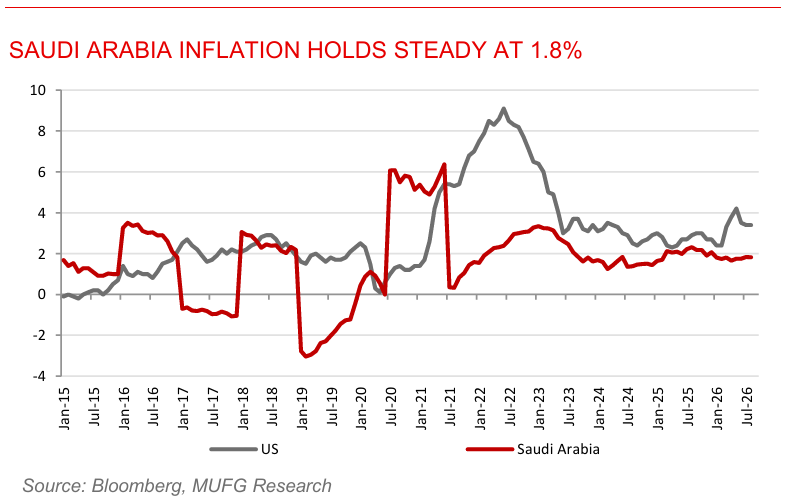
Saudi Arabia inflation holds steady at 1.8%. Saudi Arabia’s inflation remained at 1.8% y/y in August, unchanged for a fourth consecutive month, while consumer prices edged up just 0.1% m/m, highlighting relatively contained price pressures despite regional disruptions. Housing remained the largest inflation driver, with housing, utilities and fuels rising 3.9% y/y and contributing 0.8ppt to headline inflation, primarily reflecting higher residential rents. Food and beverage prices increased 1.4%, while transport costs rose 2.0%. Recreation, sport and culture prices also increased 2.8%, partly due to higher holiday and package costs. Inflation nevertheless remains subdued compared with several regional economies, supported by contained imported-goods and food-price pressures. The benign inflation backdrop provides some insulation from the broader economic shock, although SAMA’s monetary stance remains closely linked to the Fed through the riyal’s dollar peg. Persistent rental pressures are likely to remain the main domestic inflation driver, while global energy and food prices and US monetary policy will shape the broader price outlook.
Saudi Arabia boosts spot crude sales as East-West pipeline remains offline. Saudi Aramco has increased prompt crude sales from outside the Strait of Hormuz as the shutdown of the kingdom’s East-West pipeline disrupts its main alternative export route to the Red Sea. Aramco has sold around 20mb to Asian refiners for September and October delivery, including Chinese and other East Asian buyers. The cargoes will be transferred ship-to-ship in the Gulf of Oman, meaning Aramco will transport the crude through Hormuz before handing it to buyers, limiting their direct exposure to the high-risk passage. The shift follows last week’s pipeline shutdown after attacks, with no confirmed restart date, and has already led Aramco to delay some European deliveries from Yanbu. The increased use of Gulf of Oman spot sales highlights Saudi Arabia’s efforts to maintain exports despite the loss of its Red Sea bypass, but greater reliance on Hormuz leaves volumes exposed to shipping disruptions and elevated freight and security costs.