
To read the full report, please download the PDF above.
Middle East Daily
SOOJIN KIM
Research Analyst
DIFC Branch – Dubai
T: +44(4)387 5031
E: soojin.kim@ae.mufg.jp
MUFG Bank, Ltd. and MUFG Securities plc
A member of MUFG, a global financial group
Middle East Daily
COMMODITIES / ENERGY
Oil rises as Middle East tensions threaten supply. Oil prices advanced as renewed fighting in Lebanon and further tanker attacks in the Strait of Hormuz clouded prospects for ending the US-Iran war. Brent rose toward USD89/b, while WTI traded near USD82/b, with the benchmarks supported by persistent risks to regional supply. Several vessels, including ships linked to ADNOC, were attacked in Hormuz, although Gulf producers continue to move significant volumes through the waterway. Iran and Oman are moving closer to an agreement over managing Hormuz, but the US is not involved and continues to demand unrestricted passage through a route. Meanwhile, the US is preparing additional economic measures against Iran, while Iran is reportedly strengthening its military capabilities and regional alliances. Overall, continued geopolitical uncertainty and risks to key shipping routes are keeping a substantial risk premium embedded in crude prices.
Gold extends gains on softer US data and weaker dollar. Gold extended its two-week advance, trading near USD4,400/oz, as weaker US retails sales and consumer sentiment weighed on the dollar rand reduced expectations of an imminent Fed rate hike. Gold continues to benefit from renewed investor demand and sustained central bank purchases, particularly from China. However, Middle East tensions remain an upside risk to energy prices and inflation, with further vessel attacks in the Strait of Hormuz and the US preparing additional economic measures against Iran, keeping the possibility of future monetary tightening alive. Iran-Oman negotiations over Hormuz and continued oil flows through the Strait have so far helped contain energy prices. Wednesday’s Fed minutes, US economic data and developments around Hormuz will be key drivers of gold, particularly through their impact on rate expectations.
MIDDLE EAST - CREDIT TRADING
End of day comment – 14 August 2026. A bit of a replay of yesterday where volumes were typically low and longer duration bonds across liquid curves outperformed. Otherwise, flows were not worth much commentary. AT1 bonds are still very bid from retail, and they seem to be happy to inch the bids higher daily even though spreads are going tighter. KSA/ARAMCO/PIFKSA were all generally flat except at the long end where bonds were 2-3bps tighter. Bahrain was generally unchanged in cash price across the curve keeping spreads 2-3bps tighter. Inquiry was limited. Turkey’s general buying in retail across names with a focus on sukuks even on the Friday. We traded more TCELLT today. (Source: Matthew Dunker, Credit Trader)
MIDDLE EAST - MACRO / MARKETS
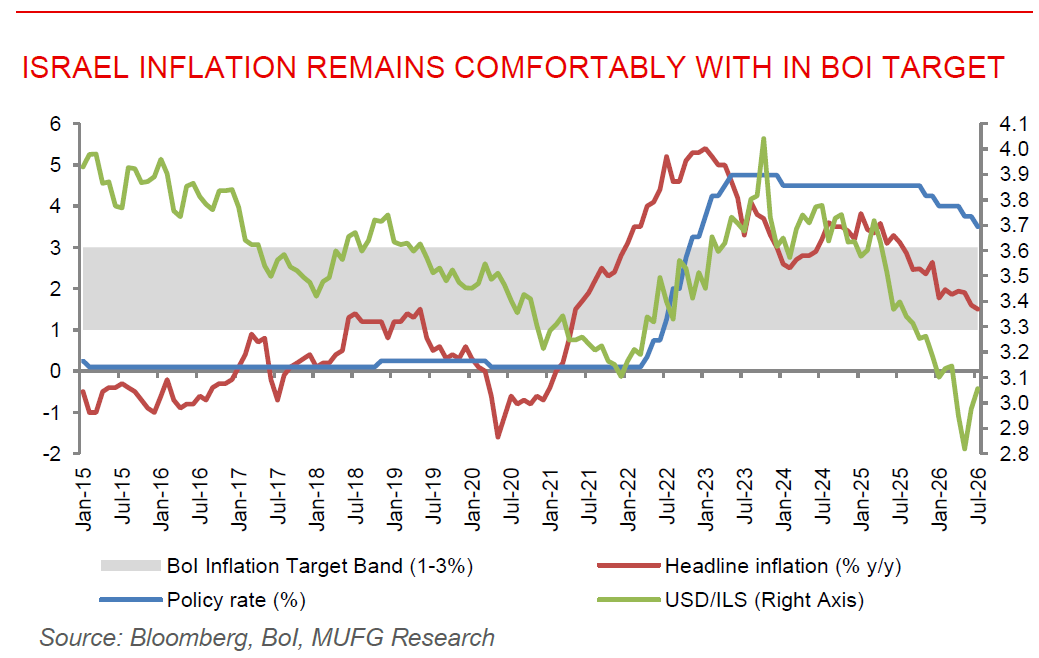
Israel’s economy rebounds strongly in Q2. Israel’s economy rebounded sharply in Q2 2026, expanding 15.4% annualized (3.6% q/q), significantly above market expectations and reversing the revised 2.2% contraction in Q1, when the war with Iran disrupted trade, employment and domestic demand. The recovery was broad-based as postponed activity resumed, with exports surging 35.2%, business-sector output rising 16.6%, private consumption increasing 14.7%, government consumption 19.5% and fixed investment 6.3%. The strong growth print was accompanied by easing inflation, with July CPI slowing to 1.5% y/y, remaining comfortably within the Bank of Israel’s 1%-3% target range and strengthening the case for renewed rate cuts. The rebound again demonstrates the economy’s ability to recover relatively quickly from conflict-related disruptions, supported by resilient exports and the high-tech sector. Looking ahead, the durability of the export and domestic-demand recovery, the pace of Bank of Israel monetary easing and geopolitical developments will be the key sustaining momentum. We forecast real GDP growth of 3.3% in 2026, accelerating to 4.4% in 2027, while inflation is expected to rise to 2.0%by year-end. The Bank of Israel currently projects CPI inflation of 1.8% in both 2026 and 2027.
S&P affirms Lebanon at ‘CCC+’ as conflict weighs on recovery. S&P Global Ratings affirmed Lebanon’s ‘CCC+/C’ local-currency ratings with a Stable Outlook, while keeping its foreign-currency rating at ‘SD/SD’ due to the continuing Eurobond default. Renewed Israel-Hezbollah fighting since March has disrupted economic activity and slowed banking, fiscal and IMF-related reforms, leading S&P to forecast GDP contraction of 8-9% in 2026, versus its previous 3% growth forecast, with reconstruction needs estimated at around USD5bn (13% of GDP). Despite the shock, the government remains current on its limited commercial local-currency debt and is expected to post a fiscal surplus of around 3% of GDP in 2026, largely reflecting tight financing constraints. S&P sees only limited near-term progress on debt restructuring and banking reforms given persistent security risks. Going forward, an easing of hostilities and progress on IMF-backed reforms, banking restructuring and Eurobond negotiations could support a 2%-3% recovery in 2027-29, while renewed escalation remains the key downside risk.